
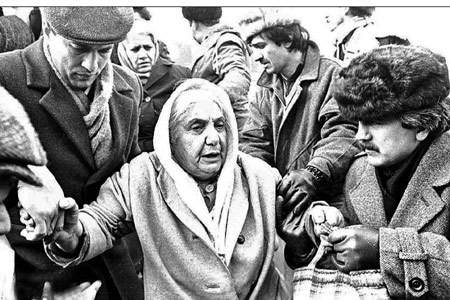
ArmInfo.The RA Ministry of Foreign Affairs has issued the following statement on the 38th anniversary of the tragic events in Sumgait, Azerbaijan.
"In these days of remembrance of the victims of the 1988 Sumgait massacres orchestrated by Azerbaijani SSR forces, we honor the memory of hundreds of Armenians who were killed. Around half a million were forcibly displaced. Remembrance is not only about reflecting on the past. It is a reaffirmation of our shared responsibility to uphold human rights, reject hatred and hate speech in all its forms, while working steadfastly toward reconciliation and lasting peace," reads an X message by the RA MFA.
On February 20, 1988, an extraordinary session of the regional council of the Nagorno-Karabakh Autonomous Oblast resolved to appeal to the Supreme Soviets of the Azerbaijan SSR and the Armenian SSR to secede from Azerbaijan and join Soviet Armenia, and to petition the Supreme Soviet of the USSR for a positive resolution. A few days later, Azerbaijan "reacted" to this decision in the city of Sumgait, a symbol of the Soviet Union's internationalism. The right of Artsakh Armenians to self-determination and to a safe and dignified life in their homeland was being challenged by pogroms and violence committed on ethnic grounds.
On February 26, anti-Armenian demonstrations began in Sumgait, with slogans such as "Death to Armenians" and "Armenians, leave." To incite hatred against Armenians, special provocateurs posing as refugees from Kapan began operating in Sumgait, spreading false rumors about alleged crimes against Azerbaijanis in Armenia. On the evening of February 27, violent actions against the city's Armenian population began. Special pogrom groups broke into Armenian homes based on a pre-prepared list. During the massacres, telephones in many Armenian apartments were disconnected, and the police demonstrated criminal inaction, or, according to some accounts, even complicity. The methods of carrying out the massacres were characterized by inhuman cruelty. The Armenian population was exterminated, killed, beaten, tortured, set on fire, raped, and physically and psychologically harmed. On the evening of February 28, Soviet Army units entered Sumgait, initially under orders to use force and weapons against the pogromists. As a result, the Azerbaijani side attacked Soviet military units, resulting in 140 wounded Soviet soldiers. Only on the evening of February 29 did army units take decisive action, and the massacre of Armenians ceased.
According to official figures, 32 people (26 Armenians, 6 Azerbaijanis) were killed in the Sumgait pogroms, over 400 people suffered varying degrees of bodily injury, approximately 200 apartments and over 50 cultural buildings were attacked and looted, and over 100 vehicles were damaged. The organized trial of the Sumgait pogroms and its "impartiality" left a number of questions unanswered, one of which is the veracity of the death toll and injuries. There are reports and data on the number of casualties and injuries that contradict the official figures.
The Sumgait pogroms resonated greatly with the Armenian public, primarily associating these events with the Armenian Genocide committed in the Ottoman Empire in the early 20th century. The pogroms against the Armenian population were genocidal in nature and aimed to halt the development of the Artsakh movement and suppress the right of Artsakh Armenians to self-determination. The Sumgait pogroms of 1988-1990 were the first in a chain of mass and large-scale crimes against Armenians in the Azerbaijan SSR.
The central authorities failed to adequately assess the mass killings of the Armenian population of Sumgait, portraying them as the actions of "hooligan elements" and mass unrest. This was officially reflected in the trial of the Sumgait pogromists, resulting in the failure to identify and punish the organizers of the pogroms. This attitude toward Armenian-Azerbaijani interethnic violence and the resulting impunity played a significant role in the further expansion and continuation of anti-Armenian violence in Azerbaijan.
Modern Azerbaijan continues the anti-Armenian policy of Soviet Azerbaijan.
The most recent such manifestation was the attack on Artsakh and its complete de-Armenization in September 2023. This was preceded by a 10-month blockade of the NKR. As a result of the Azerbaijani aggression against Artsakh in 2020-2023, more than 150 thousand Artsakh residents were left without a home and homeland.






















 Azerbaijani studies expert : Ruben Vardanyan’s wife threatened with arrest if she visits Baku
 Political scientist: The model of allied relations between Russia and Armenia has collapsed
 Expert: The defeated authorities` position on normalizing relations with the enemy should not affect the rights of Artsakh refugees
 Political scientist: If Russian-Armenian relations are destroyed, Turkey will take Russia`s place
 Political scientist: The Armenian public is simply obliged to significantly change the entire content of public discourse and struggle
 Cross tattoos are being removed from the skin of Christian prisoners in Azerbaijan by fire, according to a human rights activist.
 Zakharova: Armenia`s likely introduction of visas with Russia will be a step against Yerevan itself
 Putin: Armenia`s recognition of Karabakh as part of Azerbaijan in Prague has given Russia`s position on this issue an ambivalent character
 Putin: Armenia`s adoption of the law on EU accession means an announcement of its withdrawal from the Eurasian Economic Union
 Medvedev: Yerevan will never become an EU member, but it will permanently damage relations with the Eurasian Economic Union, including with Moscow.
 Aram Vardevanyan: Public demands solutions, not apology scandals in Parliament
 Arrested Armenian oligarch on economy and new jobs
  "In Baku, we gave a worthy rebuff to the false claims regarding the past and present of our people" – Former Artsakh Parliament Speaker from Baku captivity
  NA Vice Speaker candidate believes his wife`s salary as director of HayPost is the lowest in the company`s history
 RF Permanent Representative: There is no CSTO-Armenia conflict
 Moscow: NATO seeking to "Pull" Armenia away from CSTO Allies
  Political analyst: Russia intends to determine which "Camp" Armenia will choose through a referendum
 Narek Karapetyan will give up his parliamentary salary in favor of charitable contributions.