

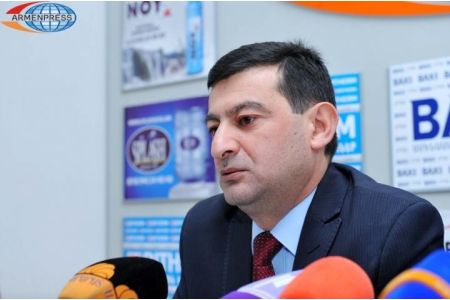
ArmInfo. The authorities who came to power in Armenia under the slogans of peace and democracy are gradually narrowing the space of memory, including that of the Sumgait pogroms of Armenians. This was stated by NKR statesman and former Artsakh Minister of Culture, Youth, and Tourism Sergey Shahverdyan.
In connection with the 38th anniversary of the Sumgait pogroms of Armenians, the former Artsakh official stated that in nearly forty years, virtually everything has been said about Sumgait. According to him, February 1988 is forever etched in history as the first systemic explosion of hatred, marking the beginning of the bloody unraveling of the Karabakh knot. Shahverdyan recalled the three days in the Azerbaijani city when Armenians were rounded up from their apartments and entryways, tortured, raped, and killed simply because they were Armenian. So many documents, photographs, witness statements, and names of executioners have been collected that they would be enough for a multi-volume investigation. And just a few years ago, it seemed the world had learned its lesson. "Sumgait" has become not just a place name, but a symbol-a harbinger of a new wave of genocide.
But the reality of today's Armenia is a sobering slap in the face. It turns out that crimes can not only be denied at the level of enemy propaganda-they can be consigned to oblivion quietly, methodically, and from within one's own country. While Ilham Aliyev pompously unveils monuments to the "victims of Khojaly" and once again dons the mantle of defender of justice, something previously unthinkable is happening in Yerevan. The authorities, who came to power under the slogans of peace and democracy, are gradually narrowing the space of memory. Discussions about the events of the late 1980s and early 1990s, not to mention the more recent crimes of Baku, "They are being reduced to a minimum. Study? Forget it. Public discussions? Only if they're in the format of 'let's not reopen the past.' In this new 'real Armenia,' the past is becoming a toxic burden that we're supposed to get rid of for the sake of a brighter future," Shahverdyan stated.
At the same time, the former Artsakh official believes that Sumgait occupies a special place on this list of those to be destroyed. "Why? Because this human-made crime is so obvious that it's difficult to hush up. Sumgait fits perfectly into the UN Genocide Convention on at least three counts: people were killed solely on the basis of their ethnicity; they suffered grievous physical and mental trauma; and finally, conditions were created that made returning to the city impossible-the 18,000 refugees became living proof of ethnic cleansing," he noted.
According to him, it's important to understand the scale of the cynicism: these crimes weren't a spontaneous mob riot. It was a planned action, where city leaders protested, the police either did nothing or participated, and Baku, a half-hour drive away, "noticed nothing" for three days. "Security services, coordination, covering up traces-all indicate that we are dealing with a state policy of extermination. But if Armenophobia was and remains an ideological foundation for Baku, then for the current Armenian leadership, oblivion is becoming the foundation. And this is no longer just inertia, but a deliberate course. Of course, on February 26, we saw the usual social media post from officials. Two lines, a candle in a story, a sigh about how 'peace is important.' The word 'genocide' will not be uttered. The name of the perpetrator country will also not be mentioned. Everything will be reduced to an abstract 'tragedy', so as not to offend anyone. Meanwhile, 'peace activists,' with a surprising chorus calling for 'not delving into the past,' will happily report on building bridges. Those very bridges that executioners can comfortably cross without fear of being called executioners," he noted.
Shahverdyan added that the outcome of this policy is terrifying in its simplicity: Armenian society is moving toward a world where Aghdam will be called "genocide" on international platforms, while Sumgait, Baku, Maragha, the murder in Budapest, the atrocities of the April War, and the exodus of the Artsakh people in 2023 will be erased. "Just as the perpetrators of the Armenian Genocide of the early 20th century erased it, so too did those who perpetrated it. But if it was the enemies who erased it back then, now it's their own people who have taken up the eraser. Nikol Pashinyan and his team, fulfilling a geopolitical imperative, are persistently shaping a 'new mentality.' An Armenia without pain, without heroes, and without martyrs. An ideal victim who has forgotten they were killed and is therefore ready to be finished off.
There is a terrible truth, carved into international law: denial and oblivion of genocide are its direct continuation. And today we are witnessing this process firsthand. Only now, denial and oblivion are not coming from Ankara or Baku. They are coming from Yerevan. And this is perhaps the most bitter thing that can be stated 38 years after the Sumgait hell," Shahverdyan concluded.
On February 20, 1988, an extraordinary session of the regional council of the Nagorno-Karabakh Autonomous Oblast resolved to appeal to the Supreme Soviets of the Azerbaijan SSR and the Armenian SSR to secede from Azerbaijan and join Soviet Armenia, and to petition the Supreme Soviet of the USSR for a positive resolution. A few days later, Azerbaijan "reacted" to this decision in the city of Sumgait, a symbol of the Soviet Union's internationalism. The right of Artsakh Armenians to self-determination and to a safe and dignified life in their homeland was being challenged by pogroms and violence committed on ethnic grounds.
On February 26, anti-Armenian demonstrations began in Sumgait, with slogans such as "Death to Armenians" and "Armenians, leave." To incite hatred against Armenians, special provocateurs posing as refugees from Kapan began operating in Sumgait, spreading false rumors about alleged crimes against Azerbaijanis in Armenia.
On the evening of February 27, violent actions against the city's Armenian population began. Special pogrom groups broke into Armenian homes based on a pre-prepared list. During the massacres, telephones in many Armenian homes were disconnected, and the police demonstrated criminal inaction, or, according to some accounts, even complicity. The methods of carrying out the massacres were characterized by inhuman cruelty. The Armenian population was exterminated, killed, beaten, tortured, set on fire, raped, and physically and psychologically harmed. On the evening of February 28, Soviet Army units entered Sumgait, initially under orders to use force and weapons against the pogromists. As a result, the Azerbaijani side attacked Soviet military units, resulting in 140 Soviet soldiers being wounded. Only on the evening of February 29 did army units take decisive action, and the massacre of Armenians ceased.
According to official figures, 32 people (26 Armenians, 6 Azerbaijanis) were killed in the Sumgait pogroms, over 400 people suffered varying degrees of bodily injury, approximately 200 apartments and over 50 cultural buildings were attacked and looted, and over 100 vehicles were damaged. The organized trial of the Sumgait pogroms and its "impartiality" left a number of questions unanswered, one of which is the veracity of the number of victims and wounded. There are reports and data on the number of victims and wounded that contradict the official figures.
The Sumgait pogroms caused a great stir in the Armenian community, primarily associating these events with the Armenian Genocide committed in the Ottoman Empire in the early 20th century. The pogroms against the Armenian population were genocidal in nature and their goal was to halt the development of the Artsakh movement and suppress the right of Artsakh Armenians to self-determination.
The Sumgait pogroms of 1988-1990 were the first in a chain of mass and large-scale crimes against Armenians in the Azerbaijan SSR. The central authorities failed to adequately assess the mass killings of the Armenian population of Sumgait, portraying them as the actions of "hooligan elements" and mass unrest. This was officially reflected in the trial of the Sumgait pogromists, resulting in the failure to identify and punish the perpetrators of the pogroms. This attitude toward Armenian-Azerbaijani interethnic violence and the resulting impunity played a significant role in the further expansion and continuation of anti- Armenian violence in Azerbaijan. Modern Azerbaijan continues the anti-Armenian policy of Soviet Azerbaijan.
The most recent such manifestation was the attack on Artsakh and its complete de-Armenization in September 2023. This was preceded by a 10-month blockade of the NKR. As a result of the Azerbaijani aggression against Artsakh in 2020-2023, more than 150 thousand Artsakh residents were left without a home and homeland.













 Expert: The arrest of opposition figures in Armenia for social media posts is a systematic attempt to intimidate the public and suppress dissent.
 Azerbaijani Studies Expert: While Azerbaijan Prepares Its Generation for War, Aliyev’s Aide Calls on Armenia to Prepare Armenian Society for “Peace”
 Turkologist: Azerbaijan will never, under any circumstances, stop pressuring the Armenian people
 Political scientist: We need to move away from the question of "when" and replace it with more important questions
 International Law Specialist: Azerbaijan intends to initiate legal proceedings against Armenia by sentencing Armenian prisoners
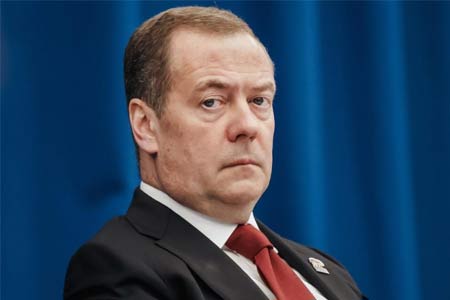 Dmitry Medvedev predicted a Ukrainian-like fate for Armenia amid the country`s shift in foreign policy
 Russian Security Council: In Armenia, they want to force Russian asset owners to dispose of their assets
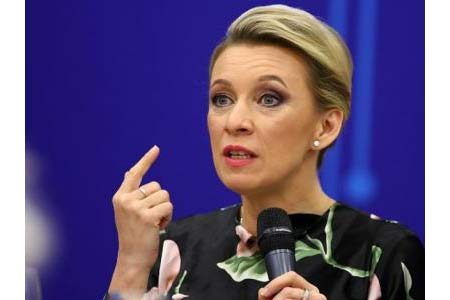 Zakharova: Russia ready to discuss with Armenia the prospects for expanding military cooperation as part of a review of bilateral ties
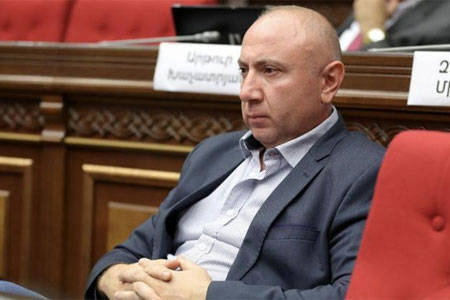 Tevanyan: Armenia, like Ukraine and Moldova, is being drawn into the EU’s global war
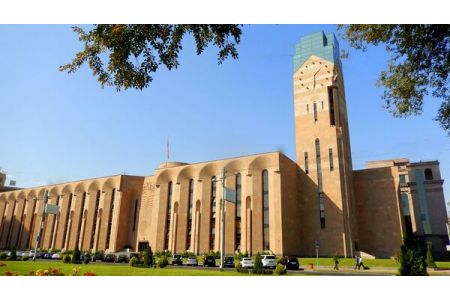 Yerevan City Hall is considering introducing a valet parking system in the city
 Expert: The circus surrounding the “Albanization” of Armenian culture in the presence of foreign ambassadors in occupied Artsakh is genocide
 Political scientist: If Russian-Armenian relations are destroyed, Turkey will take Russia`s place
 Political scientist: The Armenian public is simply obliged to significantly change the entire content of public discourse and struggle
 Cross tattoos are being removed from the skin of Christian prisoners in Azerbaijan by fire, according to a human rights activist.
 Zakharova: Armenia`s likely introduction of visas with Russia will be a step against Yerevan itself
 Putin: Armenia`s recognition of Karabakh as part of Azerbaijan in Prague has given Russia`s position on this issue an ambivalent character
 Putin: Armenia`s adoption of the law on EU accession means an announcement of its withdrawal from the Eurasian Economic Union
