
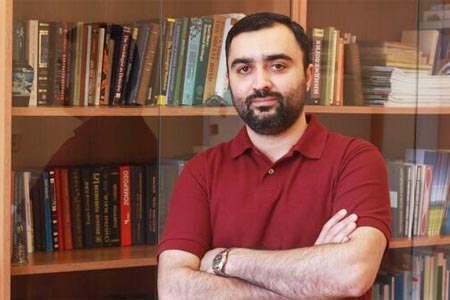
ArmInfo.Different regions of Armenia are developing their own ecology of political communication, where location, generation, and risk perception jointly determine the characteristics of discourse in political dialogue, as stated by Harutyun Vermishyan, Theory and History of Sociology Chair head, PhD in Sociology, and Associate Professor, during a discussion titled "Ahead of 2026 Parliamentary Elections: Peace and Security Factor in Election Campaign."
He presented the results of a study titled "Political Dialogues," conducted in partnership with the Yerevan Caucasus Institute and covering three regions of Armenia: Gyumri, Yeghegnadzor, and Goris. As Vermishyan noted, this isn't just sociological data, but sociological reflection within the framework of an experimental project, allowing for a deeper understanding of how the political agenda is perceived in various regions of the country. The study provided an opportunity to analyze how Armenia's political order is shaped across generations and in various contexts.
"The discussions touched on current topics-foreign policy, the peace process, and the agenda for the 2026 parliamentary elections in Armenia. It was important to emphasize that this was a discussion of political issues, not a politicized event. As a result, we concluded that people shape their speech to sound convincing to others or, conversely, prefer to remain silent, fearing that their words will be held accountable. It was interesting to observe who speaks and who remains silent during these discussions, which allowed us to understand citizens' receptivity to political topics. For example, experts recorded audience reactions to terms such as security, corridor, peace, and TRIPP (Trump's route - ed.)," Vermishyan said.
In Gyumri, discussions were held with representatives of local government, civil society organizations, political clubs, activists, and students. According to the sociologist, the audience acted not only as listeners but also as active participants in the discussion, asking questions and even changing the direction of the debate. "From a methodological perspective, this is very important, as it demonstrates that people have a voice-they're not just an audience, but co-authors of the discussion. In Gyumri, it was also interesting to observe the use of irony and sarcasm in speech, which demonstrated a critical approach to official discourse. People used humor to test the veracity of statements. For example, when discussing TRIPP, the audience might ironically refer to it as Trump Trip, where irony became a mechanism for local control. It's also worth noting that distrust of sociological surveys became a key topic of discussion; this isn't just a problem with the surveys themselves, but also a matter of the legitimacy of the expert system in Armenia," the sociologist explained. In Yeghegnadzor, the expert noted, the discussions were primarily with teenagers and only a small number with adults, making the meeting perceived more as a form of education. The sociologist noted that the audience initially remained silent, perceiving the political question as "the world of adults" and viewing the experts as knowledge holders. "From a methodological perspective, this is significant for the audience we selected in Yeghegnadzor, since in their case, political agency is still in its infancy. Peace in this audience was associated with three themes: defeat, historical justice, and dignity. This demonstrates that for them, peace is a category of moral values. And here I usually note that when a teenager asks a political question, they may not have a political toolbox, but they possess strong moral sensors that need to be transformed into civic thinking and tools," Vermishyan emphasized.
In Goris, the target audience was university and college students, as well as young activists. According to the sociologist, the meeting in Goris can be characterized by the principle of silence and risk management. Vermishyan explained that the meeting was held under a strong "security filter." According to him, silence in Goris is not a sign of a lack of information; on the contrary, from a sociological perspective, it also represents data.
"From a methodological perspective, silence is a part of speech, not a gap. And since Goris is a risky environment, a question can be perceived as an expression of opinion, meaning that political speech here is no longer a means of exchanging opinions. In other words, the principle at work here is "think about the value of your voice," which made the discussions more practical. Here, they talked more about strategies for buying time within the global agenda and changing language-that is, using the words "enemy" or "adversary." Thus, silence in Goris is not a lack of information, as I already said, but information itself," Vermishyan clarified. In conclusion, the sociologist noted that political agency is unevenly distributed across the regions in terms of space and generation. "In Gyumri, we saw a well-established, critical and debating agency; in Goris, an informed but risk-averse agency; in Yeghegnadzor, agency is still in its infancy. In other words, we see a specific ecology of political communication, where place, generation, and risk perception combine to shape discourse. Meanwhile, if we consider the peace agenda separately, in Gyumri, peace is a competition of political models; in Yeghegnadzor, it's a question of dignity and justice; and in Goris, it's a question of survival and security," the expert noted.
According to Vermishyan, it means that communication about peace cannot occur in the same context in three different regions, as people perceive the same concept through the prism of different risks. "Thus, through these visits, we have uncovered not a map of specific positions, but the local mechanics of political discourse," the sociologist concluded.










 Expert: The arrest of opposition figures in Armenia for social media posts is a systematic attempt to intimidate the public and suppress dissent.
 Azerbaijani Studies Expert: While Azerbaijan Prepares Its Generation for War, Aliyev’s Aide Calls on Armenia to Prepare Armenian Society for “Peace”
 Turkologist: Azerbaijan will never, under any circumstances, stop pressuring the Armenian people
 Political scientist: We need to move away from the question of "when" and replace it with more important questions
 International Law Specialist: Azerbaijan intends to initiate legal proceedings against Armenia by sentencing Armenian prisoners
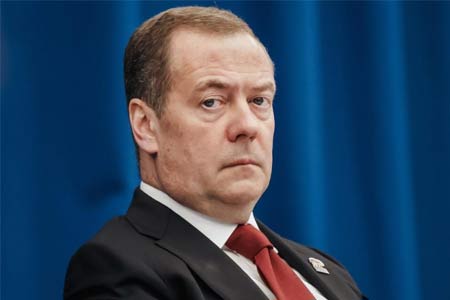 Dmitry Medvedev predicted a Ukrainian-like fate for Armenia amid the country`s shift in foreign policy
 Russian Security Council: In Armenia, they want to force Russian asset owners to dispose of their assets
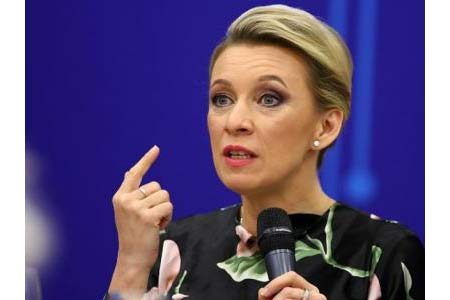 Zakharova: Russia ready to discuss with Armenia the prospects for expanding military cooperation as part of a review of bilateral ties
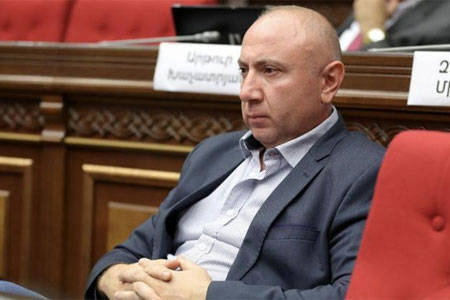 Tevanyan: Armenia, like Ukraine and Moldova, is being drawn into the EU’s global war
 Yerevan City Hall is considering introducing a valet parking system in the city
 Expert: The circus surrounding the “Albanization” of Armenian culture in the presence of foreign ambassadors in occupied Artsakh is genocide
 Political scientist: If Russian-Armenian relations are destroyed, Turkey will take Russia`s place
 Political scientist: The Armenian public is simply obliged to significantly change the entire content of public discourse and struggle
 Cross tattoos are being removed from the skin of Christian prisoners in Azerbaijan by fire, according to a human rights activist.
 Zakharova: Armenia`s likely introduction of visas with Russia will be a step against Yerevan itself
 Putin: Armenia`s recognition of Karabakh as part of Azerbaijan in Prague has given Russia`s position on this issue an ambivalent character
 Putin: Armenia`s adoption of the law on EU accession means an announcement of its withdrawal from the Eurasian Economic Union