
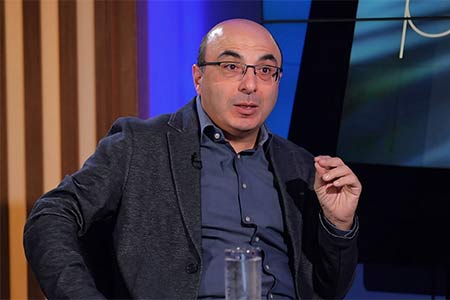
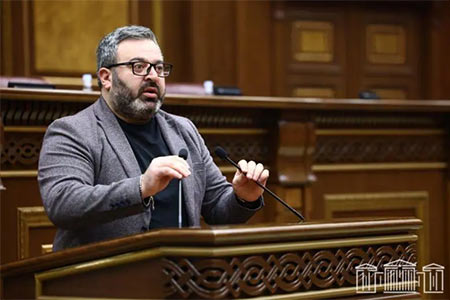
ArmInfo.It is necessary to change both the mood of Armenian society and the content of the election campaign, otherwise we will have not "Gyumri- 2," but "Yerevan-1." Political scientist and member of the Alternative Projects Group Vahe Hovhannisyan writes about this in his article, commenting on the pre-election situation in Armenia.
Earlier, on the Public Television of Armenia, Mother Armenia party leader Andranik Tevanyan stated that the opposition is going into the parliamentary elections on June 7, 2026, with the intention of implementing the "Gyumri-2" scenario, which involves collecting votes through an image or intermediary and then channeling these votes to the interests of other political centers. The ruling Civil Contract faction saw this as a risk of repeating the scenario the opposition played out during the municipal elections in Gyumri. According to Deputy Speaker of Parliament Ruben Rubinyan, the addition of part of second President Robert Kocharyan's team to oligarch Gagik Tsarukyan's list and their joint participation in the elections indicate that the opposition intends to repeat the scenario played out in Gyumri, where Communist Party representative Vardan Ghukasyan became mayor, in the national elections.
"In fact, it's good that the government raised the 'Gyumri-2' issue in a semi-SMS format. We need to understand what this ultimately means in terms of content and technology. In terms of content, the 'Gyumri scenario' is extremely problematic for me personally. The quality of the next government is far more important to me. Armenia and the region today are like a powder keg, and the nature of the next government is crucial. One misstep, one miscalculation in assessing reality, one inadequate understanding of the situation and the world, and Armenia will ultimately find itself on the brink of disaster. In this regard, the content and strength of the next government are vitally important. A state is not a testing ground. One test government was quite sufficient for us at this stage," the political scientist noted.
As for the technology of the 'Gyumri scenario,' as Vahe Hovhannisyan noted, the authorities' outburst of emotion betrays their uncertainty. "Ultimately, this scenario is constitutional, legally sound, and logical. But that's not the most important thing. In practice, it's impossible to predict the image of the future National Assembly today, and therefore the options for forming a government. It's impossible to insist on any particular development scenario today. This is probably a unique case, in which both the government and the opposition, as well as various parts of the opposition, must be honest with each other. For a number of serious, objective reasons, non-standard social strata have formed in Armenia (I'm deliberately not mentioning them), the content of the vote in which no one can predict in advance. What is the government currently bringing to the table? And finally, why are they focusing on two or three forces? There are other potential forces that could enter the National Assembly and significantly change all the calculations, and they still have time to submit their applications. Now, perhaps, the most important moment for me is the integration of a respectable list of public figures, formed in recent years, into the electoral lists. If they don't find their place in the electoral process (or don't want to, or aren't allowed to), the content and results of the elections will suffer. The inclusion of normal, principled, and non-adventurous individuals on various lists will significantly reduce unprincipledness and adventurism on a national scale," the political scientist believes.
He added that the country's interests and its current state require responsible political forces to set precisely this goal-the restoration of Armenia-and to impose precisely this content on the election campaign, starting today. "We have an extremely complex reality and a whole host of difficult questions that must be answered honestly. I'd like to begin this list with points that may seem surprising to many, but which are already on the agenda.
1. The loss of internal governance in the country. Street gangs, vendettas, and horrific manifestations of domestic violence - every day, in every city. This is a serious problem. People are afraid to let their children out of the house. Nothing like this has ever happened in Armenia, even during the most difficult periods. A stray dog can do whatever it wants on every meter. I emphasize: this is not just a police problem. It is a political problem. How can we quickly restore internal control over the country? Today, nothing is happening inside the state except arrests and criminal cases, but no problems are being resolved. Peaceful Armenia is turning into a savage country without internal rules of coexistence. The reason is the incompetence of the leadership and eight years of aggression on the part of the authorities.
2. No issues are being resolved, from deadly air quality indicators and potholed streets to reforms in all areas. Areas that are announced and then immediately suspended because they are unfeasible in real life. No programs are implemented: they are either canceled mid-progress, significantly modified, or forgotten. This speaks to extremely poor governance.
3. How can we achieve guaranteed peace? Today is not peace; today is a "war-free" situation, which will require complex and serious management from any government.
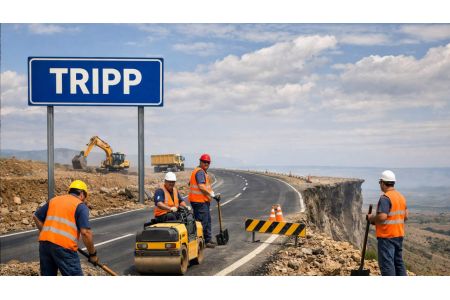
4. Finally, what is TRIPP? What link does it represent in the path connecting Armenia with Turkey and Azerbaijan? What guarantees of real peace does it provide? What development prospects does it offer?
5. If tomorrow Azerbaijan makes demands with the threat or even the use of force, say, in the Gegharkunik region, what role will TRIPP play? Perhaps Trump will establish peace for the 11th time, say, at the expense of one shore of Lake Sevan?
6. How do we envision the path to internal reconciliation? We will get nowhere with fragmented, atomized, and in some places disorganized public sentiment.
7. How do we perceive and address Armenia's most serious strategic problem - emigration? This isn't just superficial PR, when people gather together and say, "Thanks to Nikol, there is no emigration this year." We know that the emigration figures were underestimated solely due to the Russia-Ukraine conflict and Trump's anti-immigration policies. If even one of these factors were to be relaxed tomorrow, the figures would change dramatically.
8. It's clear that the issue of the return of hundreds of thousands of Azerbaijanis will soon become a pressing issue. It's no coincidence that they are already strolling carefree through the courtyards of Armenia. This government has no solution to this problem, we know that. What are others proposing? The list could go on and on. Its main goal remains to be understood. It is necessary to change both the mood and the content of the election campaign. Otherwise, we won't have Gyumri- 2, but rather Yerevan-1," Vahe Hovhannisyan concluded.







 Expert: Economic pressure on Armenia may be virtually painless for other EAEU members, but not for Armenia itself
 Expert on protests in France: Civilizations fade when society loses a vision of the future
 Turkologist: Azerbaijan is not all-powerful—its vulnerabilities should become part of Armenia’s security strategy
 Opinion: The development of the Amulsar mine near the resort town of Jermuk is the beginning of an environmental disaster in Armenia
 Expert: The arrest of opposition figures in Armenia for social media posts is a systematic attempt to intimidate the public and suppress dissent.
 The Armenian Foreign Minister commented on the country`s return to work within the CSTO.
 The Artsakh Public Council expressed outrage at the UN Secretary-General`s behavior
 Lukashenko called for Armenia to assume the CIS presidency in 2029
 Dmitry Medvedev predicted a Ukrainian-like fate for Armenia amid the country`s shift in foreign policy
 Russian Security Council: In Armenia, they want to force Russian asset owners to dispose of their assets
 Zakharova: Russia ready to discuss with Armenia the prospects for expanding military cooperation as part of a review of bilateral ties
 Tevanyan: Armenia, like Ukraine and Moldova, is being drawn into the EU’s global war
 Yerevan City Hall is considering introducing a valet parking system in the city
 Expert: The circus surrounding the “Albanization” of Armenian culture in the presence of foreign ambassadors in occupied Artsakh is genocide
 Political scientist: If Russian-Armenian relations are destroyed, Turkey will take Russia`s place
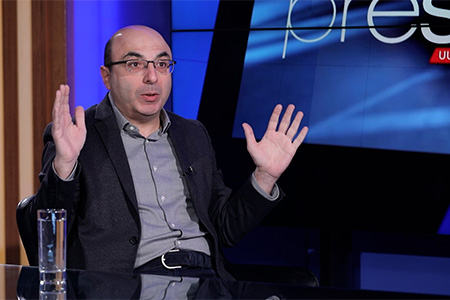 Political scientist: The Armenian public is simply obliged to significantly change the entire content of public discourse and struggle
 Cross tattoos are being removed from the skin of Christian prisoners in Azerbaijan by fire, according to a human rights activist.
 Zakharova: Armenia`s likely introduction of visas with Russia will be a step against Yerevan itself
 Putin: Armenia`s recognition of Karabakh as part of Azerbaijan in Prague has given Russia`s position on this issue an ambivalent character
 Putin: Armenia`s adoption of the law on EU accession means an announcement of its withdrawal from the Eurasian Economic Union