

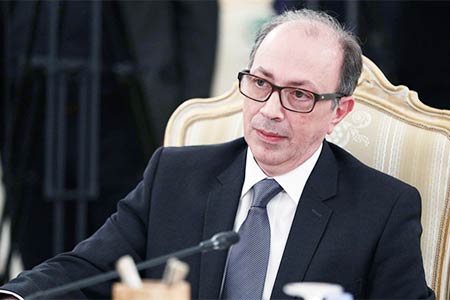
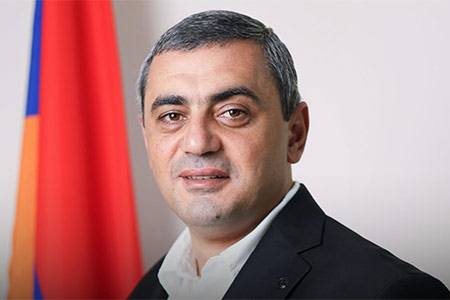
ArmInfo.Today, Armenia is at a crossroads, choosing between the role of a subject and an object of regional policy, between a strategy of recovery and development and a strategy of survival, according to Ara Ayvazian, former Foreign Minister of Armenia and founding member of the Pan-Armenian Council of Diplomats.
Analyzing the government's "Crossroads of Peace" initiative, the diplomat noted that the Armenian authorities present the project as a strategic vision for the country's future, including opening up communications, lifting the blockade, and turning Armenia into a regional hub. In this regard, Ayvazian emphasized that although small states benefit from open borders and economic interconnectedness, policies are judged not by their fine intentions, but by the conditions of their implementation. "Crossroads of Peace" implies that Armenia should be the initiator and the regulator of all processes, establishing rules, ensuring balance, and controlling communications passing through its territory. However, the reality is that Armenia is not the architect of a controlled crossroads, but a state at a crossroads, with a changed balance of power around it and a security system still reeling from the turmoil of war. The language of the project speaks of possibilities, while reality dictates limitations. "This contradiction requires a sober and clear understanding," the former Armenian Foreign Minister emphasized.
He recalled that after the 44-day war of 2020, the balance of power in the South Caucasus has changed fundamentally, and in 2023, the Armenian presence in Artsakh practically ceased. At the same time, as Ayvazian noted, Azerbaijan has further strengthened its position by deepening its close strategic cooperation with Turkey. According to him, in such circumstances, discussions about a "crossroads" requires precise calculation and a clear understanding of reality.
"A crossroads implies not only a crossing of roads, but also complete control over them, the ability to establish rules and clear mechanisms for ensuring security. If a state lacks sufficient institutional stability and a clear defense plan, the crossroads turns into a transit zone where external forces determine the course of major events," Ayvazian clarified.
The former Foreign Minister recalled that Armenia is currently engaged in active negotiations on various international platforms, including with the US and the EU, while simultaneously rethinking its relations with Russia and its role in the Collective Security Treaty Organization (CSTO). In this regard, Ayvazian noted that, while adjusting foreign policy is a natural and necessary process, it cannot replace a clearly formulated national strategy.
"A peace treaty is important, but a document does not yet guarantee systemic peace. Sustainable peace is built on legal norms, mutual obligations, a balance of power, and reliable guarantees," Ayvazian believes.
The diplomat cited the domestic situation as another important factor. As Ayvazian noted, Armenia is facing a test of the quality of its statehood, trying to answer the question of whether the country is capable of building an institutional state where security, diplomacy, and the economy are aligned within a unified strategic framework. In this regard, he pointed out that demographic decline, emigration, and social polarization are making the foundations of state stability vulnerable. "A state that loses its human resources and social cohesion cannot become a reliable regional center. The contradiction is not between peace and war, but between illusion and responsibility. Illusion is the belief that economic integration alone will solve security issues. Responsibility, however, is the realization that institutions must first be strengthened, defense capability restored, and a clear national program formulated. Only then can geographic location be transformed into a real advantage. Today, Armenia is truly at a crossroads between the role of a subject and an object of regional policy, between a strategy of recovery and development and a strategy of survival," the former minister emphasized.
With this understanding, Ayvazian noted, the Armenian people consider the upcoming parliamentary elections scheduled for June 7, 2026. He expressed his conviction that the upcoming elections will be about the quality of the state, not about individuals, not about rhetoric, but about strategy; not about promises of quick solutions, but about long-term responsibility. "And it is our decisions that will determine whether this crossroads becomes a point of collapse, where external interests are realized at the expense of internal weakness, or a point of a new beginning, where the state can control processes and shape its own program. These elections are not just another political stage: they represent the boundary between illusions and responsibility. It's about maturity. And the maturity of the state is shaped by political will, effective and balanced institutions, and informed public choice. The crossroads can become a symbol of peace only if we ourselves decide which path to choose," Ayvazian concluded.
Recall, at the end of October 2023, Armenian Prime Minister Nikol Pashinyan presented the "Crossroads of Peace" initiative for the first time at an international forum in Tbilisi. This project, in essence, is the Armenian version of a project to unblock communications in the region after the 44-day war in Artsakh. Armenian authorities assure that this is one component of the process of establishing lasting peace in the South Caucasus, which, if implemented, will allow Armenia to emerge from its isolation and become a logistics hub in the region.









 Expert: Economic pressure on Armenia may be virtually painless for other EAEU members, but not for Armenia itself
 Expert on protests in France: Civilizations fade when society loses a vision of the future
 Turkologist: Azerbaijan is not all-powerful—its vulnerabilities should become part of Armenia’s security strategy
 Opinion: The development of the Amulsar mine near the resort town of Jermuk is the beginning of an environmental disaster in Armenia
 Expert: The arrest of opposition figures in Armenia for social media posts is a systematic attempt to intimidate the public and suppress dissent.
 The Artsakh Public Council expressed outrage at the UN Secretary-General`s behavior
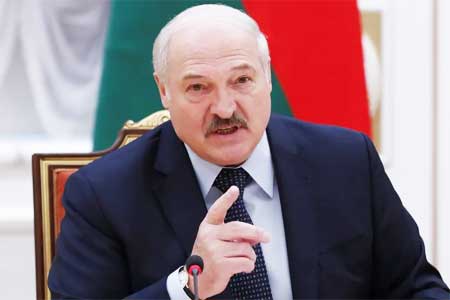 Lukashenko called for Armenia to assume the CIS presidency in 2029
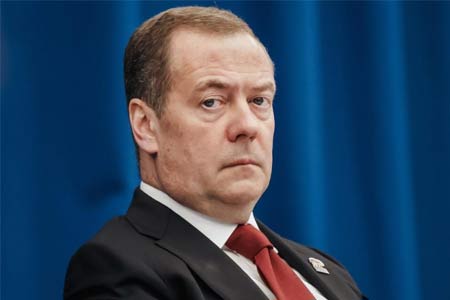 Dmitry Medvedev predicted a Ukrainian-like fate for Armenia amid the country`s shift in foreign policy
 Russian Security Council: In Armenia, they want to force Russian asset owners to dispose of their assets
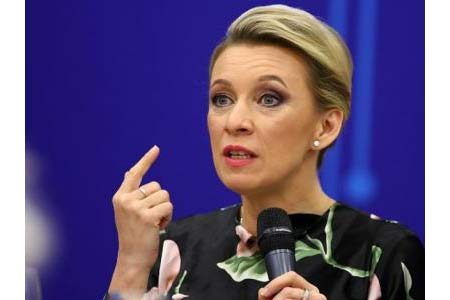 Zakharova: Russia ready to discuss with Armenia the prospects for expanding military cooperation as part of a review of bilateral ties
 Tevanyan: Armenia, like Ukraine and Moldova, is being drawn into the EU’s global war
 Yerevan City Hall is considering introducing a valet parking system in the city
 Expert: The circus surrounding the “Albanization” of Armenian culture in the presence of foreign ambassadors in occupied Artsakh is genocide
 Political scientist: If Russian-Armenian relations are destroyed, Turkey will take Russia`s place
 Political scientist: The Armenian public is simply obliged to significantly change the entire content of public discourse and struggle
 Cross tattoos are being removed from the skin of Christian prisoners in Azerbaijan by fire, according to a human rights activist.
 Zakharova: Armenia`s likely introduction of visas with Russia will be a step against Yerevan itself
 Putin: Armenia`s recognition of Karabakh as part of Azerbaijan in Prague has given Russia`s position on this issue an ambivalent character
 Putin: Armenia`s adoption of the law on EU accession means an announcement of its withdrawal from the Eurasian Economic Union