

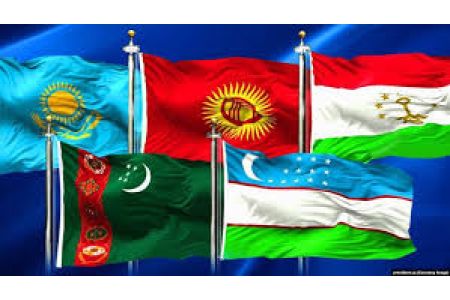
ArmInfo. The United States is returning to Central Asia—not through military bases, as in the early 2000s, but through critical minerals, investments, and economic cooperation. Experts agree: the region is becoming part of the strategic confrontation between Washington and Beijing.
For Central Asian countries, this represents an opportunity to diversify external relations, a chance to develop processing and industrial cooperation, and a risk of increased dependence on raw materials and being drawn into competition with major powers. The key question remains: will the region be able to leverage the interest of external players to strengthen its own sovereignty, or will it remain merely a source of resources in someone else's strategy? This is discussed in an article published on 24.kg.
Washington is increasing its interest in the region. This involves critical minerals, investments, and new formats of cooperation. Some see this as an opportunity, while others see the risk of increased dependence and being drawn into someone else's geopolitical struggle. 24.kg asked experts: What does the US focus on Central Asia mean? And how can Washington's growing interest in the region in the area of critical minerals be assessed?
Sherali Rizoyon, political scientist: It should be noted that the strengthening of the policies of all large and medium-sized actors in Central Asia is accompanied by the emergence of both challenges and opportunities. I view Washington's attention to Central Asia in the area of critical minerals as a positive development. This will stimulate the active participation of both traditional partners and rivals in the Central Asian region in the extraction of critical minerals. Increased US interest in Central Asia in this area could open a new window of opportunity for the region's countries to produce and process their own minerals.
Anuar Bakhitkhanov, political scientist: The US's growing interest in Central Asia, particularly in the area of critical minerals, reflects a desire to diversify global supply chains and reduce dependence on China. The region is viewed as a strategically important source of raw materials for the energy transition, high technology, and the defense industry. For the countries of Central Asia, this could be a significant opportunity: an influx of investment and technology, and a move beyond the raw materials model through the development of processing and industrial cooperation. However, without a clear national and regional strategy, there is a risk of increased dependence on raw materials, environmental problems, and the region's involvement in geopolitical rivalry between major powers.
Arkady Dubnov, Central Asia expert: This is the second time the United States has seriously entered post-Soviet Central Asia. The first time was after the start of the US military operation in Afghanistan in the early 2000s. But back then, the region interested the Americans primarily as a rear base for the operation; recall the US military bases in Kyrgyzstan and Uzbekistan... Now, the situation is different. The foreign policy concept of the 47th US President does not envisage achieving his goals through a ground military intervention in any country. Nevertheless, this does not preclude the United States' interest in accessing the military infrastructure of individual states for specific operations. The US return to Central Asia today is taking place in fundamentally different geopolitical circumstances. The most important of these is the need to counter China's growing global influence. Russia, weakened by the Central Military Operation in Ukraine, is no longer considered a threat to the United States. US policy instruments boil down to three trends: economics, politics, and security. Today, issues of economic cooperation are taking center stage. Uzbekistan and Kazakhstan are the leading players here.
Stanislav Belkovsky, writer: The world is becoming completely fragmented. It lacks stable rules of the game and any coherent hierarchy. The US presidential administration's interest in Central Asia is primarily linked to the formation of a new world order. On December 4 of last year, the US released a new security strategy, which drew a double line under the era of the American-centric world that began, figuratively, in the ruins of the Berlin Wall on November 9, 1989. The world today is an Asian highway, where no one follows the rules, everyone drives at their own speed and in the lane they want, and the only question is how big and powerful your car is. If you have a large and powerful car, then you're allowed more on the road—de facto, not de jure, because international law no longer exists—than everyone else. Today, the United States plays the role not of a global moderator, but of the largest vehicle on the road. This vehicle requires fuel—a wide variety of resources from a wide variety of regions. Central Asia is one such region. Both rare earth metals and traditional energy sources fall into this resource spectrum. Furthermore, the United States is in a competitive situation.











 Opinion: The development of the Amulsar mine near the resort town of Jermuk is the beginning of an environmental disaster in Armenia
 Expert: The arrest of opposition figures in Armenia for social media posts is a systematic attempt to intimidate the public and suppress dissent.
 Azerbaijani Studies Expert: While Azerbaijan Prepares Its Generation for War, Aliyev’s Aide Calls on Armenia to Prepare Armenian Society for “Peace”
 Turkologist: Azerbaijan will never, under any circumstances, stop pressuring the Armenian people
 Political scientist: We need to move away from the question of "when" and replace it with more important questions
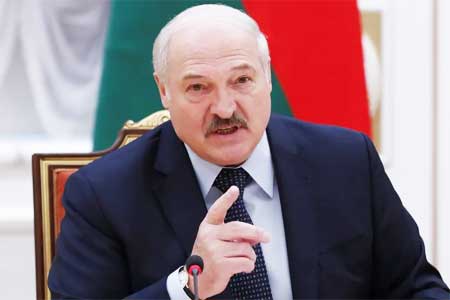 Lukashenko called for Armenia to assume the CIS presidency in 2029
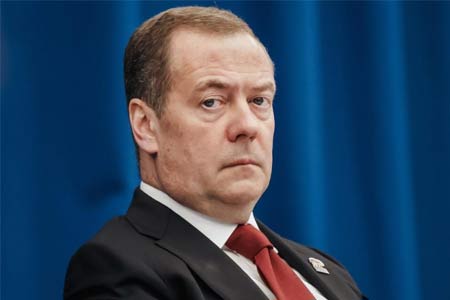 Dmitry Medvedev predicted a Ukrainian-like fate for Armenia amid the country`s shift in foreign policy
 Russian Security Council: In Armenia, they want to force Russian asset owners to dispose of their assets
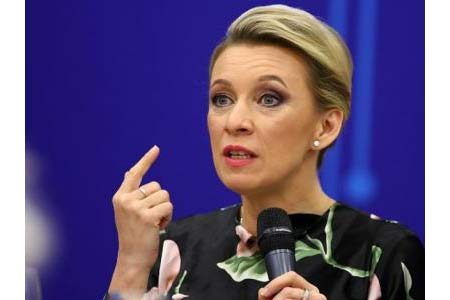 Zakharova: Russia ready to discuss with Armenia the prospects for expanding military cooperation as part of a review of bilateral ties
 Tevanyan: Armenia, like Ukraine and Moldova, is being drawn into the EU’s global war
 Yerevan City Hall is considering introducing a valet parking system in the city
 Expert: The circus surrounding the “Albanization” of Armenian culture in the presence of foreign ambassadors in occupied Artsakh is genocide
 Political scientist: If Russian-Armenian relations are destroyed, Turkey will take Russia`s place
 Political scientist: The Armenian public is simply obliged to significantly change the entire content of public discourse and struggle
 Cross tattoos are being removed from the skin of Christian prisoners in Azerbaijan by fire, according to a human rights activist.
 Zakharova: Armenia`s likely introduction of visas with Russia will be a step against Yerevan itself
 Putin: Armenia`s recognition of Karabakh as part of Azerbaijan in Prague has given Russia`s position on this issue an ambivalent character
 Putin: Armenia`s adoption of the law on EU accession means an announcement of its withdrawal from the Eurasian Economic Union
 Aram Vardevanyan: Public demands solutions, not apology scandals in Parliament