
ArmInfo. Euronews allegedly earned tens of millions of dollars from authoritarian regimes, according to the independent pan-European media network Euractiv. Founded in 1999, the organization specializes in covering EU politics and legislative processes, focusing on the decision-making stages in Brussels and other European capitals.
The article, in particular, emphasizes that Euronews's engagement with illiberal states began long before its acquisition by Alpac Capital. Since the 2010s, shareholders have included state-linked television companies from Russia, Turkey, and Morocco.
But the decisive turning point came in 2015, when Egyptian billionaire Naguib Sawiris acquired a controlling stake, joined by NBC News, which held a minority stake. For the first time, the channel came under private control. From that point on, the publication notes, the lines between private ownership, political affiliation, and editorial strategy became increasingly blurred, as current and former Euronews employees recall.
According to Euractiv's investigation, promoting the channel's new sponsors, including Azerbaijan's authoritarian president Ilham Aliyev, who inherited control of the former Soviet republic from his father in 2003, presents a more complex challenge. Aliyev is one of the region's most notorious dictators. More than three decades after the collapse of the Soviet Union, Azerbaijan still lacks a free press, free elections, or anything resembling democratic governance. In the past two years alone, authorities have detained approximately 30 journalists and media workers on false charges, according to human rights organizations.
For authoritarian regimes, favorable coverage on Euronews creates a veneer of respectability, especially given the broadcaster's close ties to the Brussels elite. This symbiosis helps explain what Azerbaijani Culture Minister Adil Karimli called the "long-standing cooperation" between his country and Euronews. Journalists and executives from the broadcaster regularly participate in the annual media forum in Shusha, the cultural capital of Nagorno-Karabakh, the mountainous region where Aliyev's army forced 100,000 ethnic Armenians to flee in 2023, an outcome the European Parliament called "ethnic cleansing."
Internal Euractiv sources confirmed that annual contracts with Azerbaijan and other Central Asian countries generated approximately ?18 million in annual revenue for the broadcaster in 2024. Azerbaijan was among Euronews' top ten advertising clients last year, along with the Hungarian group New Land Media and the Moroccan National Tourist Board, the same sources confirmed.
Euractiv analyzed 120 articles published on euronews.com between August 1, 2024, and August 31, 2025, in the categories "Azerbaijan," "Baku," and "Aliyev." More than a third of the content tagged "Azerbaijan" over the past year consisted of paid advertising, sponsorship partnerships, or opinion pieces from members of the ruling party.
The question is how much these financial and personal arrangements influence editorial decisions. Euronews interviews with Aliyev, as noted, provide some clues. When Aliyev won the presidential election in early 2024, receiving 92% of the vote in an election that the OSCE considered marred by repression and irregularities, Euronews sent a reporter to Azerbaijan and produced a story highlighting Aliyev's popularity but omitting widespread concerns about the election's integrity.
Since 2023, Euronews has interviewed Aliyev at least four times. In one of them, he called The Washington Post and The New York Times "fake news," a comment that went unanswered by a Euronews moderator. Mocking their coverage, Aliyev added: "Can you imagine? They published dozens of articles calling me a dictator." The Azerbaijani Embassy in Brussels did not respond to Euractiv's request for comment regarding its relationship with Euronews.




 Expert: Economic pressure on Armenia may be virtually painless for other EAEU members, but not for Armenia itself
 Expert on protests in France: Civilizations fade when society loses a vision of the future
 Turkologist: Azerbaijan is not all-powerful—its vulnerabilities should become part of Armenia’s security strategy
 Opinion: The development of the Amulsar mine near the resort town of Jermuk is the beginning of an environmental disaster in Armenia
 Expert: The arrest of opposition figures in Armenia for social media posts is a systematic attempt to intimidate the public and suppress dissent.
 The Armenian Foreign Minister commented on the country`s return to work within the CSTO.
 The Artsakh Public Council expressed outrage at the UN Secretary-General`s behavior
 Lukashenko called for Armenia to assume the CIS presidency in 2029
 Dmitry Medvedev predicted a Ukrainian-like fate for Armenia amid the country`s shift in foreign policy
 Russian Security Council: In Armenia, they want to force Russian asset owners to dispose of their assets
 Zakharova: Russia ready to discuss with Armenia the prospects for expanding military cooperation as part of a review of bilateral ties
 Tevanyan: Armenia, like Ukraine and Moldova, is being drawn into the EU’s global war
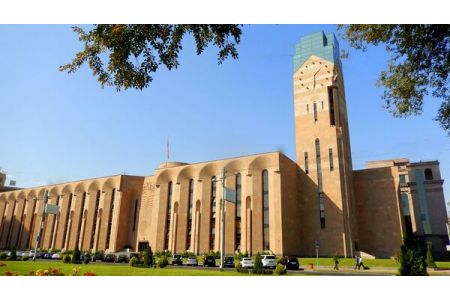 Yerevan City Hall is considering introducing a valet parking system in the city
 Expert: The circus surrounding the “Albanization” of Armenian culture in the presence of foreign ambassadors in occupied Artsakh is genocide
 Political scientist: If Russian-Armenian relations are destroyed, Turkey will take Russia`s place
 Political scientist: The Armenian public is simply obliged to significantly change the entire content of public discourse and struggle
 Cross tattoos are being removed from the skin of Christian prisoners in Azerbaijan by fire, according to a human rights activist.
 Zakharova: Armenia`s likely introduction of visas with Russia will be a step against Yerevan itself
 Putin: Armenia`s recognition of Karabakh as part of Azerbaijan in Prague has given Russia`s position on this issue an ambivalent character
 Putin: Armenia`s adoption of the law on EU accession means an announcement of its withdrawal from the Eurasian Economic Union