
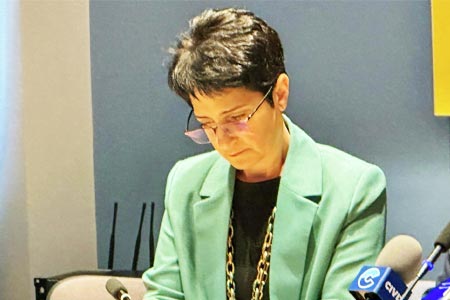
ArmInfo.The publics of Armenia and Azerbaijan are mature enough to discuss a common future, but, unfortunately, they are not yet ready to address their painful past. Naira Sultanyan. human rights activist and Director of the Democracy Development Foundation, made this statement at a press conference in Yerevan, reflecting on the results of a meeting with her Azerbaijani colleagues in Tsaghkadzor as part of the "Bridge of Peace" initiative.
She recalled that the main goal of their initiative was to convey the Armenian agenda to decision-makers in Azerbaijan, including their public. Speaking about the meeting in Tsaghkadzor, Sultanyan emphasized that humanitarian issues of concern to both sides were freely discussed. The Armenian side had raised the issue of holding Armenian prisoners of war in Baku.
"Although the Azerbaijani group does not have the authority to influence this process, they can shape public opinion. In this regard, the Armenian delegation attempted to explain to their Azerbaijani colleagues why the presence of Armenian prisoners in Baku contradicts the logic of peace. However, the Azerbaijani side brought up the issue of Armenia providing minefield maps and information on Azerbaijanis missing during the 1990 war. Although we do not have answers to these questions, we nevertheless attempted to discuss them and clarify the situation," the human rights activist said.
She also noted that, following the discussions, it became clear that events were moving too quickly for both sides, and people in both countries were failing to "digest" them. Specifically, both sides expressed dissatisfaction with not being able to keep up with the political processes between the two countries. Areg Kochinyan, Chairman of the "Armenian Council" Analytical Center and Coordinator of the Peace Bridge initiative, emphasized the importance of the meeting format, both in relation to the Armenian prisoners of war issue and the rhetoric used by the parties towards each other. He also noted that this format for interaction is established and just a one-off initiative.
"I consider it important that, in addition to these meetings, the parties are also conducting serious work on the ground. For example, our countries' delegations are organizing meetings with representatives of civil society, the media, and the expert community. Visits to the regions and joint projects are planned. We are writing joint articles, the first of which I hope to present to you in the upcoming days, including joint research. We are also discussing other projects that will be implemented soon," Kochinyan noted, adding that for the first time, the events are being held with the direct assistance of the governments of both countries, with state support and funding.
In turn, political scientist Narek Minasyan, noted that it is not yet possible to say with certainty that the initiative will be successful. He noted that the process depends not only on the participants but also on external and internal factors. However, he called it a mistake to miss such an opportunity. "During the discussions, there was no mention of quickly establishing friendly relations or forgetting the past; the discussion was about the opportunity to build dialogue and discuss the future," the political scientist noted. According to him, the participants' goal was to find common ground within which a peace process could be made inevitable. He also emphasized the importance of setting realistic expectations for the initiative. In this regard, he reported that the discussions have led to an understanding of two main approaches: overestimating the initiative's capabilities and overestimating the expectations surrounding its results. First and foremost, as Minasyan noted, attributing the discussion of border delimitation and demarcation issues to the initiative is not accurate, as these are the responsibility of the government. Minasyan noted that, although these issues were discussed, the decision on them lies within the authority of the authorities. "The other approach is to claim that the initiative will do nothing to improve relations. However, it is safe to say that the initiative is influencing the narrative to some extent," Minasyan concluded.
Recall, a bilateral roundtable meeting between civil society representatives from Armenia and Azerbaijan was held in Armenia on February 13-14 as part of the "Bridge of Peace" initiative. The Azerbaijani delegation arrived in Armenia for the event for the first time through the delimited and demarcated sections of the land border, having completed all necessary procedures. The civil society meetings were launched following the initialing of the draft peace treaty between Armenia and Azerbaijan in Washington, D.C., in August 2025.









 Expert: Economic pressure on Armenia may be virtually painless for other EAEU members, but not for Armenia itself
 Expert on protests in France: Civilizations fade when society loses a vision of the future
 Turkologist: Azerbaijan is not all-powerful—its vulnerabilities should become part of Armenia’s security strategy
 Opinion: The development of the Amulsar mine near the resort town of Jermuk is the beginning of an environmental disaster in Armenia
 Expert: The arrest of opposition figures in Armenia for social media posts is a systematic attempt to intimidate the public and suppress dissent.
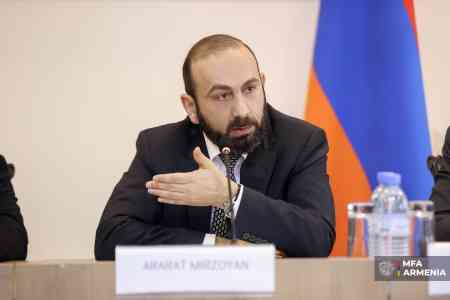 The Armenian Foreign Minister commented on the country`s return to work within the CSTO.
 The Artsakh Public Council expressed outrage at the UN Secretary-General`s behavior
 Lukashenko called for Armenia to assume the CIS presidency in 2029
 Dmitry Medvedev predicted a Ukrainian-like fate for Armenia amid the country`s shift in foreign policy
 Russian Security Council: In Armenia, they want to force Russian asset owners to dispose of their assets
 Zakharova: Russia ready to discuss with Armenia the prospects for expanding military cooperation as part of a review of bilateral ties
 Tevanyan: Armenia, like Ukraine and Moldova, is being drawn into the EU’s global war
 Yerevan City Hall is considering introducing a valet parking system in the city
 Expert: The circus surrounding the “Albanization” of Armenian culture in the presence of foreign ambassadors in occupied Artsakh is genocide
 Political scientist: If Russian-Armenian relations are destroyed, Turkey will take Russia`s place
 Political scientist: The Armenian public is simply obliged to significantly change the entire content of public discourse and struggle
 Cross tattoos are being removed from the skin of Christian prisoners in Azerbaijan by fire, according to a human rights activist.
 Zakharova: Armenia`s likely introduction of visas with Russia will be a step against Yerevan itself
 Putin: Armenia`s recognition of Karabakh as part of Azerbaijan in Prague has given Russia`s position on this issue an ambivalent character
 Putin: Armenia`s adoption of the law on EU accession means an announcement of its withdrawal from the Eurasian Economic Union