

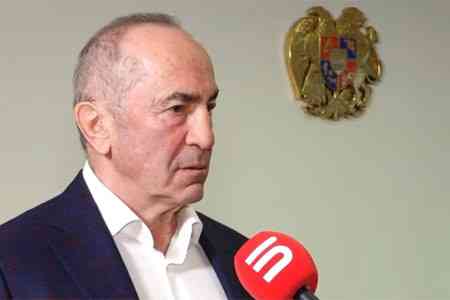
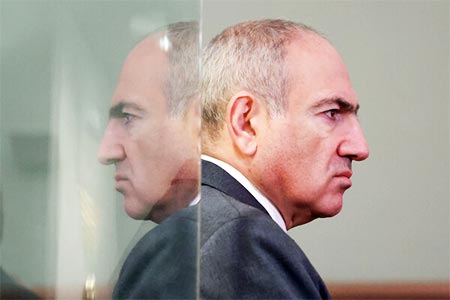
ArmInfo.What is currently being presented to the Armenian people has no relation to reality. It's nothing more than a storm in a teacup, as stated by Armenia's second president, Robert Kocharyan, on Channel 5, referring to the discussions surrounding $9 billion in American investments.
Recall, US Vice President J.D. Vance announced in Yerevan a phased $9 billion investment under the 123 Agreement as part of cooperation with Armenia in the peaceful use of nuclear energy. "This will pave the way for American and Armenian companies to conclude deals on civil nuclear energy projects." "This represents up to $5 billion in initial American exports, plus an additional $4 billion in long-term support through fuel supply and maintenance contracts," the US Vice President stated at a briefing in Yerevan. However, due to a mistranslation, many interpreted this statement as information about a $9 billion investment in the traditional sense. Consequently, representatives of the ruling Civil Contract party began congratulating Armenians on the anticipated large-scale investment, while their opponents began sounding the alarm that these $9 billion would become a new debt burden for Armenian citizens.
Meanwhile, the second President of the Republic of Armenia, Robert Kocharyan, believes that only a bilateral statement was signed concluding negotiations on joining the Treaty on Peaceful Atomic Energy. He urges people to verify this information on the US Embassy website. The same statement is written on Prime Minister Pashinyan's official website: "Prime Minister Nikol Pashinyan and US Vice President James D. Vance signed a joint statement on the completion of negotiations on the Agreement on Cooperation between the Government of the Republic of Armenia and the Government of the United States of America in the Field of Peaceful Uses of Nuclear Energy." In other words, the document merely "confirms the completion of negotiations," and not even the agreement itself.
"This is another agreement that we are becoming a party to. But this does not mean investments or anything else," Kocharyan states. The United States has signed a similar document with 26 countries, including Russia. "This does not even imply a promise that a nuclear power plant will be built in Armenia," the former president added. Therefore, Kocharyan explains, this is simply a window of opportunity for Armenia to acquire similar projects from the United States. "They are simply promoting their nuclear technologies, and it is normal for a leader to try to introduce their country's technologies to the markets of other countries," the former president asserts.
Robert Kocharyan points out that the United States has no experience building similar nuclear power plants abroad; currently, only Russia is building five or six such plants outside its borders. The United States is actively promoting this idea due to it's lagging position in this area, and the high cost of its nuclear energy. Furthermore, the United States lacks experience in building nuclear power plants outside the United States; moreover, its domestic nuclear power plants require subsidies. "The most recent nuclear power plant constructed in the United States turned out to be quite costly for the country," Kocharyan notes, emphasizing that the capital costs of generating 1 kW of installed capacity at a nuclear power plant in the United States are five to six times higher than in Russia or China.
"No one will incur such expenses, as they will then be included in the tariffs," he clarifies. "This is business, not charity. If you can build a nuclear power plant of the same quality for five times less cost, then you're imposing a burden on citizens that's five times lighter," the former president concludes. J.D. Vance arrived in Armenia on February 9 for an official two-day visit. Following talks between Armenian Prime Minister Nikol Pashinyan and the US Vice President, it was announced that Washington would supply Yerevan with $11 million worth of reconnaissance drones. An agreement was also signed to continue cooperation in developing civilian nuclear energy worth $9 billion, under which Yerevan will receive small modular reactor technology. The two countries' politicians also discussed trade issues, focusing on the sale of advanced American computer chips to Armenia, as the country plans to establish a powerful AI center. Other agreements included American investments in transportation infrastructure, as part of the Trump Route for Peace and Prosperity Initiative (TRIPP).
It is worth noting that, on February 11, in response to a question from NA Vice Speaker Ruben Rubinyan in parliament about when the Metsamor Nuclear Power Plant would finally be closed and with whom Armenia would cooperate on building a new one, Pashinyan stated that Armenia was still deciding which nuclear power plant to build. He stated that the operational life of the Metsamor Nuclear Power Plant could be extended until 2046, whereas it was previously assumed to last until 2036. He also added that a decision on constructing a new plant could be made during this period.






















 Expert: The arrest of opposition figures in Armenia for social media posts is a systematic attempt to intimidate the public and suppress dissent.
 Azerbaijani Studies Expert: While Azerbaijan Prepares Its Generation for War, Aliyev’s Aide Calls on Armenia to Prepare Armenian Society for “Peace”
 Turkologist: Azerbaijan will never, under any circumstances, stop pressuring the Armenian people
 Political scientist: We need to move away from the question of "when" and replace it with more important questions
 International Law Specialist: Azerbaijan intends to initiate legal proceedings against Armenia by sentencing Armenian prisoners
 Dmitry Medvedev predicted a Ukrainian-like fate for Armenia amid the country`s shift in foreign policy
 Russian Security Council: In Armenia, they want to force Russian asset owners to dispose of their assets
 Zakharova: Russia ready to discuss with Armenia the prospects for expanding military cooperation as part of a review of bilateral ties
 Tevanyan: Armenia, like Ukraine and Moldova, is being drawn into the EU’s global war
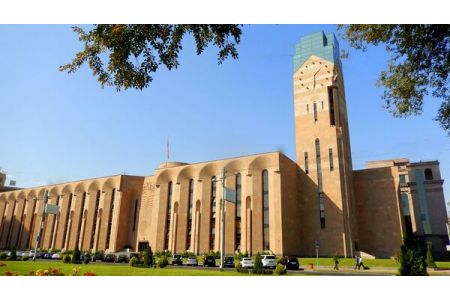 Yerevan City Hall is considering introducing a valet parking system in the city
 Expert: The circus surrounding the “Albanization” of Armenian culture in the presence of foreign ambassadors in occupied Artsakh is genocide
 Political scientist: If Russian-Armenian relations are destroyed, Turkey will take Russia`s place
 Political scientist: The Armenian public is simply obliged to significantly change the entire content of public discourse and struggle
 Cross tattoos are being removed from the skin of Christian prisoners in Azerbaijan by fire, according to a human rights activist.
 Zakharova: Armenia`s likely introduction of visas with Russia will be a step against Yerevan itself
 Putin: Armenia`s recognition of Karabakh as part of Azerbaijan in Prague has given Russia`s position on this issue an ambivalent character
 Putin: Armenia`s adoption of the law on EU accession means an announcement of its withdrawal from the Eurasian Economic Union