


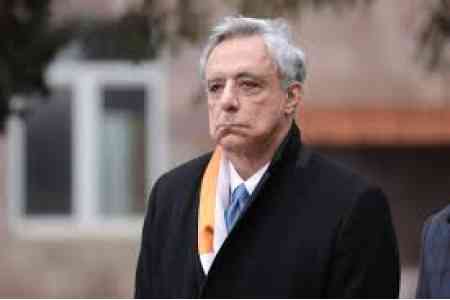
ArmInfo.In the upcoming parliamentary elections, Armenia will not be viewed as a sovereign state, but as a controlled political territory, where electoral processes serve not as a real choice, but as a formal confirmation of decisions already made. Former Foreign Minister of Armenia Vartan Oskanian wrote on his Facebook page, referring to the upcoming parliamentary elections scheduled for June 7, 2026.
The former Foreign Minister recalled that on June 7, Armenian citizens will elect the country's leadership for the next five years. However, he noted that long before the first ballot was cast, a process of "voting" had begun in the country by a different electorate: the collective West, Turkey, and Azerbaijan. In other words, as Oskanian noted, by the residents of the so-called "Real Armenia" (the ideology of Armenian Prime Minister Nikol Pashinyan - ed.).
"Their preferences are open, systematic, and pragmatic. US Vice President J.D. Vance's public support for Pashinyan marks the beginning of an already expected and predictable sequence of events. European leaders will arrive in Yerevan in May with similar statements of support for Pashinyan. Ankara will likely follow these symbolic steps by partially opening the Armenian-Turkish border. Baku may release several Armenian prisoners of war and sign a peace agreement that will not be ratified until all Azerbaijani demands are met," the former Foreign Minister suggested, noting that Armenia will pay a price for each of these gestures. Oskanian then listed the goals each side pursues from the restoration of the current Armenian government. The main strategic goal of Western countries, he said, is to reduce Russia's role in the South Caucasus, regardless of whether Armenia has viable security alternatives. "Turkey's interest is also obvious: to ensure an unimpeded corridor connecting Anatolia with the Turkic world of Central Asia. Azerbaijan's goals are more specific: to strengthen its position in Syunik, guarantee uninterrupted communication with Nakhichevan, and eliminate the geopolitical consequences of ethnic cleansing in Artsakh. The restoration of the current government is the central element of all three of these plans," Oskanian noted.
He added that Azerbaijan can reasonably expect new territorial concessions, changes to the Armenian Constitution, and a gradual, creeping Azerbaijani presence in Armenia. None of this, Oskanian noted, requires large-scale military action, as everything is based on controlled diplomacy, international approval, and a compliant partner in Yerevan. "However, the particular danger of the upcoming elections is not that external forces have interests in Armenia; this has always been the case. The danger is that Armenia will be viewed not as a sovereign state, but as a controlled political territory, where electoral processes serve not as a real choice, but as a formal confirmation of decisions already made," Oskanian concluded.



































 Expert: Even OSCE observers recorded numerous violations during elections in Armenia
  Armenia`s ex-minister of justice calls on opposition to honestly answer questions troubling Armenian citizens
 Lawyer: according to preliminary results, Pashinyan`s party lacks 2/3 majority necessary to amend Armenia`s Constitution
 Moscow to await official results of Armenian elections - Peskov
 Antonio Costa: EU to deepen its partnership with Armenia, expanding cooperation in energy, trade, and digitalization
 Israeli MFA congratulates Pashinyan
 Turkish MFA comments on results of Armenian elections
  Zakharova: International observers cannot ignore `flagrant violations` in Armenian elections
 Strong Armenia to issue statement after vote count completed - Narek Karapetyan
 Russian Senator: Opposition complaints regarding election violations by ruling party remain unanswered
 RA premier receiving congratulations on his victory in parliamentary elections
 Head of IPA CIS Council Secretariat: Extremely difficult atmosphere during parliamentary elections campaign in Armenia accompanied by mass arrests
 Pashinyan`s party leads with 51.13% based on vote counts from 533 polling stations
 Voting in parliamentary elections in Armenia ends
  Strong Armenia: Administrative Court not providing judicial decisions to citizens wishing to vote in parliamentary elections