

ArmInfo. In practical terms, Yerevan received what it expected from US Vice President J.D. Vance's visit, but it should also be noted that the atmosphere of the visit was much more pleasant and positive than expected. Armenian Prime Minister Nikol Pashinyan stated this in an interview with Public Television.
"I am very pleased to note that it (the visit) was received very positively by our public. And this is, perhaps, an important and very expressive example of a balanced and balanced foreign policy, the results of which we are seeing," Pashinyan said.
According to him, the economic context of the visit is very important, because a visit by a US Vice President, "and especially a visit by such a prominent political figure as James DeVance, naturally draws the world's attention to Armenia." It is also crucial that the attention of the US investment community be further drawn to the investment opportunities that have opened and are opening in Armenia. Pashinyan also touched on the discussions surrounding figures. As a reminder, Vance announced in Yerevan a $9 billion phased investment under the <123> agreement as part of cooperation with Armenia on peaceful nuclear energy. "This will pave the way for American and Armenian companies to conclude deals on civil nuclear energy projects. This represents up to $5 billion in initial American exports, plus an additional $4 billion in long-term support through fuel supply and maintenance contracts," the US Vice President stated at a briefing in Yerevan. However, due to a mistranslation, many interpreted this statement as information about a $9 billion investment in the classic sense.
"It is very important to note that the US Vice President, by publishing these large figures, is demonstrating the US's strong political will to support investment in Armenia. These large figures need to be clarified and translated into specific projects, specific addresses, specific locations, and, of course, the areas you've already mentioned." For the first time, we are and will continue to cooperate with the United States in the field of defense, but it is very important to note that all of this is in fact the result of a peace agenda," the Armenian Prime Minister stated.
According to Pashinyan, Armenia is expecting a "massive influx of money," including investments in the future railway. "One unit of investment in certain areas brings two more, in some places three, in some places four units of investment, and, essentially, we are talking about forming a new investment ecosystem, because a railway is a railway, but it is not only tracks; it is also access roads, other services, high-tech equipment, and so on, not to mention passenger, freight, and other transportation services. Moreover, look, we are saying and doing the right things; we are focused on the railway, and that is good, that is correct, but we are talking about new power lines, new pipelines, cables, which are very important. Let's connect these cables to the new supercomputer center being built in Hrazdan, which will provide regional and international artificial intelligence services, combine all this with tourist flows, and so on, and we will see-that is, here, investment begets investment. They usually say something similar about the tech sector: one job created in the tech sector creates three or four, sometimes they talk about five jobs in other sectors, and here we are dealing with the same phenomenon, the same effect," he stated.
J.D. Vance arrived in Armenia on February 9 for an official two-day visit. Following talks between Armenian Prime Minister Nikol Pashinyan and the US Vice President, it was announced that Washington would supply Yerevan with $11 million worth of reconnaissance drones. An agreement was also signed to continue cooperation in the development of civilian nuclear energy worth $9 billion, under which Yerevan will receive small modular reactor technology. The two countries' politicians also discussed trade issues, with special attention paid to the sale of advanced American computer chips to Armenia, as the country plans to establish a powerful AI center. Other agreements included American investments in transportation infrastructure, particularly as part of the Trump Route for Peace and Prosperity Project (TRIPP).











 Opinion: The development of the Amulsar mine near the resort town of Jermuk is the beginning of an environmental disaster in Armenia
 Expert: The arrest of opposition figures in Armenia for social media posts is a systematic attempt to intimidate the public and suppress dissent.
 Azerbaijani Studies Expert: While Azerbaijan Prepares Its Generation for War, Aliyev’s Aide Calls on Armenia to Prepare Armenian Society for “Peace”
 Turkologist: Azerbaijan will never, under any circumstances, stop pressuring the Armenian people
 Political scientist: We need to move away from the question of "when" and replace it with more important questions
 Lukashenko called for Armenia to assume the CIS presidency in 2029
 Dmitry Medvedev predicted a Ukrainian-like fate for Armenia amid the country`s shift in foreign policy
 Russian Security Council: In Armenia, they want to force Russian asset owners to dispose of their assets
 Zakharova: Russia ready to discuss with Armenia the prospects for expanding military cooperation as part of a review of bilateral ties
 Tevanyan: Armenia, like Ukraine and Moldova, is being drawn into the EU’s global war
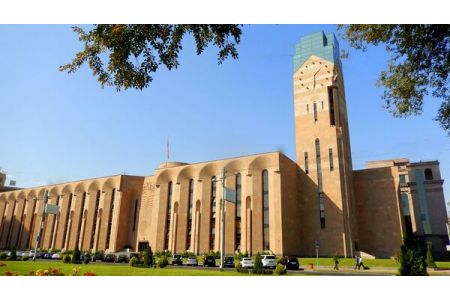 Yerevan City Hall is considering introducing a valet parking system in the city
 Expert: The circus surrounding the “Albanization” of Armenian culture in the presence of foreign ambassadors in occupied Artsakh is genocide
 Political scientist: If Russian-Armenian relations are destroyed, Turkey will take Russia`s place
 Political scientist: The Armenian public is simply obliged to significantly change the entire content of public discourse and struggle
 Cross tattoos are being removed from the skin of Christian prisoners in Azerbaijan by fire, according to a human rights activist.
 Zakharova: Armenia`s likely introduction of visas with Russia will be a step against Yerevan itself
 Putin: Armenia`s recognition of Karabakh as part of Azerbaijan in Prague has given Russia`s position on this issue an ambivalent character
 Putin: Armenia`s adoption of the law on EU accession means an announcement of its withdrawal from the Eurasian Economic Union
 Aram Vardevanyan: Public demands solutions, not apology scandals in Parliament