

ArmInfo. The Armenian authorities' actions aimed at weakening the Armenian Apostolic Church (AAC) coincide with anti-Armenian agendas in the region and contribute to the interests of forces seeking to destroy the foundations of Armenian identity.
This is stated in a statement received by ArmInfo from the Council of the National Democratic Pole (NDP), in connection with the Armenian authorities' recent anti-church actions. "In recent days, we have observed alarming steps by the current regime aimed at increasing pressure on the Holy Armenian Apostolic Church (AAC). Of particular concern is the termination of the activities of the Spiritual Primacy of the AAC in the Armenian Armed Forces by decree of Defense Minister Suren Papikyan. These clergy have stood by the servicemen for many years, supporting them during the most difficult moments of their service, during wartime and post-war trials. This step deals a serious blow to the spiritual security of soldiers and weakens the spiritual and moral environment within the Armed Forces," the NDP believes.
The Council also condemned the initiation of criminal cases aimed at restricting the free movement of high- ranking AAC clergy and preventing their participation in the Episcopal Assembly scheduled in Austria for February 16-19. The NDP called these actions interference in the affairs of the Church and its canonical life. "These actions fit into the broader policy of Armenian Prime Minister Nikol Pashinyan, who, under the guise of 'church reform,' in reality seeks to undermine the independence of the Armenian Apostolic Church and turn it into a structure dependent on the government, having lost its authority and national mission," the NDP emphasized.
In this regard, the Council recalled that the Constitution of Armenia clearly enshrines the principle of separation of Church and State, meaning that the state has no right to interfere in matters of church governance and internal affairs. The NDP expressed its conviction that the current actions constitute a gross violation of the Constitution of Armenia and internationally recognized principles of religious freedom and human rights. "The Armenian Apostolic Church has been a key element of the Armenian people's existence and resistance for centuries, and any attack on it strikes a blow to the entire nation. We call on civil society organizations and international partners not to remain silent and to clearly assess this dangerous policy being carried out against the Armenian Apostolic Church. Armenian society must remain vigilant in the face of existing threats and remain loyal to the Armenian Apostolic Church and its leadership," the Council concluded.
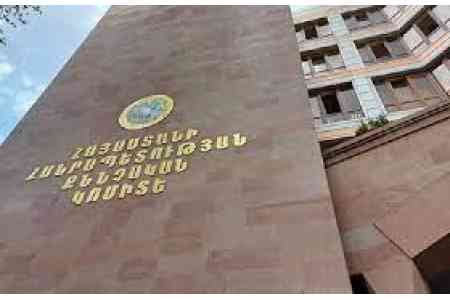
As a reminder, on January 31, six representatives of the Supreme Spiritual Council and the secretary recording the Council's meeting were summoned to the Investigative Committee as defendants under Part 2 of Article 507 (failure to execute a judicial act or obstruction of its execution, committed through the use of official authority - ed.). They were placed under travel restrictions.
The Mother See of Etchmiadzin condemned the authorities' latest interference in the internal affairs of the Armenian Church, recalling that it violates the Constitution of Armenia. The Armenian Apostolic Church stated that the persecution of members of the Supreme Spiritual Council, in particular the travel ban, is a gross violation of fundamental human rights enshrined in both Armenian state laws and international treaties. The Armenian Church expressed its conviction that the goal is to undermine the normal activities of the Armenian Apostolic Church, including obstructing the episcopal convocation scheduled to take place in Austria. In this regard, the Armenian Apostolic Church called on the Armenian authorities and law enforcement agencies to act exclusively within the framework of the country's Constitution and legislation, to uphold the highest principles of justice and truth, and to respect the Armenian Apostolic Church's right to autonomy.
Earlier, the Investigative Committee of Armenia, in violation of the Armenian Constitution, opened a criminal case following the decision of His Holiness Karekin II to defrock Bishop Gevorg Saroyan, who had joined the Armenian authorities' anti-church campaign.


















 Expert: Current process is not about peace, but implementing Azerbaijan`s wishlist
 Expert: Real peace unattainable until Armenia-Azerbaijan agreement is signed and ratified
 TRIPP`s proximity to Iranian border could slow its implementation - expert
  Who and why is sacrificing RA National Security Service`s reputation? - expert
  Tehran creating security environment in which sustainable shipping in Strait of Hormuz difficult to imagine without its direct participation - expert
  Arrested Armenian oligarch on economy and new jobs
  NA Vice Speaker candidate believes his wife`s salary as director of HayPost is the lowest in the company`s history
 RF Permanent Representative: There is no CSTO-Armenia conflict
 Moscow: NATO seeking to "Pull" Armenia away from CSTO Allies
  Political analyst: Russia intends to determine which "Camp" Armenia will choose through a referendum
 Narek Karapetyan will give up his parliamentary salary in favor of charitable contributions.
 Armenian analyst: Developing relations with Europe and the U.S. must not jeopardize relations with regional powers
 Armenia and France discuss further development of strategic partnership and EU cooperation
  To overcome risks Armenia must reduce domestic escalation - expert
  Zatulin: Pashinyan was eager to get back to Russia because he actually lost the elections
 Human rights activist Ruben Melikyan dismissed from YSU
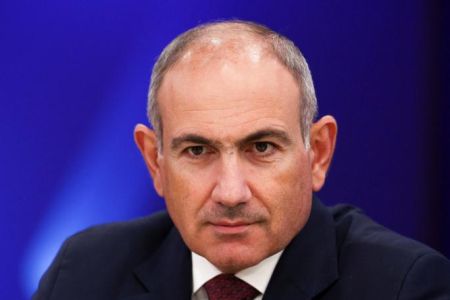 Pashinyan removed from INNOPROM guest list
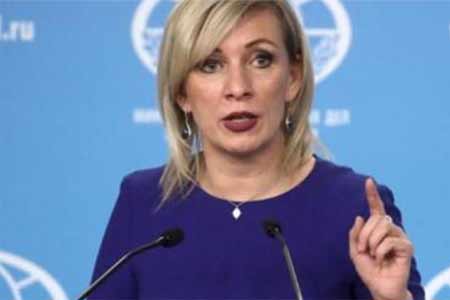 Zakharova: Armenia`s pro-EU pivot poses economic security risks to EAEU member states
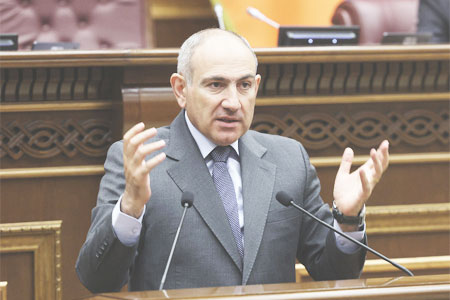 It`s time for South Caucasus countries to think of South Caucasus as single, unified region - RA premier
  Pashinyan: Armenia and Azerbaijan should leave each other alone