

ArmInfo.The law firm Amsterdam and Partners LLP expresses serious concern regarding recent developments in Armenia related to judicial and political interference in the internal governance of the Armenian Apostolic Holy Church (AACC).
The law firm's statement emphasizes that the use of a secular court to review ecclesiastical decisions of the Mother See of Etchmiadzin, particularly in matters of church discipline, represents a profound deviation from the constitutional order of Armenia and from established European legal norms governing the separation of church and state.
"This case arose from the removal of Bishop Gevorg Saroyan from his position as head of the Masyatsotn Diocese by the See of Holy Etchmiadzin. Instead of pursuing the legal remedies provided by Church canon law, Bishop Saroyan initiated proceedings in a secular court, challenging the Church's internal decision. On January 27, the Church officially defrocked him for violating his vow of obedience and for referring a sacred ecclesiastical dispute to a secular court. Despite this, Vice-President of the Armenian Parliament Ruben Rubinyan publicly declared the Church's decision "invalid," declared that the defrocked cleric "remains a bishop," and launched personal attacks against His Holiness Catholicos Karekin II, downplaying his spiritual authority and calling him an "opposition politician," Amsterdam & Partners recalled.
It is emphasized that the most serious problem is not rhetorical, but institutional: a secular court was asked to rule on disciplinary cases against the Catholicos, the highest spiritual authority of the Armenian Apostolic Holy Church. Such judicial review is fundamentally incompatible with the 2015 Constitution of the Republic of Armenia. Article 17(1) guarantees freedom of religion, and Article 17(2) explicitly provides that "religious organizations shall be separated from the state." Article 18(1) goes further, recognizing and protecting the exclusive mission of the Armenian Apostolic Holy Church as the national church, playing a central role in the spiritual life, culture, and national identity of the Armenian people. "These provisions are reinforced by the Armenian Law on Freedom of Conscience and Religious Organizations, which prohibits state interference in the internal affairs of religious organizations and explicitly prohibits state bodies or officials from exercising authority over church structures. It is important to note that Armenian legislation does not merely symbolically recognize the Armenian Apostolic Holy Church; it affirms its self-governance," the law firm emphasized.
Amsterdam & Partners notes that the decision to defrock a bishop lies at the very core of this sacred authority. Allowing secular courts to overturn or review such decisions would deprive these constitutional guarantees of any practical meaning. "This principle is neither new nor unique to Armenia. In European constitutional systems, secular courts have consistently refrained from considering internal matters of religious discipline and doctrine. The courts of Germany, France, Italy, Spain, and the United Kingdom have repeatedly affirmed that disputes concerning the status of clergy, ordination, or discipline fall outside the jurisdiction of civil courts, except in narrowly defined cases concerning purely civil rights. The European Court of Human Rights has also ruled that state interference in the internal governance of churches violates Article 9 of the European Convention on Human Rights, which protects the autonomy of religious communities as an integral element of freedom of religion," the statement continues.
In this vein, it is emphasized that, against this legal backdrop, any attempt by Armenian courts or political authorities to invalidate the ecclesiastical decisions of Holy Etchmiadzin constitutes a blatant violation of the Armenian Constitution, Armenia's domestic legislation, and its binding international obligations.
Amsterdam & Partners LLP expressed their conviction that the Investigative Committee of Armenia's initiation of criminal proceedings against the Armenian Apostolic Church and the Catholicos is part of a broader pattern of behavior by Prime Minister Nikol Pashinyan's government aimed at undermining the autonomy of the Armenian Apostolic Church and the authority of the Catholicos, which directly contradicts Armenia's constitutional framework and international obligations guaranteeing freedom of religion or belief. "The law firm Amsterdam & Partners LLP will raise these issues at the upcoming International Religious Freedom Summit, scheduled for February 2-3, where the firm will call on Armenian state institutions to immediately cease judicial and political interference in the internal governance of the Armenian Apostolic Church, respect the constitutional separation of church and state, and bring state practices into line with both Armenian law and European democratic standards," the firm concluded.
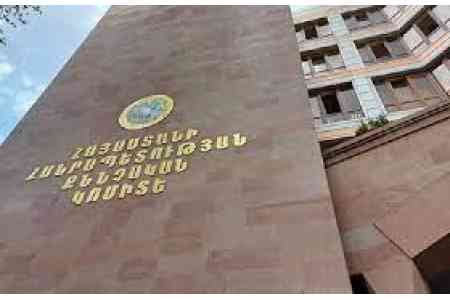
On January 29, it was reported that the Investigative Committee of Armenia had opened a criminal investigation into the failure to enforce a court decision, following an order by His Holiness Karekin II, Catholicos of All Armenians, on the advice of the Supreme Spiritual Council, to defrock the former head of the Masyatsotn Diocese of the See of Holy Etchmiadzin, Gevorg Saroyan.
























 Expert: Current process is not about peace, but implementing Azerbaijan`s wishlist
 Expert: Real peace unattainable until Armenia-Azerbaijan agreement is signed and ratified
 TRIPP`s proximity to Iranian border could slow its implementation - expert
  Who and why is sacrificing RA National Security Service`s reputation? - expert
  Tehran creating security environment in which sustainable shipping in Strait of Hormuz difficult to imagine without its direct participation - expert
  Arrested Armenian oligarch on economy and new jobs
  NA Vice Speaker candidate believes his wife`s salary as director of HayPost is the lowest in the company`s history
 RF Permanent Representative: There is no CSTO-Armenia conflict
 Moscow: NATO seeking to "Pull" Armenia away from CSTO Allies
  Political analyst: Russia intends to determine which "Camp" Armenia will choose through a referendum
 Narek Karapetyan will give up his parliamentary salary in favor of charitable contributions.
 Armenian analyst: Developing relations with Europe and the U.S. must not jeopardize relations with regional powers
 Armenia and France discuss further development of strategic partnership and EU cooperation
  To overcome risks Armenia must reduce domestic escalation - expert
  Zatulin: Pashinyan was eager to get back to Russia because he actually lost the elections
 Human rights activist Ruben Melikyan dismissed from YSU
 Pashinyan removed from INNOPROM guest list
 Zakharova: Armenia`s pro-EU pivot poses economic security risks to EAEU member states
 It`s time for South Caucasus countries to think of South Caucasus as single, unified region - RA premier
  Pashinyan: Armenia and Azerbaijan should leave each other alone