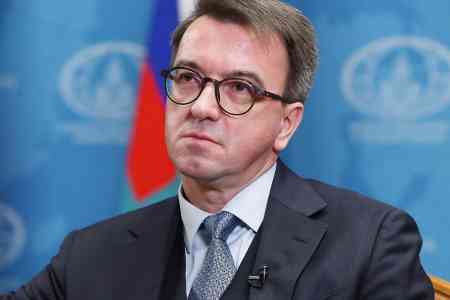
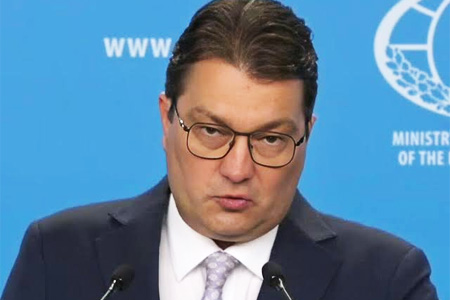
ArmInfo. At a certain point, the EU leadership will demand Armenia's full political solidarity, including with Brussels' anti-Russian policies. This was stated by Vladislav Maslennikov, Director of the Department of European Affairs at the Russian Foreign Ministry, in an interview with TASS.
"At a certain point, Brussels begins to demand full solidarity with its foreign policy, which is currently openly anti-Russian, from any candidate country," the diplomat said, commenting on Armenia's plans for European integration.
He also expressed hope that Yerevan understands that even meeting all of Brussels' demands does not guarantee EU membership. Maslennikov cited the Western Balkans as an example, "which have been 'in line for EU membership' for decades (Albania since 2000, North Macedonia since 2004, Montenegro since 2008, and Serbia since 2009), fulfilling the strict demands of European bureaucrats, often extremely unpopular with the population, but still getting no closer to fulfilling their 'Euro-dream.'" "It's also worth remembering that, in reality, EU membership, especially given its current state, by no means guarantees prosperity for candidate countries." "The economic indicators and demographic situation in the Baltic states, which recently celebrated 20 years of membership in the European Union, are, to put it mildly, unimpressive," he emphasized.
At the same time, he acknowledged that Armenia's forced rapprochement with the European Union would have negative consequences both for its alliance with Russia and for the development of integration processes throughout the post-Soviet space.
Commenting on Yerevan's intention to join the European Union, he noted that, given the EU's rapid transformation into an aggressive military-political bloc and its strategic course aimed at confrontation with Russia, "Armenia's interest in membership in this organization cannot but raise concern."
"We hope that Armenia, as a member of the Eurasian Economic Union (EAEU), understands the potential negative consequences of a forced rapprochement with Brussels, both for our allied relations and for the development of integration processes in the post-Soviet space," Maslennikov emphasized.
At the same time, the head of the Russian Foreign Ministry's Department of European Affairs reiterated that Russia respects the sovereign right of other states to participate in integration associations, and especially "their desire to gain additional opportunities for economic development and improve the well- being of their own populations." However, the Armenian leadership "has clearly signaled its interest in maximizing rapprochement with the European Union." "In line with these efforts, in April 2025, the country's President Vahagn Khachaturyan signed the law 'On the commencement of the process of accession of the Republic of Armenia to the European Union,' previously approved by parliament," he recalled.
Thus, according to Maslennikov, Brussels has already begun "actively pushing Yerevan to adopt a politically motivated transition to EU standards, which fundamentally disregards the membership of this Transcaucasian republic in the EAEU and the obligations associated with it."
"The fact remains that simultaneous membership in both the EAEU and the EU is by definition impossible," the diplomat stated.







 Analyst: The primary issue with Armenia`s new Parliament Speaker`s speech lies is its one-sided interpretation of the causes of the political crisis
 Expert: Gagik Tsarukyan embodies post-Soviet model of big business-state relations; this model is used in many other post-Soviet countries
 Expert: Azerbaijan promoting aggressive plans against Armenia at state level
 Iranologist: Baku`s propaganda of might masks the country`s inability to provide water to its own population
 NA Vice Speaker candidate believes his wife`s salary as director of HayPost is the lowest in the company`s history
 RF Permanent Representative: There is no CSTO-Armenia conflict
 Moscow: NATO seeking to "Pull" Armenia away from CSTO Allies
  Political analyst: Russia intends to determine which "Camp" Armenia will choose through a referendum
 Narek Karapetyan will give up his parliamentary salary in favor of charitable contributions.
 Armenia and France discuss further development of strategic partnership and EU cooperation
  To overcome risks Armenia must reduce domestic escalation - expert
  Zatulin: Pashinyan was eager to get back to Russia because he actually lost the elections
 Human rights activist Ruben Melikyan dismissed from YSU
 Zakharova: Armenia`s pro-EU pivot poses economic security risks to EAEU member states
 It`s time for South Caucasus countries to think of South Caucasus as single, unified region - RA premier
  Pashinyan: Armenia and Azerbaijan should leave each other alone
 Moscow sees situation with Armenia as attempt to attack Russia-involving integration associations - Russian presidential aid