
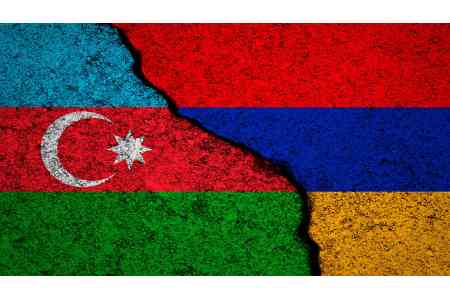
ArmInfo. The likelihood of a military escalation between Armenia and Azerbaijan in 2026 has significantly decreased, while the likelihood of a peaceful settlement has increased as a result of intensive high-level bilateral negotiations in 2025, as well as the signing of the Washington Declaration and the Agreement on the Establishment of Peace and Interstate Relations, reached with the active participation of US President Donald Trump on August 8. This is stated in the 2026 Annual External Risks Report of the Republic, published by the Foreign Intelligence Service (SVR) of Armenia.
"As a result of a comprehensive analysis of the aforementioned and related processes and data, we consider it virtually unlikely that a military escalation of varying magnitude between Armenia and Azerbaijan for military-political reasons will occur in 2026. We also consider localized actions or incidents unrelated to military-political motives to be unlikely," the report states regarding relations between Armenia and Azerbaijan. At the same time, the Armenian Foreign Intelligence Service believes that 2026 will most likely see further progress in the process of border demarcation and delimitation between the two countries, bilateral trade and economic initiatives, intersocio-cultural dialogue, humanitarian and other issues.
"Even if regional infrastructure is unblocked, progress will likely be recorded in processes already underway, and Armenia's bilateral initiatives to develop transport infrastructure with neighboring countries will stimulate the implementation of larger-scale regional economic projects," the report continues.
"However, at the same time, in 2026, the risks of malicious actions by states pursuing their own influence and growing interests in our region, directed against these transport infrastructure development processes, will increase. And the consistent use by Azerbaijan and other actors of malicious discourses and concepts that question Armenia's sovereignty and impede the implementation of transport infrastructure development programs will only contribute to the materialization of these risks," the Armenian Foreign Intelligence Service added.
It is also emphasized that the Service's comprehensive analysis shows that the discourse about so-called "Western Azerbaijan" and the "return of Western Azerbaijanis," promoted by Azerbaijan at the state level, and its accompanying actions, constitute a significant negative and risky factor for long-term peacebuilding. It is noted that the Service's data show that Azerbaijan has not only failed to reduce, but has significantly intensified this propaganda since the Washington Declaration, which poses a significant threat to regional stability, security, and long-term peace. "In 2026, one of the Service's priority tasks will be to continuously assess the actual purpose of Azerbaijan's state policy of promoting the 'return of Western Azerbaijanis.' Specifically, it will assess whether Azerbaijan, by transforming these themes into a new national ideology, intends to transfer the conflict to Armenia in some new format, or whether talk of the so- called 'return of Western Azerbaijanis' is part of Azerbaijan's foreign policy bargaining and, in particular, a tool to counter the return of Karabakh Armenians," the Armenian Foreign Intelligence Service report notes.
Following the forcible seizure of Artsakh in the fall of 2023, Azerbaijani authorities began actively promoting the narrative of the 'return of Azerbaijanis to their homeland in Western Azerbaijan.' Moreover, this homeland is defined as the entire territory of Armenia. Azerbaijani authorities falsify historical data and present the entire territory of Armenia as "historical Azerbaijani lands."





























 Expert: Current process is not about peace, but implementing Azerbaijan`s wishlist
 Expert: Real peace unattainable until Armenia-Azerbaijan agreement is signed and ratified
 TRIPP`s proximity to Iranian border could slow its implementation - expert
  Who and why is sacrificing RA National Security Service`s reputation? - expert
  Tehran creating security environment in which sustainable shipping in Strait of Hormuz difficult to imagine without its direct participation - expert
  Arrested Armenian oligarch on economy and new jobs
  "In Baku, we gave a worthy rebuff to the false claims regarding the past and present of our people" – Former Artsakh Parliament Speaker from Baku captivity
  NA Vice Speaker candidate believes his wife`s salary as director of HayPost is the lowest in the company`s history
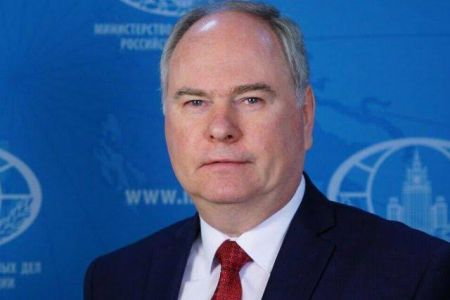 RF Permanent Representative: There is no CSTO-Armenia conflict
 Moscow: NATO seeking to "Pull" Armenia away from CSTO Allies
  Political analyst: Russia intends to determine which "Camp" Armenia will choose through a referendum
 Narek Karapetyan will give up his parliamentary salary in favor of charitable contributions.
 Armenian analyst: Developing relations with Europe and the U.S. must not jeopardize relations with regional powers
 Armenia and France discuss further development of strategic partnership and EU cooperation
  To overcome risks Armenia must reduce domestic escalation - expert
 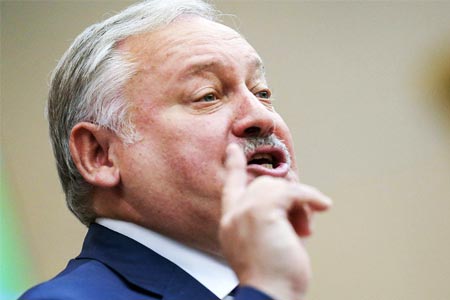 Zatulin: Pashinyan was eager to get back to Russia because he actually lost the elections
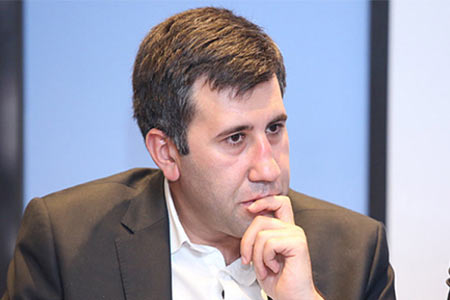 Human rights activist Ruben Melikyan dismissed from YSU
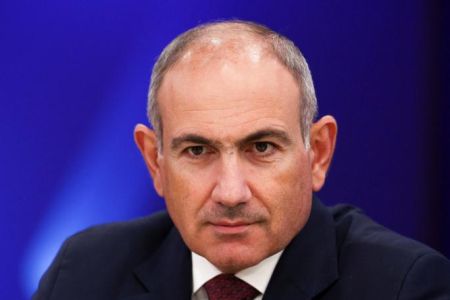 Pashinyan removed from INNOPROM guest list
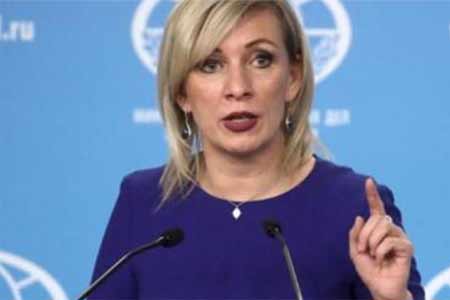 Zakharova: Armenia`s pro-EU pivot poses economic security risks to EAEU member states