
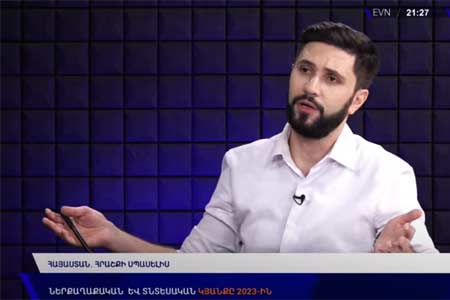
ArmInfo. The Washington meeting served primarily as a signal to Iran that Armenia is not an ally of Tehran and that the border could be closed at any moment. This was the reaction of political scientist and commentator Benjamin Matevosyan on his Telegram channel to the joint statement by the Armenian and US governments regarding the framework for implementing the Trump Roadmap to International Peace and Prosperity (TRIPP), published by the Armenian Foreign Ministry.
The analyst first presented the main agreements reached between Armenia and the US within the TRIPP framework. He pointed out under the document, Prime Minister Nikol Pashinyan handed over 74% of the TRIPP project to the US for 49 years, noting that it allows for the merging of project shares or even gifting them. This means, as the expert explained, the US could take 100% of the project and then gift the Armenian 26% to "friends" of US Ambassador to Turkey Tom Barrack. "And it's unlikely that Pashinyan's government would strongly resist this," Matevosyan believes.
He then noted that Armenia is providing both the territory and, if necessary, the investment for the project. This means that much of the construction should be financed by Armenia, but 74% of the revenue goes to the US, and Azerbaijan reaps the benefits. "Azerbaijani President Ilham Aliyev, for his part, did not want to see Armenians at border customs checkpoints, and the joint declaration 'wrapped' this desire in 'overseas terminology': a front office and a back office, where Armenians will not communicate with Azerbaijanis who receive unimpeded passage. It's worth noting that 'unimpeded passage' is precisely what Baku insisted on in the context of the so-called 'Zangezur Corridor.' The use of this term in the document with the US confirms that Pashinyan is fulfilling Aliyev's demands, simply through a 'mediator.' Aliyev has once got what he wanted from Pashinyan," the political scientist continued.
He also noted that the Armenian government essentially preferred this document over the statement of November 9, 2020, after having surrendered Artsakh in Prague in 2022. "The TRIPP project in its current form is a logical continuation of the 2022 Prague agreements. Having surrendered Artsakh under the pretext of 'saving Armenia's sovereignty,' Pashinyan is now surrendering Armenia itself, packaging his capitulation in the bright wrapping of 'Western investment,'" Matevosyan claims.
He then drew attention to the timing of the signing in the context of regional events. Matevosyan expressed conviction that all of this fits within the logic of Armenia's integration into an anti-Iran coalition. In this regard, he recalled that the United States is currently taking an open course toward dismantling the Iranian regime: imposing unprecedented sanctions on countries doing business with Tehran, while Trump calls on protesters to seize administrative buildings effectively puts the region on the brink of a major war, openly raising the prospect of military strikes against Iran. "In response, Tehran is directly declaring that any form of institutional US presence in the region, military bases, and Israel will become legitimate military targets. And it is at this very moment, when the air in the region is charged to the breaking point, that Pashinyan signs a document that personally brings the Americans to the Armenian-Iranian border.
"The current government operates according to the logic of those very same 'sleeper cells' who, having waited for the hour of reckoning, are burning mosques in Iran today. Meanwhile the Armenian authorities are stabbing the region's stability and centuries-old good-neighborly relations in the back," the expert noted.
In this regard, the political scientist mentioned that while the United States is an ocean away, Iran remains Armenia's eternal neighbor. He noted that ignoring this fundamental truth is not simply a mistake or incompetence. "In seven and a half years, we could have learned to listen to the pulse of history.What we are seeing today is deliberate, targeted sabotage, the price of which is the security and very existence of Armenia," Matevosyan emphasized.
In conclusion, the political scientist noted that, with this document of January 14, Armenia essentially stated its willingness to limit its sovereignty to 26 percent and expressed its willingness to give Aliyev what he wants: the absence of Armenians at the border and customs. Regarding the wording, the political scientist clarified that it is a frequently used diplomatic trick, necessary to avoid ratification in parliament "if necessary," while still allowing political processes to be launched, as well as to outline Armenia's geopolitical lines and priorities.
"The lack of legal obligations in this case can only serve as a ploy, allowing Pashinyan's government to avoid accusations of directly violating the Constitution, while in practice, Armenia becomes part of someone else's geopolitical scenario, directed against its regional neighbor and its own national interests. The Washington meeting was needed primarily as a signal to Iran that Armenia is not an ally of Tehran and that the border could be closed at any moment," Matevosyan concluded.
Earlier, the Armenian Foreign Ministry published a document outlining the procedures for implementing the Trump Route for International Peace and Prosperity (TRIPP) project. The document was presented following the Mirzoyan-Rubio meeting in Washington. It is noted that the document is a new step toward fulfilling the commitments made at the White House on August 8, 2025, to promote lasting peace in the South Caucasus. It is emphasized that it outlines the framework for implementing TRIPP.






















 Iranologist: Baku`s propaganda of might masks the country`s inability to provide water to its own population
 Analyst: Continued tensions between Yerevan and Moscow could entail new restrictive measures from Russia
 Political analyst: Russia intends to determine which "Camp" Armenia will choose through a referendum
 Armenia and France discuss further development of strategic partnership and EU cooperation
  To overcome risks Armenia must reduce domestic escalation - expert
  Zatulin: Pashinyan was eager to get back to Russia because he actually lost the elections
 Human rights activist Ruben Melikyan dismissed from YSU
 Pashinyan removed from INNOPROM guest list
 Zakharova: Armenia`s pro-EU pivot poses economic security risks to EAEU member states
 It`s time for South Caucasus countries to think of South Caucasus as single, unified region - RA premier
  Pashinyan: Armenia and Azerbaijan should leave each other alone
 Moscow sees situation with Armenia as attempt to attack Russia-involving integration associations - Russian presidential aid
 Zakharova: Armenia views relations with Russia as tool for financially securing reorientation toward EU
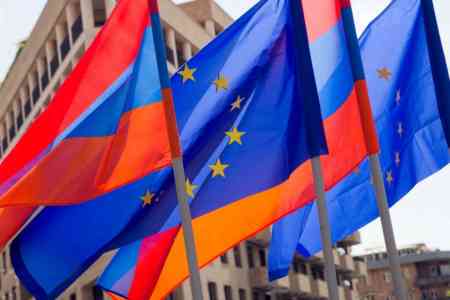 The Armenian Minister of Justice and the EU Ambassador discussed visa liberalization issues for Yerevan.
 Azerbaijan`s aggressive plans against Armenia became possible in wake of Pashinyan`s decisions on Artsakh - expert
  Zakharova: Russia sent a note of protest to Armenia over the act of vandalism at the "Mother Armenia" memorial in Gyumri