

ArmInfo.The Ishkhanutyun news outlet has discovered a "top- secret" document signed by Prime Minister Nikol Pashinyan, according to which approximately 3 billion drams, not including the so-called 13th salary, were distributed from the state budget bonus fund to pro- government officials during the pre-New Year period. Journalist Lia Sargsyan reported this on her Facebook page.
She noted that the document, which had nothing to do with state security matters, contained an 8th clause marked "top secret." The journalist reported that, according to a document obtained by the publication, hundreds of millions of drams were received by nearly all key government agencies: the Ministries of Finance, Defense, Health, Justice, Foreign Affairs, Internal Affairs, Education, Science, Culture and Sports, Economy, High-Tech Industry, the State Revenue Committee, the State Cadastre, and others.
"Not only ministers and deputy ministers were awarded, but also heads of departments and divisions, and in some cases, even ministerial spokespersons and their drivers. Thus, department heads received approximately 1.5-2 million drams, department heads 2.5-3 million drams, deputy ministers 3.5-4.5 million drams, and ministers up to 6-7 million drams. "This means that in one day, the ministers received an amount equivalent to 14 years of pension, or approximately eight years' earnings for a citizen earning the average salary in the country," Sargsyan noted.
The journalist noted that this decision was essentially made in the context of widespread price increases, a survival regime for citizens with salaries of 80,000 drams and pensions of 36,000 drams, and deepening social poverty. "This process, supported by legislation, is morally unacceptable and was carried out at the expense of the citizens themselves," she said.
Sargsyan expressed her conviction that the document's secrecy was necessary to conceal this information from the public, and to prevent citizens from subsequently comparing their salaries and pensions with the millions reaped by the ruling elite. "When in 2026 the authorities again try to convince people that poverty is 'in the minds of the citizens,' it's worth remembering these figures: 3 billion drams for government officials, and zero for ordinary employees, pensioners, the families of fallen servicemen, and soldiers disabled in the war. This isn't an opinion, it's a document, and it was funded by citizens' taxes," the journalist concluded.
According to the Statistical Committee of Armenia, inflation in the Armenian consumer market accelerated to 3.3% in January-December 2025 (from 1.5% in 2024). This was driven by a 4.6% increase in food prices and a 3.1% increase in service tariffs, with a slight increase in non-food prices of 0.9%. Meanwhile, according to a study conducted by the Friedrich-Ebert-Stiftung in collaboration with the Confederation of Trade Unions of Armenia (late 2025 - ed.) on "Minimum Wage and Socioeconomic Reality in the Republic of Armenia," 65.1% of the Armenian population cannot afford a healthy diet. As public and social policy expert Ruben Markosyan noted, according to these data, productivity and the economy in the country are not at a level that would make the average wage acceptable. Recalling that the minimum wage is indexed based on the average, he noted that the gap between them is colossal. Specifically, citing data from the Statistical Committee, the expert noted that in July-August, the average salary in Armenia was 295,000 drams, while the minimum wage is only 75,000 drams.
On December 3, Pashinyan expressed doubt from the parliamentary rostrum that pensioners are capable of wisely managing their finances and spending their money. "So, we're thinking, let's increase pensions by 10-11 thousand drams. What will pensioners do with it? What will they spend it on? Our research shows that citizens' top expenditure is healthcare. So, why give people this money? So they won't know how to effectively use this money for their health? So they'll go to the pharmacy and buy the wrong thing.
They'll receive the wrong medical care. But we're investing these 10 thousand drams in health insurance, creating a system where they'll likely receive services worth not 10, but 20, 30, 40, 50, or even perhaps 100 thousand drams," he said. At the beginning of 2026, the minimum pension was approximately 36,000 drams, and the average was approximately 49,000 drams. Meanwhile, by the third quarter of 2025, the cost of the minimum (estimated) consumer basket per person was 81,681 drams, and the food (estimated) basket was 44,152 drams.












 Opinion: The development of the Amulsar mine near the resort town of Jermuk is the beginning of an environmental disaster in Armenia
 Expert: The arrest of opposition figures in Armenia for social media posts is a systematic attempt to intimidate the public and suppress dissent.
 Azerbaijani Studies Expert: While Azerbaijan Prepares Its Generation for War, Aliyev’s Aide Calls on Armenia to Prepare Armenian Society for “Peace”
 Turkologist: Azerbaijan will never, under any circumstances, stop pressuring the Armenian people
 Political scientist: We need to move away from the question of "when" and replace it with more important questions
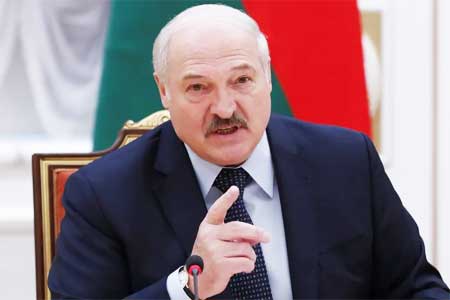 Lukashenko called for Armenia to assume the CIS presidency in 2029
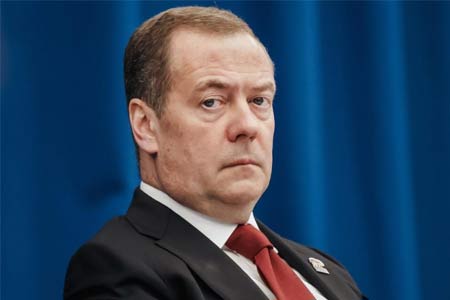 Dmitry Medvedev predicted a Ukrainian-like fate for Armenia amid the country`s shift in foreign policy
 Russian Security Council: In Armenia, they want to force Russian asset owners to dispose of their assets
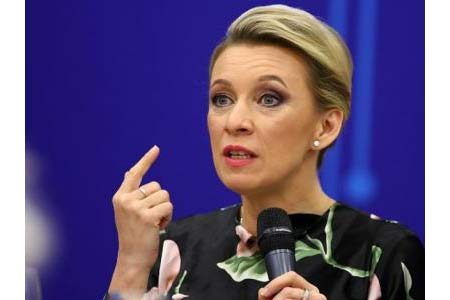 Zakharova: Russia ready to discuss with Armenia the prospects for expanding military cooperation as part of a review of bilateral ties
 Tevanyan: Armenia, like Ukraine and Moldova, is being drawn into the EU’s global war
 Yerevan City Hall is considering introducing a valet parking system in the city
 Expert: The circus surrounding the “Albanization” of Armenian culture in the presence of foreign ambassadors in occupied Artsakh is genocide
 Political scientist: If Russian-Armenian relations are destroyed, Turkey will take Russia`s place
 Political scientist: The Armenian public is simply obliged to significantly change the entire content of public discourse and struggle
 Cross tattoos are being removed from the skin of Christian prisoners in Azerbaijan by fire, according to a human rights activist.
 Zakharova: Armenia`s likely introduction of visas with Russia will be a step against Yerevan itself
 Putin: Armenia`s recognition of Karabakh as part of Azerbaijan in Prague has given Russia`s position on this issue an ambivalent character
 Putin: Armenia`s adoption of the law on EU accession means an announcement of its withdrawal from the Eurasian Economic Union
 Aram Vardevanyan: Public demands solutions, not apology scandals in Parliament