

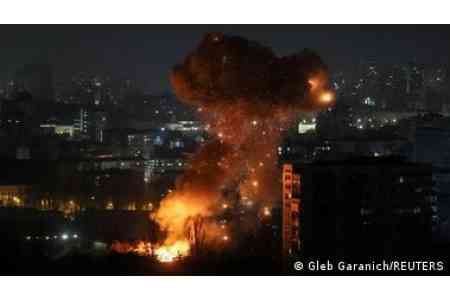
ArmInfo. (DW). Following a combined strike by the Ukrainian Armed Forces (UAF) on the Belgorod Region on the night of Friday, January 9, more than 500,000 residents were left without electricity and heat, and approximately 200,000 without water. Governor Vyacheslav Gladkov reported this on Telegram.
"Based on the enemy's overnight shelling of the Belgorod Region's utility infrastructure, as of 6 a.m. today, 566,000 people in six municipalities are without power, and almost the same number are without heat. This primarily affects 1,920 apartment buildings. Nearly 200,000 people are without water and sanitation," one of his messages reads.
Gladkov also noted that the regional capital, Belgorod, was hit by missile fire, damaging unspecified "infrastructure and commercial facilities." The governor did not specify the number of missiles that attacked the region or their names. Moreover, according to the aftermath report he provided, attacks by 40 Ukrainian UAVs were recorded in five other municipalities in the region, 16 of which were "shot down and suppressed." According to Gladkov, there were no injuries.
In turn, the Russian Ministry of Defense reported the "interception and destruction" of five Ukrainian fixed-wing UAVs by air defense systems, only one of which was shot down over the Belgorod Region. According to the ministry, two more were shot down over the Bryansk Region, and one each over the Rostov and Oryol Regions.
It should be noted that the Russian army attacked Kyiv and Lviv overnight. In the Lviv Region, a critical infrastructure facility was damaged as a result of the Russian strike, according to Maksym Kozitsky, head of the regional military administration (OVA). According to Ukrainian media, the Russian army may have targeted the Stryiske gas field and an underground gas storage facility. The Ukrainian Air Force stated that the missile fired at Lviv was traveling at 13,000 kilometers per hour. There is no official confirmation yet of the use of the Oreshnik missile.














 Expert: Economic pressure on Armenia may be virtually painless for other EAEU members, but not for Armenia itself
 Expert on protests in France: Civilizations fade when society loses a vision of the future
 Turkologist: Azerbaijan is not all-powerful—its vulnerabilities should become part of Armenia’s security strategy
 Opinion: The development of the Amulsar mine near the resort town of Jermuk is the beginning of an environmental disaster in Armenia
 Expert: The arrest of opposition figures in Armenia for social media posts is a systematic attempt to intimidate the public and suppress dissent.
 The Armenian Foreign Minister commented on the country`s return to work within the CSTO.
 The Artsakh Public Council expressed outrage at the UN Secretary-General`s behavior
 Lukashenko called for Armenia to assume the CIS presidency in 2029
 Dmitry Medvedev predicted a Ukrainian-like fate for Armenia amid the country`s shift in foreign policy
 Russian Security Council: In Armenia, they want to force Russian asset owners to dispose of their assets
 Zakharova: Russia ready to discuss with Armenia the prospects for expanding military cooperation as part of a review of bilateral ties
 Tevanyan: Armenia, like Ukraine and Moldova, is being drawn into the EU’s global war
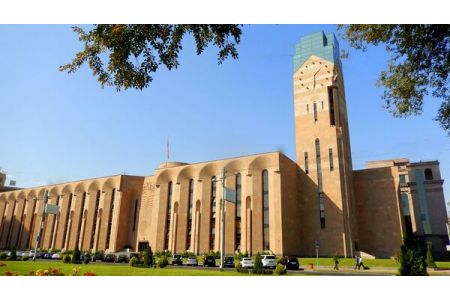 Yerevan City Hall is considering introducing a valet parking system in the city
 Expert: The circus surrounding the “Albanization” of Armenian culture in the presence of foreign ambassadors in occupied Artsakh is genocide
 Political scientist: If Russian-Armenian relations are destroyed, Turkey will take Russia`s place
 Political scientist: The Armenian public is simply obliged to significantly change the entire content of public discourse and struggle
 Cross tattoos are being removed from the skin of Christian prisoners in Azerbaijan by fire, according to a human rights activist.
 Zakharova: Armenia`s likely introduction of visas with Russia will be a step against Yerevan itself
 Putin: Armenia`s recognition of Karabakh as part of Azerbaijan in Prague has given Russia`s position on this issue an ambivalent character
 Putin: Armenia`s adoption of the law on EU accession means an announcement of its withdrawal from the Eurasian Economic Union