


ArmInfo.A new systems map from Khachkar Studios challenges Armenian Christian institutions to reconsider how health and success are defined. The analysis replaces anecdotal confidence with measurable performance across the ecosystem.
According to the study, only 3 percent of Armenian Americans regularly attend church outside holidays. This figure is grounded in verified attendance data rather than surveys or self-reporting. Yet many leaders assume engagement is far higher.
Khachkar Studios argues that this misalignment has shaped institutional behavior for decades. Without accurate baselines, leaders cannot identify problems or prioritize reform.
The systems map evaluates 12 body parts using defined performance indicators. These include worship participation, youth engagement, Bible engagement, leadership household formation, philanthropy, and media presence. On several indicators, performance is effectively zero.
Youth retention emerges as one of the most severe failures. Only 1 percent of Armenians aged 18 to 29 remain “Faithful”, despite strong participation in Armenian schools. The analysis characterizes this as a breakdown in continuity rather than a generational rejection of faith.
The absence of structured management practices is a recurring theme. Churches do not track outcomes, donors lack performance data, and institutions operate without feedback loops. As a result, ineffective patterns persist.
Media and cultural production reinforce these dynamics. Over many decades, Armenian films, documentaries, and news outlets have devoted minimal attention to religious life, further marginalizing the ecosystem’s spiritual core.
Khachkar Studios emphasizes that low performance also implies high potential. When systems lack discipline, even modest improvements can yield significant gains.
The analysis’ message is clear. Renewal begins with measurement.










 Expert: Economic pressure on Armenia may be virtually painless for other EAEU members, but not for Armenia itself
 Expert on protests in France: Civilizations fade when society loses a vision of the future
 Turkologist: Azerbaijan is not all-powerful—its vulnerabilities should become part of Armenia’s security strategy
 Opinion: The development of the Amulsar mine near the resort town of Jermuk is the beginning of an environmental disaster in Armenia
 Expert: The arrest of opposition figures in Armenia for social media posts is a systematic attempt to intimidate the public and suppress dissent.
 The Armenian Foreign Minister commented on the country`s return to work within the CSTO.
 The Artsakh Public Council expressed outrage at the UN Secretary-General`s behavior
 Lukashenko called for Armenia to assume the CIS presidency in 2029
 Dmitry Medvedev predicted a Ukrainian-like fate for Armenia amid the country`s shift in foreign policy
 Russian Security Council: In Armenia, they want to force Russian asset owners to dispose of their assets
 Zakharova: Russia ready to discuss with Armenia the prospects for expanding military cooperation as part of a review of bilateral ties
 Tevanyan: Armenia, like Ukraine and Moldova, is being drawn into the EU’s global war
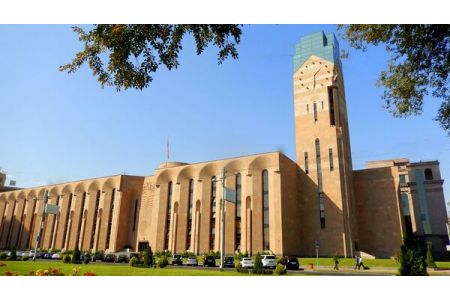 Yerevan City Hall is considering introducing a valet parking system in the city
 Expert: The circus surrounding the “Albanization” of Armenian culture in the presence of foreign ambassadors in occupied Artsakh is genocide
 Political scientist: If Russian-Armenian relations are destroyed, Turkey will take Russia`s place
 Political scientist: The Armenian public is simply obliged to significantly change the entire content of public discourse and struggle
 Cross tattoos are being removed from the skin of Christian prisoners in Azerbaijan by fire, according to a human rights activist.
 Zakharova: Armenia`s likely introduction of visas with Russia will be a step against Yerevan itself
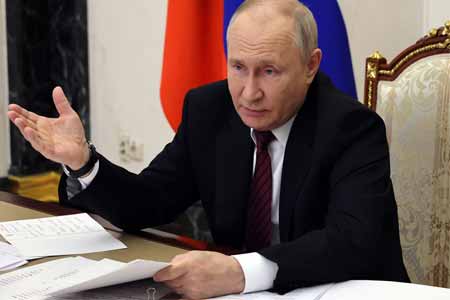 Putin: Armenia`s recognition of Karabakh as part of Azerbaijan in Prague has given Russia`s position on this issue an ambivalent character
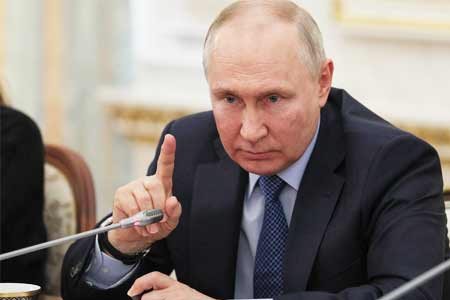 Putin: Armenia`s adoption of the law on EU accession means an announcement of its withdrawal from the Eurasian Economic Union