
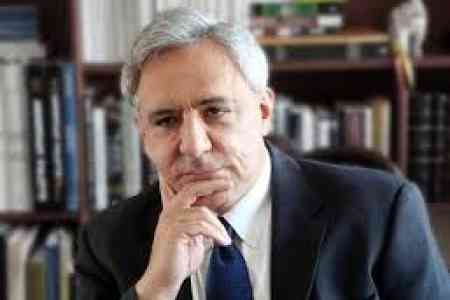
ArmInfo. Former Armenian Foreign Minister Vartan Oskanian responded to Armenian Prime Minister Nikol Pashinyan's remarks about completely closing the Artsakh issue in exchange for Azerbaijan's refusal to promote the so-called "Western Azerbaijan" narrative.
"Nikol Pashinyan made a sensational statement today that threatens Armenia's state interests and the future of the Armenian people. Just as the statement 'Artsakh is Armenia, that's it' in 2019 laid the groundwork for a devastating war, his statement today could in the future serve as the basis for legitimizing new attacks on Armenia's sovereign territory," the diplomat noted in a post on his Facebook page.
"It's simply unbelievable what Pashinyan is 'offering' to the Azerbaijanis: he's urging them to stop calling Armenian territory 'Western Azerbaijan' and to settle Azerbaijanis there, promising in return that the Armenian side will also resolve the issue of the 'return of Karabakh Armenians.' One doesn't need a diplomatic education to understand that there are no parallels between these two topics, neither in terms of international law, nor in terms of international perception, nor in terms of simple logic," Oskanian added. According to him, there are dozens of international conventions and provisions of international law that grant the right of peoples who enjoyed autonomy even during the Soviet era to return to their places of residence from where they were forcibly expelled.
"The return, at a minimum. Any degree of autonomy, at a minimum. Dozens of international platforms, agreements, conventions, and precedents grant the Armenian people the right not only to return to a previously autonomous entity populated predominantly by Armenians, but also to discuss the status of this entity within the framework of international law, right down to the issue of sovereignty.
By equating these topics, Pashinyan has achieved only one "achievement" today: he has paved the way for Azerbaijan to bring to the forefront the issue of its encroachments on Armenia, which lack legitimacy under international law," Oskanian concluded.

















 Expert: Real peace unattainable until Armenia-Azerbaijan agreement is signed and ratified
 TRIPP`s proximity to Iranian border could slow its implementation - expert
  Who and why is sacrificing RA National Security Service`s reputation? - expert
  Tehran creating security environment in which sustainable shipping in Strait of Hormuz difficult to imagine without its direct participation - expert
  Arrested Armenian oligarch on economy and new jobs
  NA Vice Speaker candidate believes his wife`s salary as director of HayPost is the lowest in the company`s history
 RF Permanent Representative: There is no CSTO-Armenia conflict
 Moscow: NATO seeking to "Pull" Armenia away from CSTO Allies
  Political analyst: Russia intends to determine which "Camp" Armenia will choose through a referendum
 Narek Karapetyan will give up his parliamentary salary in favor of charitable contributions.
 Armenian analyst: Developing relations with Europe and the U.S. must not jeopardize relations with regional powers
 Armenia and France discuss further development of strategic partnership and EU cooperation
  To overcome risks Armenia must reduce domestic escalation - expert
  Zatulin: Pashinyan was eager to get back to Russia because he actually lost the elections
 Human rights activist Ruben Melikyan dismissed from YSU
 Pashinyan removed from INNOPROM guest list
 Zakharova: Armenia`s pro-EU pivot poses economic security risks to EAEU member states
 It`s time for South Caucasus countries to think of South Caucasus as single, unified region - RA premier
  Pashinyan: Armenia and Azerbaijan should leave each other alone