
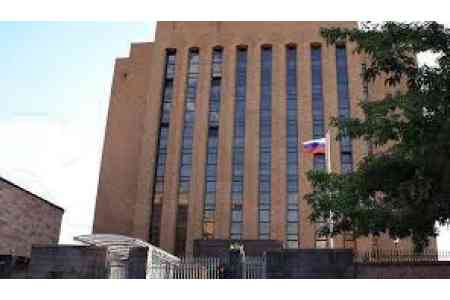
ArmInfo. The Russian Embassy in Armenia honored the memory of the victims of the 1988 earthquake.
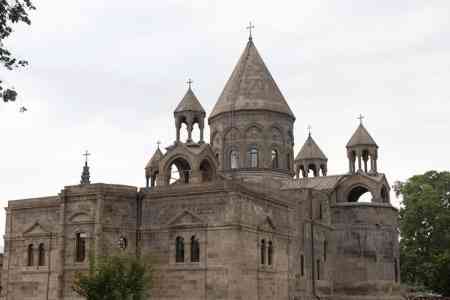
"On December 7, at the monument 'To Innocent Victims, To Merciful Hearts' in the courtyard of the Holy Savior Church, representatives of the Russian House in Gyumri, the 102nd Russian Military Base, and the Leninakan Red Banner Border Detachment honored the memory of the victims of the 1988 Spitak earthquake. Memories of the 1988 tragedy remain vivid, reminding us of the price of human life and the need to remember those who passed too soon. We bow our heads in memory of the innocent victims," the Russian Embassy in Armenia stated in a statement.
On December 7, Armenia remembers the victims of the Spitak earthquake. Thirty-seven years ago, on December 7, 1988, a devastating earthquake struck Armenia. According to official figures, 25,000 people died, almost as many were injured, and 514,000 people lost their homes. Within 30 seconds, the city of Spitak was virtually destroyed, while Leninakan (now Gyumri), Stepanavan, and Kirovakan (now Vanadzor) were devastated. In total, 21 cities and regions of Armenia, as well as 350 villages, were damaged by the earthquake, 58 of which were completely destroyed.
The earthquake began on December 7, 1988, at 11:41 a.m. local time and lasted only 30 seconds. Its magnitude on the Richter scale reached 10 on the Richter scale at its epicenter in Spitak, 9 on the Richter scale in Leninakan, and 8 on the Richter scale in Kirovakan. The village of Nalband, closest to the earthquake's epicenter, was completely buried, and more than 340 other villages and 20 towns were seriously damaged. The magnitude 6 earthquake zone covered a significant portion of the republic, with tremors felt in Yerevan and Tbilisi. The earthquake's tremors circled the globe twice and were recorded by scientific laboratories in Europe, Asia, America, and Australia. The earthquake struck northern Armenia, affecting approximately 40% of its territory.
In the aftermath of the earthquake, various state projects were implemented in Armenia, including those aimed at providing housing to families affected by the earthquake. By 2008, 60,000 families affected by the earthquake had received housing, and from 2008 to 2017, another 4,839 families were provided with housing under the state program. At this point, the government announced that it had completed the program for providing housing to urban families affected by the earthquake, although even at that point, more than 500 families were known to be living in temporary housing in rural areas.
In December 2018, the Armenian government assured that those affected by the 1988 earthquake would receive housing by 2020. In 2019, a government task force conducted an inventory of temporary structures in the Spitak earthquake zone. In the Shirak, Lori, and Aragatsotn regions, there were 7,219 temporary structures housing approximately 25,000 people. On July 26, 2019, authorities announced that 453 affected families would be relocated from temporary structures to new housing. Armenian Prime Minister Nikol Pashinyan announced at the time that approximately $6.3 million was planned for this purpose. However, the pandemic and armed conflict in the fall of 2020 hampered the implementation.









 An Armenian political analyst exposed Hajiyev’s lies and attempts to mislead diplomats accredited in Azerbaijan in occupied Artsakh
 Expert: The circus surrounding the “Albanization” of Armenian culture in the presence of foreign ambassadors in occupied Artsakh is genocide
 An Armenian historian harshly criticized the visit of Western coalition diplomats to occupied Artsakh
 Armenian expert: TRIPP and European integration are incompatible
 Azerbaijani studies expert : Ruben Vardanyan’s wife threatened with arrest if she visits Baku
 Political scientist: If Russian-Armenian relations are destroyed, Turkey will take Russia`s place
 Political scientist: The Armenian public is simply obliged to significantly change the entire content of public discourse and struggle
 Cross tattoos are being removed from the skin of Christian prisoners in Azerbaijan by fire, according to a human rights activist.
 Zakharova: Armenia`s likely introduction of visas with Russia will be a step against Yerevan itself
 Putin: Armenia`s recognition of Karabakh as part of Azerbaijan in Prague has given Russia`s position on this issue an ambivalent character
 Putin: Armenia`s adoption of the law on EU accession means an announcement of its withdrawal from the Eurasian Economic Union
 Medvedev: Yerevan will never become an EU member, but it will permanently damage relations with the Eurasian Economic Union, including with Moscow.
 Aram Vardevanyan: Public demands solutions, not apology scandals in Parliament
 Arrested Armenian oligarch on economy and new jobs
  "In Baku, we gave a worthy rebuff to the false claims regarding the past and present of our people" – Former Artsakh Parliament Speaker from Baku captivity
  NA Vice Speaker candidate believes his wife`s salary as director of HayPost is the lowest in the company`s history
 RF Permanent Representative: There is no CSTO-Armenia conflict
 Moscow: NATO seeking to "Pull" Armenia away from CSTO Allies
  Political analyst: Russia intends to determine which "Camp" Armenia will choose through a referendum
 Narek Karapetyan will give up his parliamentary salary in favor of charitable contributions.