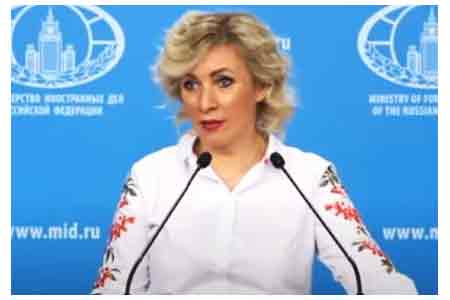
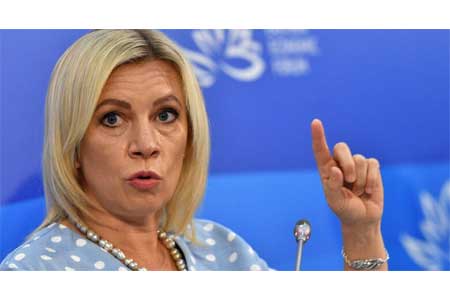
ArmInfo.Yerevan has disregarded ethical standards by disclosing the working materials of the OSCE Minsk Group Co-Chairs, and especially the correspondence of the heads of state, without proper coordination with the parties involved, as stated by Russian Foreign Ministry spokesperson Maria Zakharova during a weekly briefing on December 4. She was asked to comment on the nearly complete package of documents on the Nagorno-Karabakh conflict settlement negotiation process released by the Armenian government.
Zakharova acknowledged that since the Armenian authorities have done it, Moscow has the right to comment. "It seems to me that all the published documents somewhat undermine the arguments that official Yerevan is trying to promote. The published UN and OSCE documents, in the development and adoption of which Russia played an active role, convincingly confirm that for three decades, our country, both in its national capacity and as a co-chair of the Minsk Group, has made consistent efforts to achieve a political and diplomatic settlement of the Nagorno-Karabakh conflict, and much has been accomplished," she said.
According to her, the Russian position has always been based on finding a reasonable balance between the following two components: respect for the territorial integrity of Azerbaijan and ensuring the rights and interests of the indigenous Karabakh population in accordance with generally recognized international principles and standards. Zakharova added that, as the journalist quoted, Moscow has never conducted negotiations regarding the recognition of Artsakh's independence or its annexation to Armenia. The diplomat also touched on the statements made by Russian OSCE Minsk Group Co-Chair Igor Popov in the media in 2021, recalling that the Russian mediator, with facts in hand, refuted Armenian Prime Minister Nikol Pashinyan's assertion in his article "The Origins of the 44-Day War" that Russia's settlement proposals amounted to the return of seven districts to Azerbaijan "just like that," without addressing the status of Karabakh.
"In reality, everything was somewhat different, if not the opposite. This can be easily verified by carefully reading the draft declaration on the first phasee and further steps of the Nagorno-Karabakh settlement published on the Armenian government's website, as well as the draft statement by Russia, the United States, and France in support of the aforementioned declaration and the corresponding draft UN Security Council resolution," she noted.
According to her, these documents were discussed during Armenian-Azerbaijani negotiations even before the change of power in Yerevan in May 2018. "Neither side rejected them, although full agreement was not reached," she continued. According to Zakharova, negotiations were held regularly until 2018-2019, when the Pashinyan administration effectively interrupted substantive dialogue. She recalled that Yerevan then began to talk about international recognition of Artsakh's independence as Armenia's priority: Pashinyan made statements to that effect in March and August 2019 in Stepanakert, including the famous "Artsakh is Armenia, that's it." She recalled that this was followed by the 44-day war of 2020, which was stopped thanks to the efforts of the Russian Federation.
"Recently, it's not the Russian Federation's position that has changed, but Armenia's, or rather its leadership's position, and it has changed radically," Zakharova said, pointing out the Prague agreements of October 6, 2022, when Pashinyan recognized Nagorno-Karabakh as part of Azerbaijan, without regard for the interests of the people living in those territories. "Yes, these documents show that there were opportunities for settlement, and they were missed. But that's not our fault," she concluded.









 Narek Karapetyan will give up his parliamentary salary in favor of charitable contributions.
 Armenia and France discuss further development of strategic partnership and EU cooperation
  To overcome risks Armenia must reduce domestic escalation - expert
  Zatulin: Pashinyan was eager to get back to Russia because he actually lost the elections
 Human rights activist Ruben Melikyan dismissed from YSU
 Pashinyan removed from INNOPROM guest list
 Zakharova: Armenia`s pro-EU pivot poses economic security risks to EAEU member states
 It`s time for South Caucasus countries to think of South Caucasus as single, unified region - RA premier
  Pashinyan: Armenia and Azerbaijan should leave each other alone
 Moscow sees situation with Armenia as attempt to attack Russia-involving integration associations - Russian presidential aid
 Zakharova: Armenia views relations with Russia as tool for financially securing reorientation toward EU
 The Armenian Minister of Justice and the EU Ambassador discussed visa liberalization issues for Yerevan.
 Azerbaijan`s aggressive plans against Armenia became possible in wake of Pashinyan`s decisions on Artsakh - expert
  Zakharova: Russia sent a note of protest to Armenia over the act of vandalism at the "Mother Armenia" memorial in Gyumri