

ArmInfo. By rejecting the 2019 proposal of the OSCE Minsk Group (OSCE MG) Co-Chairs for a final settlement of the Nagorno-Karabakh conflict, Armenian Prime Minister Nikol Pashinyan has challenged not only Azerbaijan but the entire international community, as well as the OSCE MG Co-Chair countries.
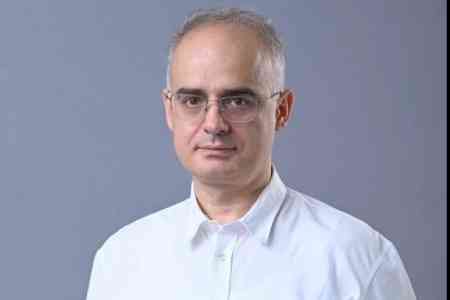
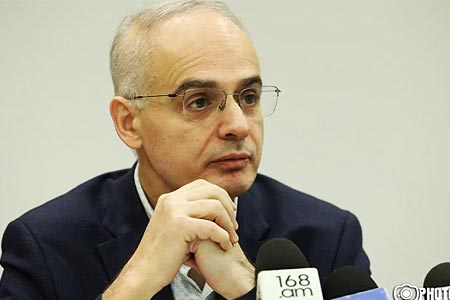
Levon Zurabyan, deputy chairman of the Armenian National Congress (ANC) party, made this statement at a press conference in Yerevan regarding the Armenian government's release of a nearly complete package of documents on the negotiation process for the settlement of the Nagorno-Karabakh conflict. "Thus, the Armenian Prime Minister essentially legitimized Azerbaijani aggression against the Artsakh people in 2020, which ultimately called into question the existence of the Armenian state," the ANC deputy chairman said.
Zurabyan stated that by publishing historical documents on the settlement, Pashinyan demonstrated that what happened, including the 2020 war and the loss of Artsakh, are a consequence of his policies. In this regard, Zurabyan reminded the specific nature of the 2019 proposal on Artsakh. "This proposal implied a phased settlement of the conflict. "During the first phase, five districts were to be transferred to Azerbaijan, with the condition that international peacekeeping forces would be stationed around the perimeter of Kelbajar and Lachin (Karvachar and Berdzor in Armenian - ed.), as well as in five regions," Zurabyan clarified.
Thus, according to the ANC deputy chairman, an internationally recognized interim status for Artsakh would be ensured. Regarding security, he noted that, according to this proposal, it would be ensured through several means, specifically, a commitment by Azerbaijan not to use force against Artsakh, as well as a statement that Armenia would be the guarantor of NKR security. "That is, in essence, Armenia would receive an internationally recognized right to intervene in the conflict should Azerbaijan violate its obligations. The OSCE Minsk Group co-chair countries and the UN Security Council were supposed to become security guarantors under this proposal," Zurabyan added.
The second phase of the settlement, according to the ANC deputy chair, included issues whose resolution was to be discussed later. Specifically, ensuring a corridor for communication between Armenia and Artsakh and determining the final status of the Nagorno-Karabakh Republic based on the free will of the Artsakh people.
"Therefore, in the first phase, we confirmed the establishment of peace, and left the resolution of the remaining issues to future generations, whereby Karvachar and Berdzor could subsequently be transferred to Azerbaijan, provided that it recognized the independence of Artsakh," Zurabyan recalled.
The ANC deputy chairman further stated that it was Pashinyan who torpedoed the implementation of the proposal when, instead of responding diplomatically, he made several statements that provoked the 2020 war. "Therefore, Pashinyan is responsible for the consequences of his policies, including the 2020 war, the loss of Artsakh, clashes on the border with Azerbaijan, the loss of strategically important points, and the ongoing capitulation," the ANC deputy chairman emphasized.
Furthermore, Zurabyan pointed out that in 2020, Pashinyan again had the opportunity to agree to implement this proposal, but did not do so. In 2020, Azerbaijani President Ilham Aliyev essentially agreed to a settlement of the Artsakh conflict when, during the October 2020 war, following a meeting with Pashinyan, he stated in an interview with Russian media that he was being offered "a phased liberation of the occupied regions in exchange for negotiations to determine the final status of Nagorno-Karabakh."
In conclusion, the ANC deputy chairman noted that in today's reality, discussing the return of the Artsakh population to their homeland is only possible if Azerbaijan's authority in the territory is restricted, which is impossible without diplomatic pressure. "It turns out that at the moment we are talking exclusively about war. Therefore, in the current situation, it seems to me that the priority is to ensure the life of the Artsakh population in Armenia, and perhaps in the future the conditions for discussing other options will arise. I consider anything else adventurous," Zurabyan concluded.










 Expert: Economic pressure on Armenia may be virtually painless for other EAEU members, but not for Armenia itself
 Expert on protests in France: Civilizations fade when society loses a vision of the future
 Turkologist: Azerbaijan is not all-powerful—its vulnerabilities should become part of Armenia’s security strategy
 Opinion: The development of the Amulsar mine near the resort town of Jermuk is the beginning of an environmental disaster in Armenia
 Expert: The arrest of opposition figures in Armenia for social media posts is a systematic attempt to intimidate the public and suppress dissent.
 Expert: It`s time for Armenia to move away from uncertainty and choose between West and East
 The Armenian Foreign Minister commented on the country`s return to work within the CSTO.
 The Artsakh Public Council expressed outrage at the UN Secretary-General`s behavior
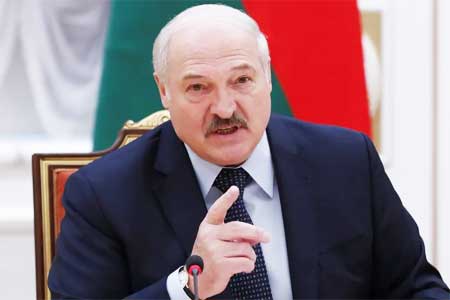 Lukashenko called for Armenia to assume the CIS presidency in 2029
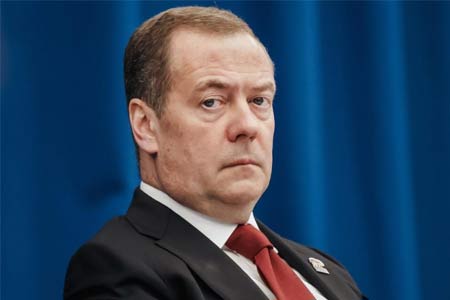 Dmitry Medvedev predicted a Ukrainian-like fate for Armenia amid the country`s shift in foreign policy
 Russian Security Council: In Armenia, they want to force Russian asset owners to dispose of their assets
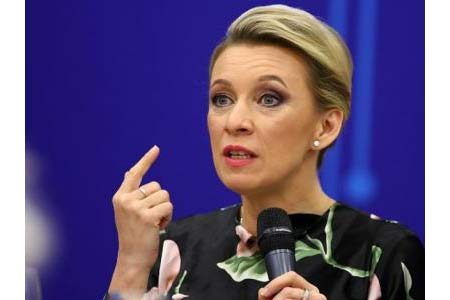 Zakharova: Russia ready to discuss with Armenia the prospects for expanding military cooperation as part of a review of bilateral ties
 Tevanyan: Armenia, like Ukraine and Moldova, is being drawn into the EU’s global war
 Yerevan City Hall is considering introducing a valet parking system in the city
 Expert: The circus surrounding the “Albanization” of Armenian culture in the presence of foreign ambassadors in occupied Artsakh is genocide
 Political scientist: If Russian-Armenian relations are destroyed, Turkey will take Russia`s place
 Political scientist: The Armenian public is simply obliged to significantly change the entire content of public discourse and struggle
 Cross tattoos are being removed from the skin of Christian prisoners in Azerbaijan by fire, according to a human rights activist.
 Zakharova: Armenia`s likely introduction of visas with Russia will be a step against Yerevan itself
