

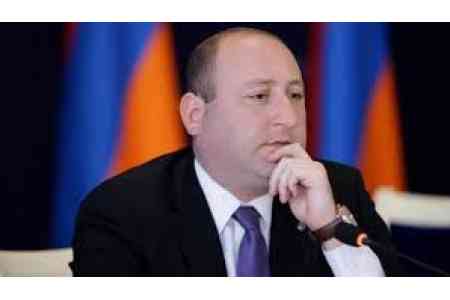
ArmInfo. The United States is using Turkey in its global competition with Russia and China, according to political scientist Suren Sargsyan, director of the Armenian Center for American Studies.
The expert noted that the question of why the United States views developments in the South Caucasus through the lens of the Turkish (Turkic) factor has been frequently discussed recently. Sargsyan is confident that this is, in fact, a rather pragmatic calculation within the context of American foreign policy and only part of the overall picture.
"The United States views Turkey as a natural barrier, counterweight, and competitor against Washington's main adversaries-Russia and China, and, of course, Iran. That is, a strong Turkey-also integrated into the ideological framework of the Turkic world-could create problems for Moscow and Beijing, ranging from the South Caucasus and the Black Sea region to Central Asia and the Middle East, where Russia and China have vital interests," the political scientist asserts. According to him, this is precisely why Washington is creating obstacles, barriers, and additional challenges for its competitors, which is consistent with the natural geopolitical rivalry between world powers. Sargsyan stated that, according to this logic, growing Turkish influence benefits Washington as long as it creates problems for Beijing and Moscow. The expert added that Washington is simultaneously creating new tools to keep Turkey under its control while continuing to use traditional mechanisms.
Sargsyan emphasized that Washington is taking a similar approach toward India, viewing New Delhi as a natural counterweight to China, no matter how much this approach may cause discontent in India.
"Therefore, as long as Turkey is used in the global competition with Beijing and Moscow, its regional weight will grow, absorbing as much as possible-be it Artsakh, Syria, corridors and routes, influence in the Turkic states, etc. As for us, in the absence of checks and balances in the South Caucasus, this natural process will continue until equilibrium is restored. As the saying goes, 'a holy place abhors a vacuum,'" the expert concluded.





















 Armenian Political Scientist: The approaches, methods, rmphases and content of today’s struggle in Armenia Cannot Remain the Same
 Political scientist: Armenians will live peacefully in their homeland only when they can once again set national goals for themselves, such as Artsakh
 Armenian Historian: People Like Magdalena Grono Should Be Kept Away from the Thresholds of Armenian Shrines
 Azerbaijani studies expert: Armenia’s Foreign Ministry could use the ICC against Aliyev’s Armenophobic statements
 Zakharova: Russia ready to discuss with Armenia the prospects for expanding military cooperation as part of a review of bilateral ties
 Tevanyan: Armenia, like Ukraine and Moldova, is being drawn into the EU’s global war
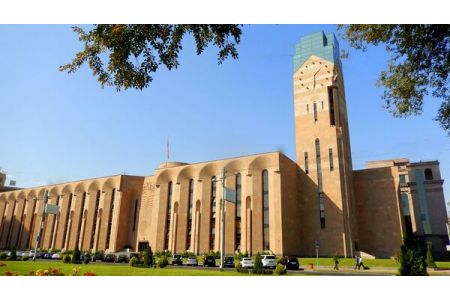 Yerevan City Hall is considering introducing a valet parking system in the city
 Expert: The circus surrounding the “Albanization” of Armenian culture in the presence of foreign ambassadors in occupied Artsakh is genocide
 Political scientist: If Russian-Armenian relations are destroyed, Turkey will take Russia`s place
 Political scientist: The Armenian public is simply obliged to significantly change the entire content of public discourse and struggle
 Cross tattoos are being removed from the skin of Christian prisoners in Azerbaijan by fire, according to a human rights activist.
 Zakharova: Armenia`s likely introduction of visas with Russia will be a step against Yerevan itself
 Putin: Armenia`s recognition of Karabakh as part of Azerbaijan in Prague has given Russia`s position on this issue an ambivalent character
 Putin: Armenia`s adoption of the law on EU accession means an announcement of its withdrawal from the Eurasian Economic Union
 Medvedev: Yerevan will never become an EU member, but it will permanently damage relations with the Eurasian Economic Union, including with Moscow.
 Aram Vardevanyan: Public demands solutions, not apology scandals in Parliament
 Arrested Armenian oligarch on economy and new jobs
  "In Baku, we gave a worthy rebuff to the false claims regarding the past and present of our people" – Former Artsakh Parliament Speaker from Baku captivity