
ArmInfo. The Artsakh Union called on MEPs to travel to Baku and attend the upcoming court hearings of Armenian prisoners of war to ensure transparency, prevent further violations, and hold Azerbaijan accountable in accordance with international law, as stated in a report the Union submitted to the European Parliament on 23 Armenian hostages unlawfully held in Azerbaijan.
According to the Union's press service, the report details the status of all 23 hostages, including their legal history, charges, and the conditions of the sham trials taking place in Azerbaijani courts. In this regard, it is noted that seven of the Armenian prisoners of war have already been sentenced to prison terms ranging from 15 to 20 years on false charges, while the remaining sixteen are currently awaiting similar sentences.
According to the source, the report documents violations of international humanitarian law and human rights, including the denial of prisoner-of-war status, the lack of due process, decades of politically motivated charges, and credible reports of torture and ill-treatment. "It highlights the deterioration of control mechanisms, particularly following the closure of the International Committee of the Red Cross office in Azerbaijan in 2025. The report contains information on the international community's response, including numerous demands and calls made by EU institutions, UN special procedures, the International Court of Justice, and the European Court of Human Rights for the immediate release of prisoners of war. It also presents recommendations that must be adopted by the international community without delay," the Artsakh Union added. As the organization further noted, the report emphasizes that the illegal trials of Armenian prisoners of war are nothing more than a political stunt and part of a broader strategy aimed at blaming the victims and concealing crimes committed against the Armenian population of Artsakh.
In this regard, it is stated that several international organizations, including the UN Human Rights Committee, Freedom House, and the US State Department, have documented the lack of an independent and impartial judicial system in Azerbaijan. Moreover, the US State Department stated that there is "credible evidence that judges and prosecutors took instructions from the presidential administration and the Ministry of Justice, particularly in politically sensitive cases," while the European Court of Human Rights noted a "disturbing pattern" of repressive criminal prosecutions and arbitrary arrests of government critics, civil society activists, and human rights defenders. "In this context, it is emphasized that the ongoing politically motivated persecution of 23 Armenian prisoners of war is yet another act of gross violation of international law and reflects the strategy employed against Armenians by the Ottoman Empire in 1915 with the aim of eliminating the leadership of the people and sowing fear," the Union noted.
Furthermore, it is noted that the trial of Armenian prisoners of war is a message from Azerbaijan to the 150,000 forcibly displaced Armenians of Artsakh: do not return. "Because any attempt to return to their homeland will lead to further persecution," the organization clarified.
Meanwhile, as the Artsakh Union noted, under international law, all 23 Armenian prisoners of war meet the definition of state hostages. "These sham trials are a vivid example of Azerbaijan's long-standing and systemic policy of discrimination against Armenians, which is thoroughly documented by international treaties and UN special procedures, the European Court of Human Rights, the International Court of Justice, the Council of Europe, and leading international human rights organizations. The Artsakh Union and its partners call on the international community to act decisively and immediately," the organization stated. According to the source, the report was prepared jointly with partner organizations such as the Center for International and Comparative Law, the Rule of Law NGO, the Armenian Legal Front, and a group of individual human rights defenders.










 Expert: The arrest of opposition figures in Armenia for social media posts is a systematic attempt to intimidate the public and suppress dissent.
 Azerbaijani Studies Expert: While Azerbaijan Prepares Its Generation for War, Aliyev’s Aide Calls on Armenia to Prepare Armenian Society for “Peace”
 Turkologist: Azerbaijan will never, under any circumstances, stop pressuring the Armenian people
 Political scientist: We need to move away from the question of "when" and replace it with more important questions
 Lukashenko called for Armenia to assume the CIS presidency in 2029
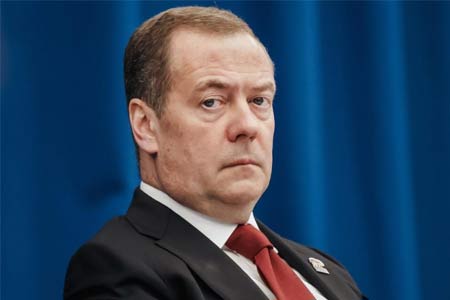 Dmitry Medvedev predicted a Ukrainian-like fate for Armenia amid the country`s shift in foreign policy
 Russian Security Council: In Armenia, they want to force Russian asset owners to dispose of their assets
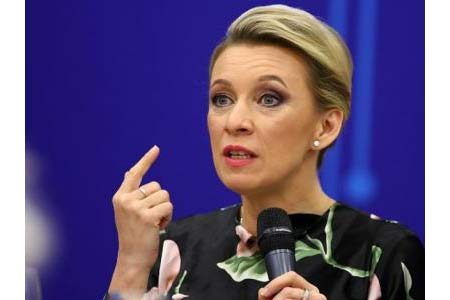 Zakharova: Russia ready to discuss with Armenia the prospects for expanding military cooperation as part of a review of bilateral ties
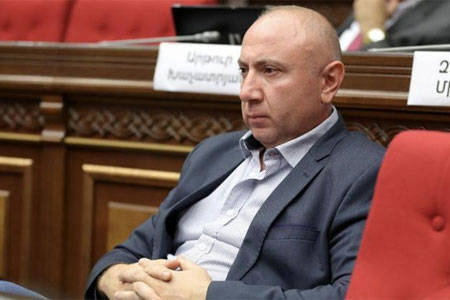 Tevanyan: Armenia, like Ukraine and Moldova, is being drawn into the EU’s global war
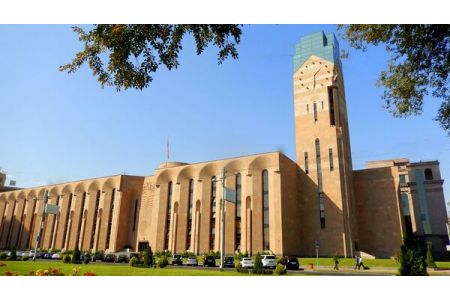 Yerevan City Hall is considering introducing a valet parking system in the city
 Expert: The circus surrounding the “Albanization” of Armenian culture in the presence of foreign ambassadors in occupied Artsakh is genocide
 Political scientist: If Russian-Armenian relations are destroyed, Turkey will take Russia`s place
 Political scientist: The Armenian public is simply obliged to significantly change the entire content of public discourse and struggle
 Cross tattoos are being removed from the skin of Christian prisoners in Azerbaijan by fire, according to a human rights activist.
 Zakharova: Armenia`s likely introduction of visas with Russia will be a step against Yerevan itself
 Putin: Armenia`s recognition of Karabakh as part of Azerbaijan in Prague has given Russia`s position on this issue an ambivalent character
 Putin: Armenia`s adoption of the law on EU accession means an announcement of its withdrawal from the Eurasian Economic Union