

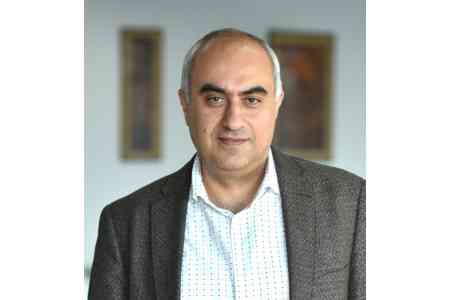
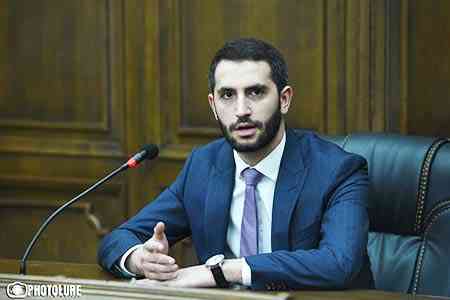
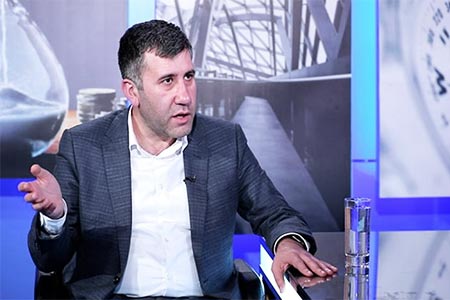
ArmInfo. 65.1% of Armenia's population cannot afford healthy food, as stated by Ruben Markosyan, Vice-Rector for Academic and Methodological Work at the Eurasian University, an expert in public and social policy, and Associate Professor at Yerevan State University, on November 25
He noted that this per capita figure is approximately $4.2. "The important issue isn't just the numbers, but the lack of productivity and economic development in the country, which results in average wages, that are not sufficient for a decent living standard. When we calculate the average salary using a relative method, we are again disappointed in many cases, because we understand that it does not provide the conditions for a decent life," the expert noted.
Recalling that the minimum wage is indexed based on the average, he noted that the gap between them is significant. Specifically, citing data from the Statistical Committee, the expert noted that in July-August, the average salary in Armenia was 295,000 drams, while the minimum wage is 75,000 drams. According to him, in many countries, automatic indexation has been implemented-that is, increases occur based on clearly established mechanisms and criteria in accordance with the law.
"We are talking about institutional processes where the influence of political decisions is minimized," he added. Armenian legislation, however, lacks a procedure for revising the criteria or methodology for calculating the minimum wage. The Law on the Minimum Consumer Basket, which was adopted in 2004, is also not operational. According to Markosyan, the Statistical Committee of Armenia publishes the minimum consumer basket quarterly, which in 2024 amounted to 916,000 drams, exceeding the minimum annual wage. He noted that he had approached the relevant agencies with recommendations to revise the methodology for the structure of the minimum consumer basket, which is outdated. Pointing out its shortcomings, the expert noted that, for instance, the minimum consumer basket only includes apples as fruit, and potatoes and onions as vegetables.
"If we look at the period from 2020 to 2024, the goods included in the minimum basket increased in price by 23.2%, while the minimum wage increased by 10.3%, meaning the minimum wage in 2024 should have been at least 83,000 drams, not 75,000 drams," the speaker noted. In conclusion, Markosyan emphasized that the cost of the minimum consumer basket should ensure decent living conditions, including necessary expenses such as transportation, utilities, healthcare, and others.
"Government decisions are needed to ensure that minimum wage increases are inclusive. We understand that today, neither the average nor the minimum wage reflects people's real social needs. But we have what we have-a country with a high poverty rate, where 65% of the population cannot afford a healthy diet," the associate professor said. Summing up, he noted the need to develop an objective methodology for calculating the minimum consumer basket, a methodology for calculating the minimum wage, and enshrine this in legislation. He suggested that the most appropriate approach would be an automatic revision mechanism for Armenia, or the government should be required to ensure regular revisions of the minimum wage. Specifically, during the transition period, according to the study's recommendations, the minimum wage in Armenia should be raised to 90,000-100,000 drams-that is, until a methodology is developed that will allow for more objective indicators.
It should be noted that the study was conducted by the Friedrich-Ebert-Stiftung in collaboration with the Confederation of Trade Unions of Armenia. The study was led by Ruben Marksyan, Anna Martirosyan, and David Petrosyan.





















 Armenian Historian: People Like Magdalena Grono Should Be Kept Away from the Thresholds of Armenian Shrines
 Azerbaijani studies expert: Armenia’s Foreign Ministry could use the ICC against Aliyev’s Armenophobic statements
 An Armenian political analyst exposed Hajiyev’s lies and attempts to mislead diplomats accredited in Azerbaijan in occupied Artsakh
 Russian Security Council: In Armenia, they want to force Russian asset owners to dispose of their assets
 Zakharova: Russia ready to discuss with Armenia the prospects for expanding military cooperation as part of a review of bilateral ties
 Tevanyan: Armenia, like Ukraine and Moldova, is being drawn into the EU’s global war
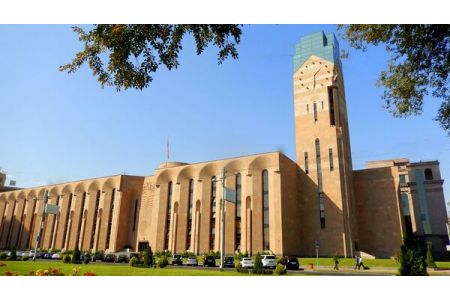 Yerevan City Hall is considering introducing a valet parking system in the city
 Expert: The circus surrounding the “Albanization” of Armenian culture in the presence of foreign ambassadors in occupied Artsakh is genocide
 Political scientist: If Russian-Armenian relations are destroyed, Turkey will take Russia`s place
 Political scientist: The Armenian public is simply obliged to significantly change the entire content of public discourse and struggle
 Cross tattoos are being removed from the skin of Christian prisoners in Azerbaijan by fire, according to a human rights activist.
 Zakharova: Armenia`s likely introduction of visas with Russia will be a step against Yerevan itself
 Putin: Armenia`s recognition of Karabakh as part of Azerbaijan in Prague has given Russia`s position on this issue an ambivalent character
 Putin: Armenia`s adoption of the law on EU accession means an announcement of its withdrawal from the Eurasian Economic Union
 Medvedev: Yerevan will never become an EU member, but it will permanently damage relations with the Eurasian Economic Union, including with Moscow.
 Aram Vardevanyan: Public demands solutions, not apology scandals in Parliament
 Arrested Armenian oligarch on economy and new jobs
  "In Baku, we gave a worthy rebuff to the false claims regarding the past and present of our people" – Former Artsakh Parliament Speaker from Baku captivity