
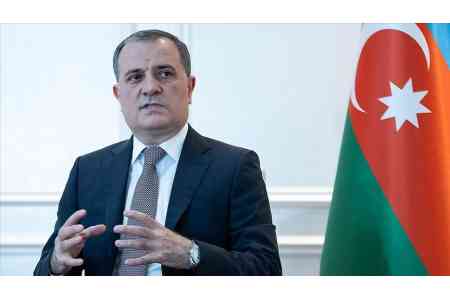
ArmInfo. The Moscow meeting during the 44-day war in Nagorno-Karabakh was unusual in its level of tension, as stated by Azerbaijani Foreign Minister Jeyhun Bayramov in an interview with ITV, Azerbaijani media reported.
According to him, the Russian side persistently proposed negotiations and emphasized the importance of achieving a result. An agreement to hold the meeting was reached on October 9.
"When the negotiations began, Russian Foreign Minister Sergey Lavrov presented the parties with a document. It consisted of only a few points. On the night of October 10th, it was proposed to cease all military action, deploy Russian peacekeepers and the Azerbaijani army on the eastern part of the line of contact, and Russian peacekeepers and the Armenian army on the western part.
That is, the proposed document already stipulated that as soon as a ceasefire was declared on the 9th, Russian peacekeepers would be deployed on both sides immediately-without any additional conditions, without the withdrawal of Armenian troops, without the liberation of any territories.
We had completely different instructions from Mr. President. We proceeded from our position and raised completely different issues. We are ready to negotiate with Armenia: let the Armenian side present a schedule for when they plan to withdraw [troops from the occupied areas]. Tthe Armenian side, Minister Mnatsakanyan, began to express dissatisfaction, saying that this should not be the case, that Azerbaijan should return to the situation of September 27th, because they allegedly will not negotiate under pressure," Bayramov stated. According to him, between these two positions, Russia seemed to be taking a more "neutral" position: "No, you don't need to withdraw, stay where you are, but Russian peacekeepers must remain with you." And, of course, there were other points: the exchange of prisoners of war, the return of the bodies of the dead, and other issues.
Bayramov noted that it was crucial for the Armenian side to achieve a result that day. "We said we could continue the negotiations the next day. While we were there, news came in that Hadrut had been liberated. We were told this news. Fifteen minutes later, we noticed panic among the members of the Armenian delegation. This was a remarkable moment. We informed them that Hadrut had been liberated, because when the Armenian side proposed the 5+2 format (the liberation of five of the seven occupied regions, with the exception of Kalbajar and Lachin), we declared that this option was no longer viable, since Jabrayil and Hadrut had been liberated," the Minister emphasized.
The negotiations were very tense, and eventually, closer to the morning, the parties agreed on a document. Many have probably already forgotten about this, but from the point of view of Azerbaijan's interests, this was a document that completely satisfied us. First of all, the ceasefire was described there only as a humanitarian truce. That is, it was not about a complete ceasefire. A humanitarian truce was for the exchange of prisoners of war and the removal of bodies from the battlefield with the participation of the International Committee of the Red Cross. Secondly. There was no mention of peacekeepers or the presence of any third party. And here Lavrov used the argument: "Okay, you say this, but how can this be ensured? How can the situation be controlled?" The interesting point is that Mr. President told us in advance: if there is such an argument, you will say that all the co-chairing countries are space powers, they all have satellites, cameras, drones - they can see everything anyway, and will be able to control who is violating the regime. We used the same arguments. "The extent to which this had an impact is another matter, but it was one of the most memorable details of the negotiations," Bayramov said.
The head of Azerbaijan's diplomatic service noted that a parallel plan was to resume negotiations under the auspices of the Minsk Group.
"Another very important point, which was significant then (it no longer matters today), was maintaining the unchanged format of the negotiations. This point was introduced at the insistence of the Azerbaijani side. Why? Because before the war, Armenia had stated: if Azerbaijan wants to talk, let it talk to the separatists; we have nothing to do with it. And the establishment of an unchanged format meant that Armenia had backed down from this position and once again recognized itself as a party to the negotiations.
The negotiations continued until the morning, and an agreement was reached that a ceasefire would be declared at 12:00. As soon as the negotiations concluded, we immediately flew to Baku. At 12:00, as is known, a ceasefire was declared. Less than half an hour later, the ceasefire was violated," Bayramov said, noting that after this, the fighting intensified further.










 Armenian Historian: People Like Magdalena Grono Should Be Kept Away from the Thresholds of Armenian Shrines
 Azerbaijani studies expert: Armenia’s Foreign Ministry could use the ICC against Aliyev’s Armenophobic statements
 An Armenian political analyst exposed Hajiyev’s lies and attempts to mislead diplomats accredited in Azerbaijan in occupied Artsakh
 Expert: The circus surrounding the “Albanization” of Armenian culture in the presence of foreign ambassadors in occupied Artsakh is genocide
 Zakharova: Russia ready to discuss with Armenia the prospects for expanding military cooperation as part of a review of bilateral ties
 Tevanyan: Armenia, like Ukraine and Moldova, is being drawn into the EU’s global war
 Yerevan City Hall is considering introducing a valet parking system in the city
 Political scientist: If Russian-Armenian relations are destroyed, Turkey will take Russia`s place
 Political scientist: The Armenian public is simply obliged to significantly change the entire content of public discourse and struggle
 Cross tattoos are being removed from the skin of Christian prisoners in Azerbaijan by fire, according to a human rights activist.
 Zakharova: Armenia`s likely introduction of visas with Russia will be a step against Yerevan itself
 Putin: Armenia`s recognition of Karabakh as part of Azerbaijan in Prague has given Russia`s position on this issue an ambivalent character
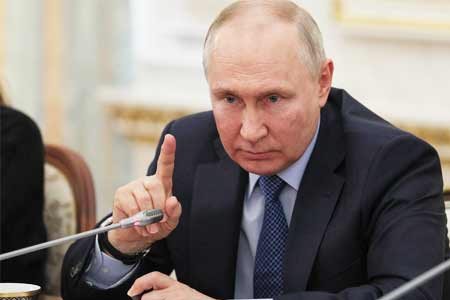 Putin: Armenia`s adoption of the law on EU accession means an announcement of its withdrawal from the Eurasian Economic Union
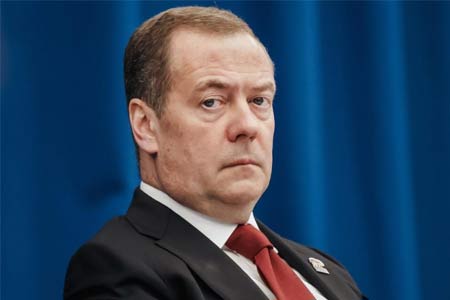 Medvedev: Yerevan will never become an EU member, but it will permanently damage relations with the Eurasian Economic Union, including with Moscow.
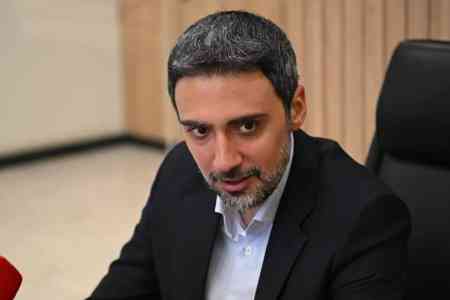 Aram Vardevanyan: Public demands solutions, not apology scandals in Parliament
 Arrested Armenian oligarch on economy and new jobs
  "In Baku, we gave a worthy rebuff to the false claims regarding the past and present of our people" – Former Artsakh Parliament Speaker from Baku captivity
  NA Vice Speaker candidate believes his wife`s salary as director of HayPost is the lowest in the company`s history