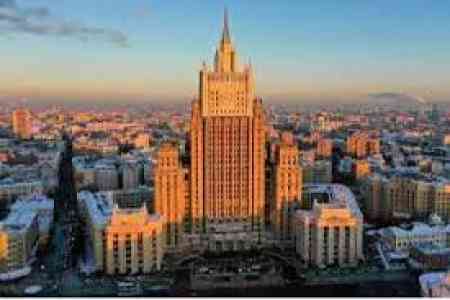
ArmInfo. The Russian Foreign Ministry has issued a statement on the fifth anniversary of the agreement between the leaders of Russia, Azerbaijan, and Armenia on a ceasefire in the Nagorno-Karabakh conflict zone.
The statement, published on the website of the Russian Foreign Ministry, recalls that November 9, 2025, marks five years since the signing of the Statement on a complete ceasefire and all military actions in the Nagorno-Karabakh conflict zone by Russian President Vladimir Putin, Azerbaijani President Ilham Aliyev, and Armenian Prime Minister Nikol Pashinyan. It is noted that the hours-long talks between the leaders of the three countries ended the bloodshed and launched a series of measures to restore peace in the region.
The Russian Foreign Ministry emphasized that the Russian peacekeeping contingent (RPC), deployed in accordance with the Statement of November 9, 2020, has made an indispensable contribution to stabilizing the situation and ensuring security in the region, including even at the cost of our soldiers lives. Since the beginning of the peacekeeping operation, RPC forces have cleared 2,550.2 hectares of explosive ordnance, demined more than 689 kilometers of roads, inspected 1,940 buildings, and detected and neutralized 26,794 explosive ordnance. The operation ensured functioning of 31 socially significant facilities, 40 kilometers of communication lines, and 20 kilometers of gas pipelines. An exchange of detainees and prisoners of war was organized with a total of 213 people returned, 189 of them to Armenia and 24 to Azerbaijan.
"Following the resumption of hostilities in September 2023, Russian military personnel facilitated a ceasefire, ensured the safety of the civilian population, accommodated approximately 5,000 civilians, including more than 2,000 children, at their deployment points and observation posts, and guaranteed the safe passage of the Armenian population to Armenia. The peacekeepers continued to fulfill their duty until their return to their homeland on June 12, 2024," the Russian Foreign Ministry said in a statement.
It was also noted that, following the November 9, 2020 statement, during the Moscow summit on January 11, 2021, a decision was made at Putin's suggestion to establish a Trilateral Working Group (TWG) under the joint chairmanship of the Deputy Prime Ministers of Azerbaijan, Armenia, and Russia to unblock all economic and transport links in the region. Moreover, on November 26, 2021, in Sochi, the leaders of the three countries reached an agreement to establish commissions for the delimitation of the Armenian- Azerbaijani state border, followed by its demarcation with the advisory assistance of the Russian Federation at the request of the parties. During a meeting on October 31, 2022, in Sochi, the heads of state emphasized the importance of actively preparing for the conclusion of a peace treaty to achieve sustainable and long-term peace in the region based on existing developments and with the assistance of the Russian Federation. They also agreed to make efforts aimed at resolving outstanding issues, including humanitarian issues.
"Taken together, the four high-level statements constitute a roadmap for the peace process. These agreements remain in force and have not lost their relevance. The important foundations created in the trilateral format are being actively utilized by the Azerbaijani and Armenian sides, including in direct dialogue. In this context, the Russian side has positively assessed the initialing of the draft Agreement on the Establishment of Peace and Interstate Relations between the Republic of Azerbaijan and the Republic of Armenia by the Foreign Ministers of Azerbaijan and Armenia in Washington on August 8, 2025.
Baku and Yerevan still have a lot to do to make the process of normalizing bilateral relations irreversible, including the signing of a peace treaty, restoring transport and economic communications in the interests of all countries of the South Caucasus and their immediate neighbors, fair delimitation and demarcation of the state border, and establishing effective contacts within civil society. The Russian side is ready to continue providing its Azerbaijani and Armenian partners with comprehensive assistance in all areas, including within the framework of the Regional Cooperation Platform. "3+3"(Azerbaijan, Armenia, Georgia - Russia, Iran, Turkiye)," the Russian Foreign Ministry concluded.











 Iranologist: Baku`s propaganda of might masks the country`s inability to provide water to its own population
 Analyst: Continued tensions between Yerevan and Moscow could entail new restrictive measures from Russia
 Political analyst: Russia intends to determine which "Camp" Armenia will choose through a referendum
 Armenia and France discuss further development of strategic partnership and EU cooperation
  To overcome risks Armenia must reduce domestic escalation - expert
  Zatulin: Pashinyan was eager to get back to Russia because he actually lost the elections
 Pashinyan removed from INNOPROM guest list
 Zakharova: Armenia`s pro-EU pivot poses economic security risks to EAEU member states
 It`s time for South Caucasus countries to think of South Caucasus as single, unified region - RA premier
  Pashinyan: Armenia and Azerbaijan should leave each other alone
 Moscow sees situation with Armenia as attempt to attack Russia-involving integration associations - Russian presidential aid
 Zakharova: Armenia views relations with Russia as tool for financially securing reorientation toward EU
 The Armenian Minister of Justice and the EU Ambassador discussed visa liberalization issues for Yerevan.
 Azerbaijan`s aggressive plans against Armenia became possible in wake of Pashinyan`s decisions on Artsakh - expert
  Zakharova: Russia sent a note of protest to Armenia over the act of vandalism at the "Mother Armenia" memorial in Gyumri