
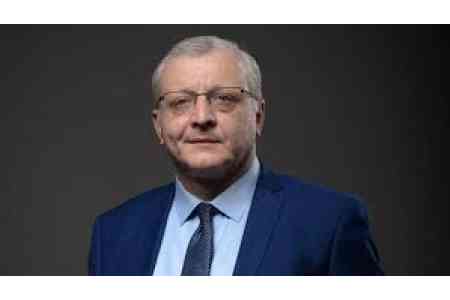
ArmInfo. Armenian Prime Minister Nikol Pashinyan's statements regarding Catholicos of All Armenians Garegin II constitute state interference in the internal affairs of the Church, and the emphasis on public indifference on these issues suggests that the government has chosen the path of pressure. Political scientist Suren Surenyants wrote this on his Facebook page, commenting on Pashinyan's latest statements regarding the Catholicos.
The political scientist noted that more than five months after the start of the anti-Church campaign, Pashinyan is surprised to note that the Armenian public doesn't care whether the Catholicos has children. Surenyants explained that Pashinyan constantly cites public opinion to justify the process of "spiritual renewal" he is promoting. "However, the Prime Minister himself now admits that society is indifferent to the accusations the government is using to justify its actions against the Armenian Apostolic Church. Although, it must be acknowledged, this doesn't actually change the ruling regime's goals," the expert believes.
According to Sureniants, the Armenian Prime Minister's statements that "Ktrich Nersisyan" (the Catholicos's secular name - ed.) is not currently the Catholicos, and that the Armenian Apostolic Church does not have a Catholicos, raises an important issue. As the political scientist explained, this raises the question of the extent to which the head of state has the authority to use his position to collect information about the personal lives of citizens, especially given that the government's interest in the clergy's personal lives contradicts both the law on privacy and the principle of a secular state. "Pashinyan effectively admits that his anti-church initiative is not resonating with society. Public indifference indicates that the Armenian people are not receptive to the themes being imposed upon them. However, Pashinyan views this not as a public stance, but as an obstacle that needs to be 'corrected,'" Sureniants points out.
According to him, the Armenian Prime Minister's statement that the country "has no Catholicos" contradicts Article 17 of the Constitution of the Republic, which emphasizes that the state is separate from the Armenian Apostolic Church, meaning the status of the Catholicos is determined by church rules and that Pashinyan has absolutely no authority in these matters. "From the Prime Minister's words, it appears that if society 'does not react,' the authorities may interpret this as an opportunity to take harsher, more forceful steps. This could escalate into renewed pressure, the initiation of new fabricated cases against the clergy, and a new attempt to control the Armenian Apostolic Church. In other words, Pashinyan's statements indicate that the policy being pursued toward the Church is not a public demand, but an unconstitutional agenda shaped by the authorities," the political scientist emphasized.
As a result, he said, the autonomy of the Church, the stability of constitutional institutions, and the natural balance between the state and the Church are at risk.
It's worth noting that on November 6, at a briefing with journalists, the Prime Minister stated that "the Armenian Apostolic Church today has no Catholicos." He then expressed surprise that journalists weren't interested in whether the Catholicos had a child.
As a reminder, the Armenian Prime Minister launched a campaign against the Armenian Apostolic Church in May, imprisoning anyone who disagrees with the Church for various serious offenses. As part of this campaign, the Armenian Prime Minister also supported Stepan Asatryan, a cleric defrocked by the Catholicos of All Armenians, who called his defrocking illegal. Asatryan's statements served as the basis for the detention of several clergymen of the Aragatsotn Diocese of the Armenian Apostolic Church.











 Opinion: Following Berlin talks, Baku gains expanded influence within EU and strengthens cooperation ties with main European powerhouse
 Armenian Analyst: One of the Key Tasks of the United Opposition is to Form Effective Mechanisms to Contain the Armenian Authorities
 Armenian expert: Could modern Azerbaijan even exist without Russian and Soviet modernization?
 South Caucasus is entering a new phase of turbulence - ex-official
  Zatulin: Pashinyan was eager to get back to Russia because he actually lost the elections
 Human rights activist Ruben Melikyan dismissed from YSU
 Pashinyan removed from INNOPROM guest list
 Zakharova: Armenia`s pro-EU pivot poses economic security risks to EAEU member states
 It`s time for South Caucasus countries to think of South Caucasus as single, unified region - RA premier
  Pashinyan: Armenia and Azerbaijan should leave each other alone
 Moscow sees situation with Armenia as attempt to attack Russia-involving integration associations - Russian presidential aid
 Zakharova: Armenia views relations with Russia as tool for financially securing reorientation toward EU
 The Armenian Minister of Justice and the EU Ambassador discussed visa liberalization issues for Yerevan.
 Azerbaijan`s aggressive plans against Armenia became possible in wake of Pashinyan`s decisions on Artsakh - expert
  Zakharova: Russia sent a note of protest to Armenia over the act of vandalism at the "Mother Armenia" memorial in Gyumri
 Samvel Karapetyan proposes creating a post-election opposition coalition
 Artsakh`s Cultural Heritage Ombudsman called on Moscow to respond to destruction of WWII monuments by Azerbaijan in occupied NKR