
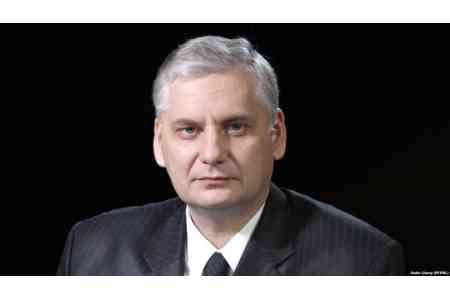
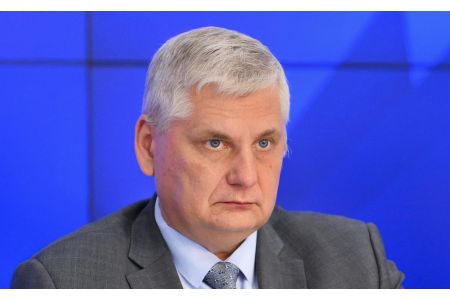
ArmInfo. It's easy to repeat like a mantra that Russia has done nothing to establish peace in the South Caucasus. However, who stopped the war in 1994 in the Nagorno-Karabakh conflict zone? For 26 years, Russia maintained the status quo in this region, as stated by Sergei Markedonov, political scientist and leading researcher at the Center for Euro-Atlantic Security of the Institute for International Studies at MGIMO.
"Who stopped the war in 1994 and ensured the signing of a ceasefire agreement? Was it Donald Trump or perhaps Mr. Macron? I assume it was Russia. For 26 years, the status quo was maintained and guaranteed by Russia," the Russian expert recalled. According to him, Russia, through the OSCE Minsk Group- which, he says, some lazy people criticize for its inaction-proposed a strategy that not only envisioned the return of the occupied Azerbaijani territories but also the preservation of Nagorno-Karabakh through a referendum. He acknowledged, however, that these proposals are currently being criticized by many, given Donald Trump's predominance.
Additionally, Markedonov agreed with some experts' assessments that Russia is not making sufficient efforts in the South Caucasus. He also noted that Russia is a proponent of so-called soft power. He cited the example of Georgia, with which Russia has no diplomatic relations, but this does not hinder trade and economic cooperation. "It's very easy to repeat like a mantra that Russia has done nothing. But let's look at some numbers. Armenia is a good hub for our communications. Therefore, it's important to ensure that everyone understands that Russia is not against peace. Peace has its authors. We are not conspiracy theorists. You've probably heard American official James O'Brien. He was here in Yerevan and stated that the Middle Corridor should prevent Russia and China from participating in the region's affairs. And why, given these realities, should Russia support such a scenario?" the Russian political scientist asked. He emphasized that Russia is interested in its presence in the South Caucasus, at the very least because it is closer to the region than the United States.










 Armenian Analyst: One of the Key Tasks of the United Opposition is to Form Effective Mechanisms to Contain the Armenian Authorities
 Armenian expert: Could modern Azerbaijan even exist without Russian and Soviet modernization?
 South Caucasus is entering a new phase of turbulence - ex-official
  Zatulin: Pashinyan was eager to get back to Russia because he actually lost the elections
 Human rights activist Ruben Melikyan dismissed from YSU
 Pashinyan removed from INNOPROM guest list
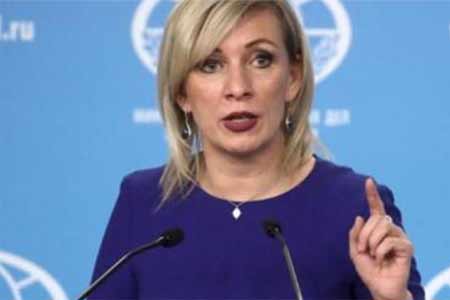 Zakharova: Armenia`s pro-EU pivot poses economic security risks to EAEU member states
 It`s time for South Caucasus countries to think of South Caucasus as single, unified region - RA premier
  Pashinyan: Armenia and Azerbaijan should leave each other alone
 Moscow sees situation with Armenia as attempt to attack Russia-involving integration associations - Russian presidential aid
 Zakharova: Armenia views relations with Russia as tool for financially securing reorientation toward EU
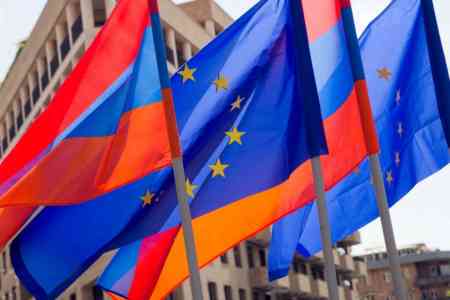 The Armenian Minister of Justice and the EU Ambassador discussed visa liberalization issues for Yerevan.
 Azerbaijan`s aggressive plans against Armenia became possible in wake of Pashinyan`s decisions on Artsakh - expert
  Zakharova: Russia sent a note of protest to Armenia over the act of vandalism at the "Mother Armenia" memorial in Gyumri
 Samvel Karapetyan proposes creating a post-election opposition coalition
 Artsakh`s Cultural Heritage Ombudsman called on Moscow to respond to destruction of WWII monuments by Azerbaijan in occupied NKR
