

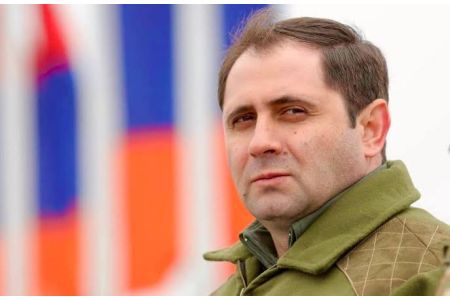
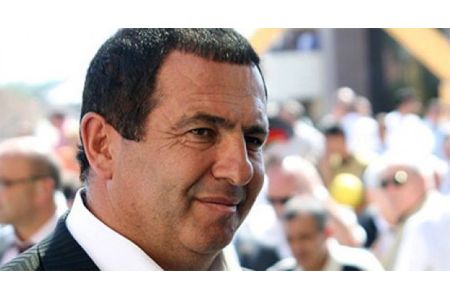
ArmInfo. The events unfolding in the Aragatsotn Diocese of the Armenian Apostolic Church have gone beyond the legal process. Suren Surenyants, leader of the Democratic Alternative party, wrote in a post on his Facebook page.
According to him, this is no longer about the Church, but about the struggle for freedom. "We are dealing with political pressure, the purpose of which is not only to neutralize the Church, but also to limit freedom and ensure the irreversibility of the authoritarian system. This is not a legal investigation; it is a demonstrative and vulgar use of state power to suppress a structure endowed with public influence," the politician noted.
He pointed out that the authorities' goal is clear: to create an atmosphere of fear and send a signal to all independent structures. "But does what is happening have only a domestic political context? The current situation cannot be viewed only in its domestic context. A few days ago, the Chairman of the Caucasus Muslim Board, Sheikh-ul-Islam Allahshukur Pashazade, stated that "the Armenian Apostolic Church has always been a participant in political processes, raised in the spirit of separatism and hatred, and today continues to interfere in state policy, hindering the establishment of peace in the region."
This was a direct political message, an attempt to portray the Church as an enemy and make it the target of diplomatic and political pressure. And now, shortly afterwards, a criminal prosecution has begun in Armenia with the same logic of accusations. This coincidence is not accidental: it testifies to the dangerous confluence of external incentives and the internal state agenda. Pressure on the Church is becoming not only an instrument of domestic policy, but also an element of regional influence policy, the goal of which is to weaken our spiritual identity and state independence. And it is regrettable that so-called "civil society" is an active player in this anti-state process. The starting signal for today's process was the program presented by Daniel Ioannisyan. This clearly demonstrates how some "civil society" structures have become executors of state orders, claiming independence but in reality serving a policy of restricting freedoms and strengthening control. The Armenian Apostolic Church has been a pillar of national identity, resistance, and freedom for centuries. When the government attempts to restrict it through searches and arrests, not only the Church is at risk, but also national memory, public freedom, and the foundations of statehood. The attempt to silence the Church is not only about the spiritual sphere but also about the destruction of a free society, the establishment of an authoritarian system where state power becomes indispensable, suppressing any dissent. If we do not protect the Church today, we will not be able to protect any fundamental right tomorrow," the politician stated.











 Expert: The arrest of opposition figures in Armenia for social media posts is a systematic attempt to intimidate the public and suppress dissent.
 Azerbaijani Studies Expert: While Azerbaijan Prepares Its Generation for War, Aliyev’s Aide Calls on Armenia to Prepare Armenian Society for “Peace”
 Turkologist: Azerbaijan will never, under any circumstances, stop pressuring the Armenian people
 Political scientist: We need to move away from the question of "when" and replace it with more important questions
 Lukashenko called for Armenia to assume the CIS presidency in 2029
 Dmitry Medvedev predicted a Ukrainian-like fate for Armenia amid the country`s shift in foreign policy
 Russian Security Council: In Armenia, they want to force Russian asset owners to dispose of their assets
 Zakharova: Russia ready to discuss with Armenia the prospects for expanding military cooperation as part of a review of bilateral ties
 Tevanyan: Armenia, like Ukraine and Moldova, is being drawn into the EU’s global war
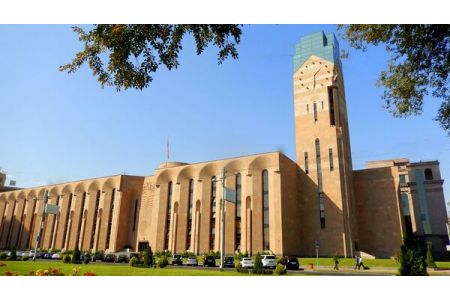 Yerevan City Hall is considering introducing a valet parking system in the city
 Expert: The circus surrounding the “Albanization” of Armenian culture in the presence of foreign ambassadors in occupied Artsakh is genocide
 Political scientist: If Russian-Armenian relations are destroyed, Turkey will take Russia`s place
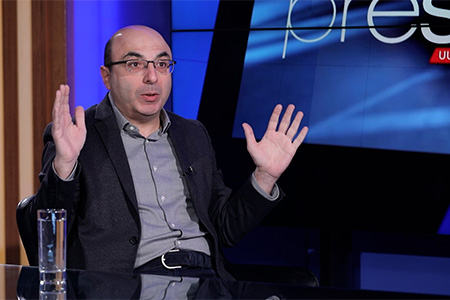 Political scientist: The Armenian public is simply obliged to significantly change the entire content of public discourse and struggle
 Cross tattoos are being removed from the skin of Christian prisoners in Azerbaijan by fire, according to a human rights activist.
 Zakharova: Armenia`s likely introduction of visas with Russia will be a step against Yerevan itself
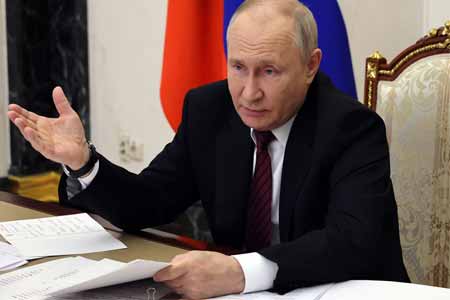 Putin: Armenia`s recognition of Karabakh as part of Azerbaijan in Prague has given Russia`s position on this issue an ambivalent character
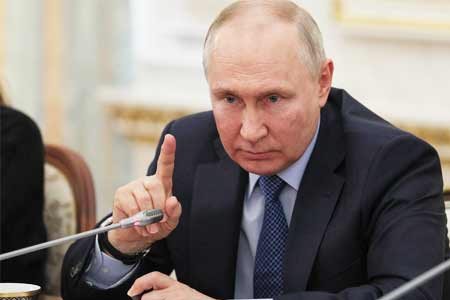 Putin: Armenia`s adoption of the law on EU accession means an announcement of its withdrawal from the Eurasian Economic Union