
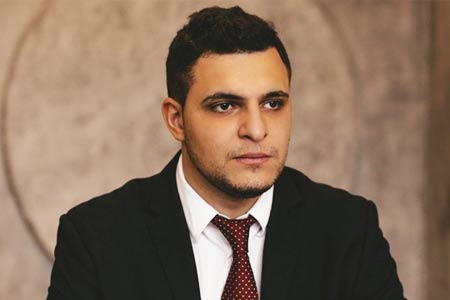
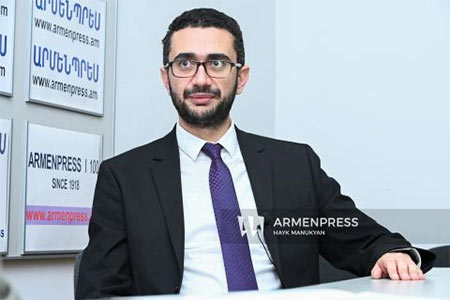
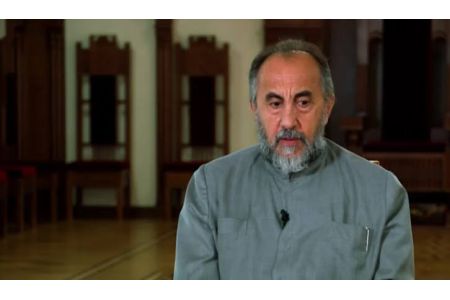
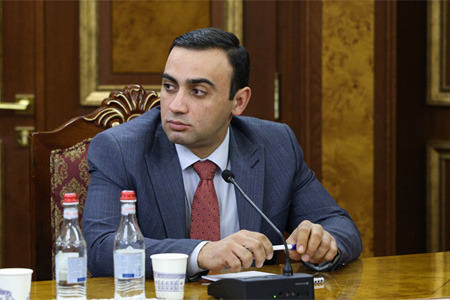
ArmInfo. Azerbaijan has received two documents from Armenia - the Washington Agreement and the November 9 trilateral statement - guaranteeing unimpeded communication with its exclave of Nakhichevan, as stated by Sergey Melkonyan, an orientalist and history PHD, during a lecture in Yerevan dedicated to recent events in the region.
Specifically, the expert touched on the peace treaty and called for consideration of three aspects of the negotiation process: the peace treaty, the unblocking of communications, and the border delimitation and demarcation. According to Melkonyan, all of these, were laid out following the 44-day war of 2020. Regarding the first aspect, the expert recalled that Armenia and Azerbaijan finalized consultations on the peace treaty text in March 2025. However, he noted that after the meeting in Washington, the peace treaty was only initialed, not signed.
As Melkonyan clarified in this regard, many more steps must be taken before the treaty can be signed. Specifically, the treaty's constitutionality must be verified, its ratification by the country's parliament, the presidential signature, and so on. "Meanwhile, Armenia and Azerbaijan have made no progress on any of these points. Essentially, they haven't moved forward. They haven't even begun to implement the first stage of signing the peace treaty," Melkonyan noted.
Touching on the second aspect of the negotiation process, namely, unblocking communications, the expert mentioned that the parties haven't yet reached a final conclusion. There is no comprehensive agreement on this issue, except for the agreement reached in Washington regarding the Trump route. "As for border delimitation and demarcation, this negotiation track could last for decades, as we're talking about difficult mountainous and sometimes forested terrain," the expert noted.
Considering this, the expert further also took into account what each side gained from the Washington meeting and the initialing of the peace treaty. In terms of Azerbaijan, Melkonyan noted that this included the dissolution of the OSCE Minsk Group, mandated to resolve the Karabakh conflict; the repeal of Section 907, which was passed with the assistance of the Armenian lobby in the United States and prohibits the US from providing military assistance to Azerbaijan and establishing a strategic partnership with them; and Azerbaijan's unimpeded access to its exclave of Nakhichevan.
"As for Armenia, it has received a reduction in the risk of escalation, meaning the country has gained a year. This includes a partial normalization of relations with Turkey. However, Armenia was unable to change the modalities of negotiations with the Turkish side regarding the reopening the road that was closed in April 1993. Furthermore, the country received a new formula for the road, namely, the Trump route. And another benefit is the assurance of a peace agenda before the 2026 elections," Melkonyan listed. However, the expert also touched on the vestiges of the conflict, including the occupation of 220 square kilometers of Armenian territory, prisoners of war in Baku, the absence of processes for implementing the right of return to Artsakh, and Azerbaijan's territorial claims. "Regarding the first issue, that is, the occupation of Armenian territories, it is also important to note that Azerbaijan holds a dominant position in along the entire eastern line of contact. This means the imbalance is quite serious," Melkonyan noted.
Regarding the peace treaty, the expert also noted that Azerbaijan initially has set a demand that is virtually impossible to fulfill. He referred to the Armenian Constitution. The expert noted that constitutional amendments can only be made through a referendum, and the majority of the population is currently opposed to such a requirement. "Essentially, Azerbaijan has created an obstacle that will prevent the signing of a peace treaty. It's clear that Azerbaijan isn't even pursuing this, as the treaty isn't beneficial to them. They have already received two documents from Armenia-the Washington Agreement and the November 9 trilateral statement-guaranteeing unimpeded communication with its exclave of Nakhichevan. A peace treaty isn't of interest to Azerbaijan until they receives additional benefits from it," Melkonyan concluded.



















 Expert: Current process is not about peace, but implementing Azerbaijan`s wishlist
 Expert: Real peace unattainable until Armenia-Azerbaijan agreement is signed and ratified
 TRIPP`s proximity to Iranian border could slow its implementation - expert
  Who and why is sacrificing RA National Security Service`s reputation? - expert
  Tehran creating security environment in which sustainable shipping in Strait of Hormuz difficult to imagine without its direct participation - expert
  Arrested Armenian oligarch on economy and new jobs
  NA Vice Speaker candidate believes his wife`s salary as director of HayPost is the lowest in the company`s history
 RF Permanent Representative: There is no CSTO-Armenia conflict
 Moscow: NATO seeking to "Pull" Armenia away from CSTO Allies
  Political analyst: Russia intends to determine which "Camp" Armenia will choose through a referendum
 Narek Karapetyan will give up his parliamentary salary in favor of charitable contributions.
 Armenian analyst: Developing relations with Europe and the U.S. must not jeopardize relations with regional powers
 Armenia and France discuss further development of strategic partnership and EU cooperation
  To overcome risks Armenia must reduce domestic escalation - expert
  Zatulin: Pashinyan was eager to get back to Russia because he actually lost the elections
 Human rights activist Ruben Melikyan dismissed from YSU
 Pashinyan removed from INNOPROM guest list
 Zakharova: Armenia`s pro-EU pivot poses economic security risks to EAEU member states
 It`s time for South Caucasus countries to think of South Caucasus as single, unified region - RA premier
  Pashinyan: Armenia and Azerbaijan should leave each other alone
