


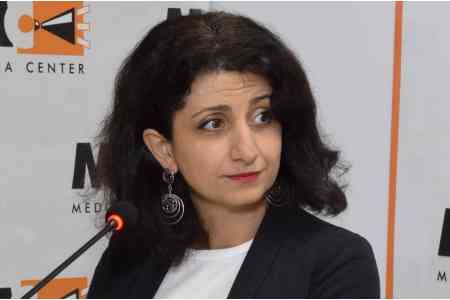
ArmInfo. Against the backdrop of the statements made by Armenian authorities' about their readiness to suspend the international investigation into crimes committed by Azerbaijan, the effectiveness of domestic efforts, including in the context of determining the fate of Armenian prisoners of war, is a concern. Anna Melikyan, human rights expert and representative of the "Protection of Rights Without Borders," NGO made this statement during a discussion on the rights of Armenian prisoners of war held in Baku.
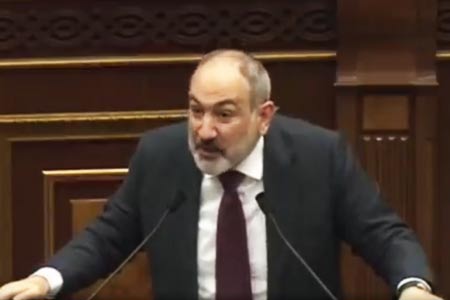
The expert noted that the absence of the issue of prisoners in the draft peace agreement, which could essentially provide guarantees for their return, is concerning. Furthermore, she said that after the Washington agreements, high-ranking Armenian officials are less frequently addressing this issue. In this vein, she recalled Prime Minister Nikol Pashinyan's participation in a session of the Parliamentary Assembly of the Council of Europe (PACE). "From the PACE rostrum, the Armenian Prime Minister merely stated that this issue (the issue of Armenian prisoners of war - ed.) "needs to be addressed". That is, it is unclear whether the Armenian side simply wants to record that our compatriots are being forcibly held there, whether it is striving for their return at all, or has no demands whatsoever regarding our prisoners of war," Melikyan lamented.
In this context, the expert pointed out the risks that may follow in case of refusal to investigate these violations. She recalled that ignoring the crimes committed by Azerbaijan during the April 2016 war allowed the country to move to more extensive action in 2020. Regarding the fate of the Armenian hostages, Melikyan mentioned that back in 2020, when Azerbaijan returned several captives to Yerevan, it was recorded in interviews with them that they had been tortured even in the presence of their lawyers. "This means that the Armenian prisoners of war currently officially in Baku are left without any protection," the expert noted.
In this regard, she noted that seven of them have already been sentenced, and therefore, they no longer appear in public. "It turns out that the only way to get information about their fate is through phone calls with their relatives. It should be noted that these are monitored calls, which make it impossible to determine the actual conditions they are in," the human rights expert added. Regarding the lack of condemnation of Azerbaijan's actions, Melikyan stated that international law allows for administration of justice for detainees during conflict situations. However, she noted that this only applies to cases where a crime has actually been committed. "Azerbaijan is taking full advantage of this opportunity, and for this very reason, it chooses charges that, under international law, should be punishable. This allows Azerbaijan to demonstrate that they are not judging prisoners , but criminals, thereby justifying all of their actions against them," Melikyan clarified.
It is precisely for this purpose, as the expert noted, that Azerbaijani President Ilham Aliyev misses no opportunity at international forums to reiterate that the crimes in Artsakh were committed within the framework of international law. "Therefore, it is crucial for the Armenian side to take steps to document violations by the human rights structures of another country," the expert added.
Summarizing the above, Melikyan emphasized that without documenting the crimes committed by Azerbaijan, the peace treaty cannot guarantee their prevention in the future.









 Political scientist: Real recount will deprive Pashinyan of any constitutional majority
 Expert: Even OSCE observers recorded numerous violations during elections in Armenia
  Armenia`s ex-minister of justice calls on opposition to honestly answer questions troubling Armenian citizens
 Elections in Armenia were accompanied by unprecedented pressure on opposition, RF MFA spokesperson claims
  Moscow to await official results of Armenian elections - Peskov
 Antonio Costa: EU to deepen its partnership with Armenia, expanding cooperation in energy, trade, and digitalization
 Israeli MFA congratulates Pashinyan
 Turkish MFA comments on results of Armenian elections
  Zakharova: International observers cannot ignore `flagrant violations` in Armenian elections
 Strong Armenia to issue statement after vote count completed - Narek Karapetyan
 Russian Senator: Opposition complaints regarding election violations by ruling party remain unanswered
 RA premier receiving congratulations on his victory in parliamentary elections
 Head of IPA CIS Council Secretariat: Extremely difficult atmosphere during parliamentary elections campaign in Armenia accompanied by mass arrests
 Pashinyan`s party leads with 51.13% based on vote counts from 533 polling stations
 Voting in parliamentary elections in Armenia ends
  Strong Armenia: Administrative Court not providing judicial decisions to citizens wishing to vote in parliamentary elections