


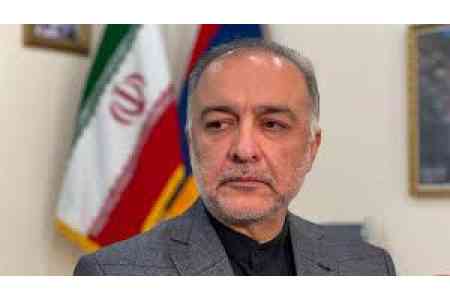
ArmInfo. Iranian Ambassador to Armenia Mehdi Sobhani supported the Washington agreements between Yerevan and Baku.
According to the diplomat, the agreement between Yerevan and Baku includes five principles that the Islamic Republic of Iran adheres to, including respect for national sovereignty, respect for the integrity of borders, jurisdiction, reciprocity and inviolability of borders. In this vein, he quoted Armenian officials who stated that Yerevan "will not take any steps that contradict the interests of the Islamic Republic of Iran and the relations between the two countries."
Referring to the issue related to the transit corridor, the diplomat said that this issue was only initialed in the 17-point peace agreement between the two countries and has not yet been finally signed. According to Sobhani, neither the peace agreement document nor the statement signed by the two countries in Washington mentions transport routes or anything called a corridor, but only discusses opening transport routes that will provide Azerbaijan with access to Nakhchivan, while Armenia, in turn, will be connected to Jolfa in Iran by rail.
"The text of the statement between Azerbaijan and Armenia, the details of which are to be discussed by the two countries in the future, fully takes into account the five principles that the Islamic Republic of Iran desires, including respect for national sovereignty, respect for the integrity of borders, jurisdiction, reciprocity and inviolability of borders, and therefore there is no reason to worry about this," he said in an interview with Isca News. Sobhani added that Armenia and the United States have agreed verbally, not in writing, to register an Armenian-American joint venture in Armenia and to determine the operator and investor for the implementation of the project, which will be entirely within the framework of Armenia's national sovereignty and jurisdiction and will be regulated by Armenian security agencies, passport control and customs procedures. "According to the agreement, this will be a kind of operatorship, not ownership of the route," he noted.
The senior Iranian diplomat cited the example of Yerevan Airport, which is owned by the Armenian government, and passport control, customs procedures and security checks are carried out by the government, but the management of the airport has been handed over to an investment company, adding that based on the above, the expressions used under the name of "99-year lease" for the agreed transit route are incorrect.
Sobhani assured that the Armenian government stated during the visit of the Iranian President that it will not take any steps that are contrary to the interests of the Islamic Republic of Iran and the relations between the two countries, and that the common border with Iran is of special importance to them, and they will not harm it in any way.
The Iranian ambassador to Yerevan said that the common border between the two countries is a "border of hope" and has been a symbol of good neighborliness between the two countries throughout history, and stressed: "Considering the agreements reached, the future of relations between the two countries will be very bright and will expand further than before." The diplomat assured that the visit of the Secretary of the National Security Council of Armenia to Tehran just a few days after the visit of the Iranian President to Yerevan for security talks reflects the understanding of the Armenian side of Iran's sensitive issues. "Very good negotiations took place in this regard, and both countries are on the way to signing a long-term strategic agreement that will take into account all considerations," he concluded.
On August 8, Armenian Prime Minister Nikol Pashinyan and Azerbaijani President Ilham Aliyev signed a seven-point joint "Declaration of Peace" in Washington. It provides for a joint appeal to the Organization for Security and Cooperation in Europe (OSCE) to terminate the OSCE Minsk process and related structures, as well as the creation of a transport corridor through Armenian territory that will connect Azerbaijan with its Nakhchivan exclave, surrounded by Armenia, Turkey and Iran. The TRIPP project (Trump Route for International Peace and Prosperity, a 42-km road in the south of Armenia that will hand over control of the road to the United States for 99 years), according to experts, is capable of significantly changing the geopolitical situation in the South Caucasus.






































 Expert: Even OSCE observers recorded numerous violations during elections in Armenia
  Armenia`s ex-minister of justice calls on opposition to honestly answer questions troubling Armenian citizens
 Lawyer: according to preliminary results, Pashinyan`s party lacks 2/3 majority necessary to amend Armenia`s Constitution
 Moscow to await official results of Armenian elections - Peskov
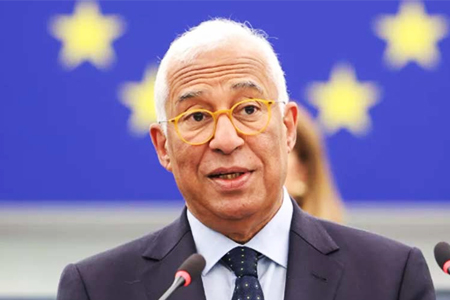 Antonio Costa: EU to deepen its partnership with Armenia, expanding cooperation in energy, trade, and digitalization
 Israeli MFA congratulates Pashinyan
 Turkish MFA comments on results of Armenian elections
  Zakharova: International observers cannot ignore `flagrant violations` in Armenian elections
 Strong Armenia to issue statement after vote count completed - Narek Karapetyan
 Russian Senator: Opposition complaints regarding election violations by ruling party remain unanswered
 RA premier receiving congratulations on his victory in parliamentary elections
 Head of IPA CIS Council Secretariat: Extremely difficult atmosphere during parliamentary elections campaign in Armenia accompanied by mass arrests
 Pashinyan`s party leads with 51.13% based on vote counts from 533 polling stations
 Voting in parliamentary elections in Armenia ends
  Strong Armenia: Administrative Court not providing judicial decisions to citizens wishing to vote in parliamentary elections