


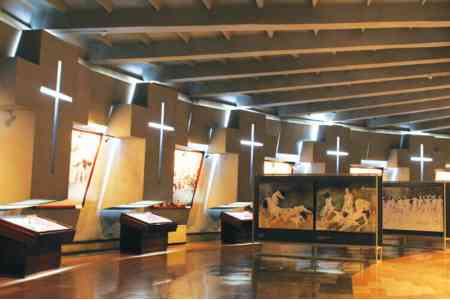
ArmInfo. The Armenian Genocide Museum-Institute received a valuable donation from the Artinyan family, who came to Armenia from the United States. It is a handwritten lament by Karapet Artinyan (1879-1925), a survivor of the Adana massacre (1909), which was donated to the Institute by his great-grandson Robert Artinyan as a result of a unanimous decision of his heirs, as noted in a statement issued by the Armenian Genocide Museum-Institute. It mentions that Karapet Artinian, who lost his wife and child in the Adana massacres, shortly after, in June 1909, wrote this lament in Armenian letter Turkish in chronological order of the massacres.
The lament (destan) consists of fifty-seven quatrains written in the third person. The genre of destan, which has Persian origins, was also widespread in the Ottoman Empire, depicting heroic deeds, romantic stories, and sometimes tragic events. Due to its secular nature, the destan was widely used by various religious communities in the Ottoman Empire: Armenians, Greeks, Assyrians, Jews, and Muslims.
Karapet Artinyan was born in 1879 in Adana. He studied at the seminary of the Armenian Patriarchate of Jerusalem. Having lost his parents during the Hamidian massacres, he left the seminary. In 1909, his wife and child fell victim to the Adana massacres. Despite his deep emotional experiences, a few years later he married a second time, taking as his wife a woman named Asante (or Anet). According to his grandson, Robert Artinian, after the massacres, Artinian and the rest of his family moved from Adana to Alexandria, then to Argentina, where they lived until 1917.
According to US immigration documents, Charles-Karapet Artinian arrived in New York in January 1917 on the ship "Vestiris". Five months later, he was joined by his wife, Asante, and children, Maria and Frank. The family settled in Malden, Massachusetts, where Artinian worked as a shoemaker at the Converse Rubber Company from 1917-1918. After living in Malden for a year, the family moved to Detroit. The traumas that Artinian suffered - the murder of his parents and family and the horrors he witnessed in Adana - had serious consequences for his health. He constantly suffered from health problems. In 1925, at the age of forty-five, Charles-Karapet Artinian died suddenly of a heart attack. Historian Petros Ter-Matosyan discussed Karapet Artinian's valuable work in his scientific article in 2023.










































 Political scientist: Real recount will deprive Pashinyan of any constitutional majority
 Expert: Even OSCE observers recorded numerous violations during elections in Armenia
  Armenia`s ex-minister of justice calls on opposition to honestly answer questions troubling Armenian citizens
 Elections in Armenia were accompanied by unprecedented pressure on opposition, RF MFA spokesperson claims
  Moscow to await official results of Armenian elections - Peskov
 Antonio Costa: EU to deepen its partnership with Armenia, expanding cooperation in energy, trade, and digitalization
 Israeli MFA congratulates Pashinyan
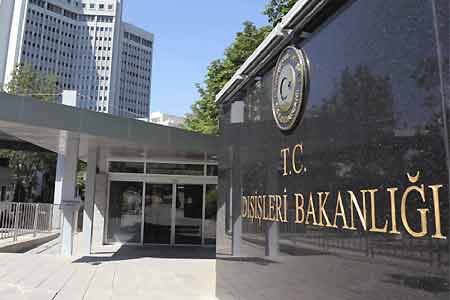 Turkish MFA comments on results of Armenian elections
  Zakharova: International observers cannot ignore `flagrant violations` in Armenian elections
 Strong Armenia to issue statement after vote count completed - Narek Karapetyan
 Russian Senator: Opposition complaints regarding election violations by ruling party remain unanswered
 RA premier receiving congratulations on his victory in parliamentary elections
 Head of IPA CIS Council Secretariat: Extremely difficult atmosphere during parliamentary elections campaign in Armenia accompanied by mass arrests
 Pashinyan`s party leads with 51.13% based on vote counts from 533 polling stations
 Voting in parliamentary elections in Armenia ends
  Strong Armenia: Administrative Court not providing judicial decisions to citizens wishing to vote in parliamentary elections