

ArmInfo. The Azerbaijan-Israel alliance, driven by the mutual and individual interests of the two countries, poses a realistic threat to reshaping the "map" of the Middle East and the South Caucasus, and is dangerous not only for the entire region but also for individual states, including Armenia, Iran, and Turkey, as stated in an analytical note by the Geghard Scientific and Analytical Foundation, received by ArmInfo.
In this vein, the foundation mentioned that Israel was among the first to officially recognize the independence of Azerbaijan on December 25, 1991. In addition, diplomatic relations were established between the countries in 1992, and in 1993, Israel opened its embassy in Azerbaijan. "And from the mid 2000s, the Israeli leadership gave new impetus to the development of relations with Azerbaijan. A catalyst for this was the success of the Israel Our Home party in the 2006 Knesset elections (Israeli parliament - ed.) and the appointment of its leader, Avigdor Lieberman as Deputy Prime Minister and Minister of Strategic Planning," the report notes. As Geghard noted, it was with his assistance that Baku began acquiring modern Israeli equipment, which was used against Artsakh war in 2016, 2020 and 2023.
The foundation noted that it was after the war in Artsakh and its occupation that this cooperation, after 30 years of direct contacts, was made public. " However, it was only in July 2021 that Azerbaijan opened a trade office in Tel Aviv, which the Israeli ambassador in Baku described as a historic event. Despite nearly 30 years of direct contacts, Azerbaijan only opened its embassy in Israel in March 2023," the report explains. In addition, Geghard noted that although the initial data on the signing of contracts for the purchase of Israeli weapons dates back to 2008, there is information about Israel's military support to Azerbaijan during the first Artsakh war, in particular, the provision of Stinger missiles. "Meanwhile, according to the Stockholm International Peace Research Institute (SIPRI), between 2016 and 2020, 69% of weapons imported to Azerbaijan came from Israel, accounting for 17% of Israel's total arms exports. The sale of weapons to Azerbaijan brought Israel not only provide economic benefits, but with such support, the Jewish state acquire a significant platform against Iran," Geghard noted.
In this vein, the foundation recalled the statement by Azerbaijani President Ilham Aliyev that the relations between the countries resemble an iceberg, nine-tenth of which is out of sight of outsiders. "In fact, while the Azerbaijan-Israel alliance has positive significance for both countries, it is problematic for other regional states due to security challenges. Within the framework of this alliance, the civilian populations of Azerbaijan and Israel are used as "military fodder," while the results benefit exclusively the ruling families and their relatives," Geghard concluded.
























 Opinion: Following Berlin talks, Baku gains expanded influence within EU and strengthens cooperation ties with main European powerhouse
 Armenian expert: Could modern Azerbaijan even exist without Russian and Soviet modernization?
 Zatulin: Pashinyan was eager to get back to Russia because he actually lost the elections
 Human rights activist Ruben Melikyan dismissed from YSU
 Pashinyan removed from INNOPROM guest list
 Zakharova: Armenia`s pro-EU pivot poses economic security risks to EAEU member states
 It`s time for South Caucasus countries to think of South Caucasus as single, unified region - RA premier
  Pashinyan: Armenia and Azerbaijan should leave each other alone
 Moscow sees situation with Armenia as attempt to attack Russia-involving integration associations - Russian presidential aid
 Zakharova: Armenia views relations with Russia as tool for financially securing reorientation toward EU
 The Armenian Minister of Justice and the EU Ambassador discussed visa liberalization issues for Yerevan.
 Azerbaijan`s aggressive plans against Armenia became possible in wake of Pashinyan`s decisions on Artsakh - expert
 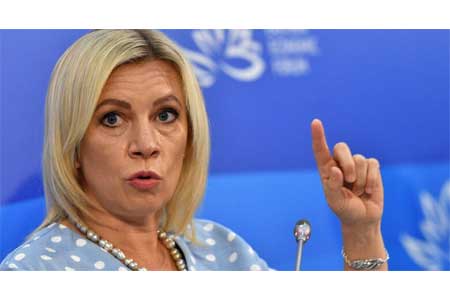 Zakharova: Russia sent a note of protest to Armenia over the act of vandalism at the "Mother Armenia" memorial in Gyumri
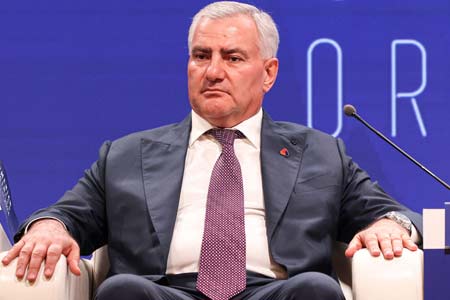 Samvel Karapetyan proposes creating a post-election opposition coalition