

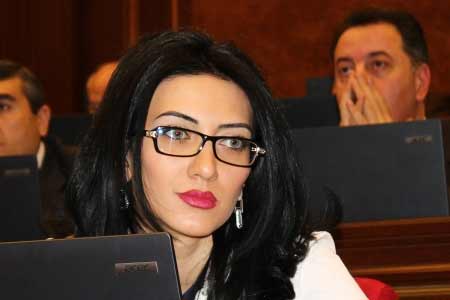
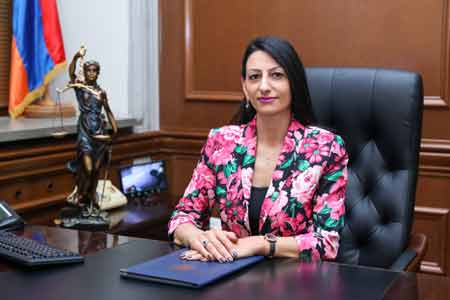
ArmInfo. The urgent decision from the arbitration court regarding the claim of Russian businessman Samvel Karapentyan against the Armenian authorities' decision to nationalize his company "Electric Networks of Armenia," is the first alarm for the authorities and a warning to stop, as stated by the former Minister of Justice of Armenia, Arpine Hovhannisyan, referring to today's decision of the Stockholm Arbitration Court.
"In essence, the arbitration court has obligated the Armenian authorities to refrain from actions outlined in amendments to Armenian laws on energy and public services. The decision is now in effect and is mandatory for execution," the lawyer noted.
Hovhannisyan pointed out that Art. 17 of Armenia's law "On Commercial Arbitration" includes provisions for enforcing the execution of an interim award, and addressing issues that may arise from non- compliance with the award. According to her, international mechanisms allow for double arbitration and compensation for damages. She expressed confidence that there will be a final decision on this case by an arbitration tribunal in the future.
"Why is urgent arbitration important? It is crucial as because it addressee identified threats and aims to neutralize them. This is a warning to the state about potentially more serious problems," the former minister noted. Hovhannisyan added that she is not yet familiar with the act and the security measures outlined by the arbitration, but it is obvious that it at least obligates the government to refrain from taking action against the ENA.
Then she touched on the recently introduced legislative amendments to the laws on energy and public services, breaking them down into stages. According to her, the first had already taken place: an interim manager of the ENA had been appointed. "Something unprecedented has happened: preventive measures were not entrusted to the Public Services Regulatory Commission, but to the head of the commission, which is a gross violation and an unconstitutional step that will likely be recognized by international courts in the future. Moreover, the head of the commission did not even provide explanations for appointing an administrator, nor did he develop a program. There is no explanation," the lawyer continued.
The second stage, according to her, involves the termination of the license, which will likely occur after "violations identified by law enforcement officers." "There is international experience suggesting that license termination is tantamount to property deprivation. While it may initially appear as administrative interference, it is actually considered interference in property relations,. There are many similar cases in world practice that are recognized as indirect deprivation of property," Hovhannisyan noted.
The third stage, she continued, concerns the fact that the state receives priority in acquiring property under certain conditions. "And here big questions arise related to constitutionality. From the point of view of property valuation, it may turn out that a person will be forced to sell property at a price at which he would never sell it," she noted. At the same time, the expert drew attention to the fact that in addition to the legal side of the issue, there is another aspect to consider - the attitude towards business.
"After all, this is a private business, and there is no culture of dialogue with private businesses. The decision is made hastily, implemented crudely and with serious legal issues. Frankly, there is no room for legal maneuvers. People may be unhappy with the power outages and think that government management will improve the situation, but they do not understand that ultimately, everything happened not through nationalization, but through hastily created structural solutions. Under these conditions, it is possible that all this will be transferred to another private owner, creating new problems and not solving the existing one. This is playing people's emotions. Not only will the problem not be solved, but due to the abuse of emotions, the state's reputation will suffer, the investment climate will worsen, and huge funds will be needed to compensate for the damage caused," Hovhannisyan noted, adding that it is important to understand this before giving in to emotions.















 Expert: The arrest of opposition figures in Armenia for social media posts is a systematic attempt to intimidate the public and suppress dissent.
 Azerbaijani Studies Expert: While Azerbaijan Prepares Its Generation for War, Aliyev’s Aide Calls on Armenia to Prepare Armenian Society for “Peace”
 Turkologist: Azerbaijan will never, under any circumstances, stop pressuring the Armenian people
 Political scientist: We need to move away from the question of "when" and replace it with more important questions
 Lukashenko called for Armenia to assume the CIS presidency in 2029
 Dmitry Medvedev predicted a Ukrainian-like fate for Armenia amid the country`s shift in foreign policy
 Russian Security Council: In Armenia, they want to force Russian asset owners to dispose of their assets
 Zakharova: Russia ready to discuss with Armenia the prospects for expanding military cooperation as part of a review of bilateral ties
 Tevanyan: Armenia, like Ukraine and Moldova, is being drawn into the EU’s global war
 Yerevan City Hall is considering introducing a valet parking system in the city
 Expert: The circus surrounding the “Albanization” of Armenian culture in the presence of foreign ambassadors in occupied Artsakh is genocide
 Political scientist: If Russian-Armenian relations are destroyed, Turkey will take Russia`s place
 Political scientist: The Armenian public is simply obliged to significantly change the entire content of public discourse and struggle
 Cross tattoos are being removed from the skin of Christian prisoners in Azerbaijan by fire, according to a human rights activist.
 Zakharova: Armenia`s likely introduction of visas with Russia will be a step against Yerevan itself
 Putin: Armenia`s recognition of Karabakh as part of Azerbaijan in Prague has given Russia`s position on this issue an ambivalent character
 Putin: Armenia`s adoption of the law on EU accession means an announcement of its withdrawal from the Eurasian Economic Union