

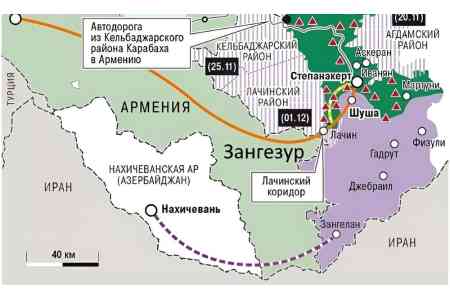
ArmInfo. Zangezur Corridor is a decisive test of the US ability to forge mutually beneficial solutions in contested regions, as noted in an analytical article published by Forbes.
The publication asks whether in a world scrambling for non-Russian energy amid escalating global tensions, could a 43-kilometer strip of Armenian land America's masterstroke against Moscow and Tehran? The US bold bid to lease the Zangezur Corridor for a century promises 50-100 billion dollars in annual trade flows, but risks igniting a new Cold War flashpoint in the Caucasus.
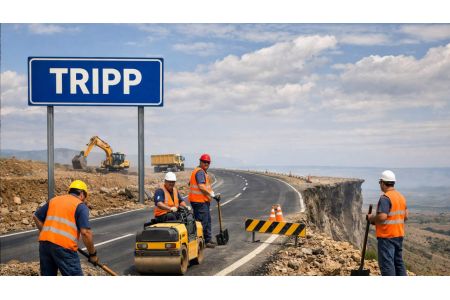
The United States has thrust itself into the center of a high-stakes diplomatic gamble that could fundamentally alter energy flows across Eurasia. Through its ambitious proposal for the Zangezur Corridor, a strategic 43-kilometer passage through Armenia's Syunik region, Washington aims to break decades-old deadlocks, diversify Europe's energy supplies away from Russia, and counter the growing influence of Moscow, Beijing, and Tehran in a critical transit region. The initiative reflects America's broader ambition to exploit a rare power vacuum in the South Caucasus, a region historically dominated by Russia but now ripe for realignment following Moscow's stark failure to protect its ally Armenia during Azerbaijan's decisive September 2023 offensive in Nagorno-Karabakh.
As former US Deputy Secretary of State James O'Brien noted: "The future built around the axis of Russia and Iran as the main players in regional security is unstable and undesirable, including for the governments of Armenia and Azerbaijan." "This Western alignment creates an unprecedented opening for U.S. influence. Russian imports to the region, which supplied 20-30% of regional trade pre- 2022, now face sanctions constraints. Meanwhile, Louis Bono, the U.S. Senior Adviser for Caucasus Negotiations, has advanced proposals for international oversight of the corridor, drawing on precedents like the Panama Canal and Cold War Berlin corridors. The potential economic rewards are vast enough to override political and security concerns. World Bank modeling suggests the corridor could unlock $50-100 billion in annual trade value by 2027. This surge would be driven by dramatic improvements in logistics: Bloomberg data from May 2025 indicates the route could cut transit Europe-Asia transit times by 12-15 days compared to existing routes. The return on investment appears compelling. The Caspian Policy Center estimates infrastructure costs of $3-5 billion over 5-10 years, while Oxford Economics models project $20-30 billion in annual logistics savings. For Azerbaijan, the Center for Economic Reforms Analysis and Communication projects the corridor would increase total exports by over $700 million and boost non-oil GDP by 2% annually. In 2023, Azerbaijan's Southern Gas Corridor delivered 12 billion cubic metres to Europe, targeting 20 billion by 2027 under a 2022 EU memorandum. Kazakhstan plans to transit increasing oil volumes via Azerbaijan, with actual flows reaching 1.2 million tones between January and October 2024, despite technical challenges limiting capacity. For European energy security, the implications are profound. The IEA's 2025World Energy Outlook projects Europe needs 20 billion cubic meters more non-Russian gas by 2030. Normalized Armenia-Turkey border could enhance access to Caspian reserves, potentially cutting import costs by 10-15% for companies like BP.
However, as the article highlights, the core challenges lies in irreconcilable positions: Azerbaijan demands an unimpeded corridor as dividends from its 2023 military victory, while Armenia categorically refuses to cede sovereignty what it views as critical territory.. The US "lease" proposal presents a creative attempt to use corporate legal frameworks to circumvent this deadlock, offering Baku security guarantees while allowing Yerevan to maintain nominal sovereignty. The approach draws inspiration from historical precedents in which creative governance mechanisms have resolved seemingly intractable disputes. Like the Panama Canal under US administration from 1914 to 1999, the model promises to facilitate global trade while addressing security concerns. Yet , critics warn of potential neo-colonial overtones and the risk of long-term backlash. The March 2025 peace deal drafts marked significant progress, finalising terms on mutual territorial recognition, border delimitation and non-use of force. However, they stalled on transport guarantees and enclave access - precisely where the US proposal seeks to break through.
The corridor's success would fundamentally alter regional power dynamics, explaining why rival powers are recalibrating their strategies. Iran faces the prospect of losing 20-30% of its transit role, disrupting critical trade routes, including the 43,000 Turkish trucks that pass annually to Central Asia.. Russia confronts potential revenue losses of $10-20 billion over a decade and a 10-15% erosion of its leverage over European energy markets. China, meanwhile, eyes $20-30 billion in Belt and Road efficiencies by 2030 through improved connectivity. Yet Beijing must balance these gains against the risk of reduced dependence on Chinese-controlled routes. The corridor could position Turkey as critical energy hub with direct access to Turkic states, potentially capturing $10-15 billion in annual transit revenue by 2030. Energy majors are positioning for opportunity. SOCAR expands pipeline capacity, while ADNOC explores hydrogen. joint ventures. BP and Chevron project $5-10 billion in upstream investment boosts from expanded export capacity. However, political stalemates could inflate project costs by 20%, while regulatory delays might push timelines beyond viable investment windows.
Turkey's strategic calculus adds complexity to the equation. Ankara explores Kurdish de-escalation through PKK conflict, signaling a "big reset" that could stabilize borders and unlock economic potential. This diplomatic thaw, if successful, could complement the Zangezur initiative by creating a more stable regional environment for major infrastructure projects. Turkish businesses in Eastern Anatolian provinces forecast a 310% increase in export capacity, from $160 million to $500 million annually, if the corridor materializes. This economic momentum provides strong incentives for sustained diplomatic engagement, even amid domestic political sensitivities. Despite compelling economics, significant risks remain. Observers assign a 60% probability to stalled talks, potentially delaying implementation by 12-18 months. Lloyd's data from June 2025 warns of 20% commodity volatility talks fail, while insurance premiums could spike by 20%.
Armenia has explicitly denied discussions regarding any lease or transfer of territorial control. Spokesperson Nazeli Baghdasaryan stated firmly that "Armenia has not discussed and is not discussing the transfer of control over its sovereign territory to any third party." This resistance highlights the fundamental challenge facing US mediators. The feasibility of international oversight remains uncertain. CSIS analysis estimate only 40-50% success probability even with UN guarantees, vulnerable to Armenian vetoes over perceived sovereignty encroachment. The success of the model depends on addressing core security concerns while maintaining sufficient international legitimacy.
More than an infrastructure development project, the Zangezur initiative represents a broader test of American diplomatic creativity in an increasingly multipolar world. Success would demonstrate Washington's ability to forge solutions that counter rival influence while serving real economic interests. Failure could signal diminished US capacity to shape outcomes in contested regions.









































 Expert: Economic pressure on Armenia may be virtually painless for other EAEU members, but not for Armenia itself
 Expert on protests in France: Civilizations fade when society loses a vision of the future
 Turkologist: Azerbaijan is not all-powerful—its vulnerabilities should become part of Armenia’s security strategy
 Opinion: The development of the Amulsar mine near the resort town of Jermuk is the beginning of an environmental disaster in Armenia
 Expert: The arrest of opposition figures in Armenia for social media posts is a systematic attempt to intimidate the public and suppress dissent.
 The Armenian Foreign Minister commented on the country`s return to work within the CSTO.
 The Artsakh Public Council expressed outrage at the UN Secretary-General`s behavior
 Lukashenko called for Armenia to assume the CIS presidency in 2029
 Dmitry Medvedev predicted a Ukrainian-like fate for Armenia amid the country`s shift in foreign policy
 Russian Security Council: In Armenia, they want to force Russian asset owners to dispose of their assets
 Zakharova: Russia ready to discuss with Armenia the prospects for expanding military cooperation as part of a review of bilateral ties
 Tevanyan: Armenia, like Ukraine and Moldova, is being drawn into the EU’s global war
 Yerevan City Hall is considering introducing a valet parking system in the city
 Expert: The circus surrounding the “Albanization” of Armenian culture in the presence of foreign ambassadors in occupied Artsakh is genocide
 Political scientist: If Russian-Armenian relations are destroyed, Turkey will take Russia`s place
 Political scientist: The Armenian public is simply obliged to significantly change the entire content of public discourse and struggle
 Cross tattoos are being removed from the skin of Christian prisoners in Azerbaijan by fire, according to a human rights activist.
 Zakharova: Armenia`s likely introduction of visas with Russia will be a step against Yerevan itself
 Putin: Armenia`s recognition of Karabakh as part of Azerbaijan in Prague has given Russia`s position on this issue an ambivalent character
 Putin: Armenia`s adoption of the law on EU accession means an announcement of its withdrawal from the Eurasian Economic Union