

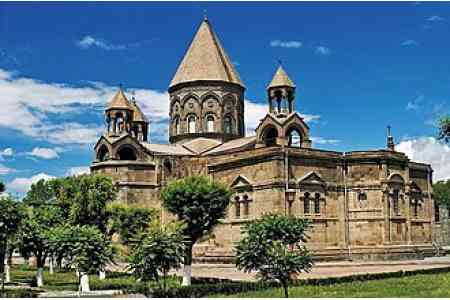
ArmInfo. The Pan-Armenian Council for the Protection of the Armenian Church has condemned Prime Minister Nikol Pashinyan's attacks against the Armenian Apostolic Church (AAC).
Moreover, noting the significance of expressing public support for the Church by public figures from the Armenian Diaspora, the Pan-Armenian Council suggested familiarizing oneself with the stance of Artashes Kasakhian, former Glendale Mayor in the USA and now a member of the City Council, regarding the authorities' attacks on the AAC.
Kasakhian's stance is outlined in a message received by ArmInfo from the Pan-Armenian Council. Specifically, he pointed out that attempts to weaken the Armenian Apostolic Church could undermine the last institution that continues to unite the Armenian community worldwide. "Armenian Prime Minister Nikol Pashinyan makes little effort to hide his hostility towards the AAC. He is driving a wedge between the people he is supposed to serve and the institution that has maintained the unity of the nation for nearly two thousand years. His campaign, disguised as populist slogans about "reforms" and "transparency" that brought him to power, quickly transformed into a well- thought- out attempt to take control of the Church. What began as political rhetoric has turned into a political cleansing," Kasakhian clarified.
In this vein, he recalled that clergy and those who criticized the prime minister's position have been arrested on fabricated charges, and an attempt is being made to deprive the Church of its autonomy and status. "Of course, none of these things are about modernization or morality: they are simply about control," the former Glendale mayor added. Kasakhian also pointed out another disturbing trend. According to him, Pashinyan's rhetoric regarding the AAC echoes Azerbaijan's stance. He mentioned that for many years, the Azerbaijani regime has accused the Armenian Church of "nationalism and extremism." "They accused the clergy of inciting hatred and presented our Church as a threat to peace. Now these messages from Baku about recognizing the Church as illegal, discrediting its leaders and removing it from the people coincide with official statements from Yerevan," the former mayor noted.
He drew attention to the fact that Nikol Pashinyan himself, during a meeting with representatives of the Armenian diaspora in Istanbul, made it clear that this is not just an internal issue. As Kasakhian noted, today this is a threat that impacts, among other things, Armenians living in the diaspora. "During a recent meeting with representatives of the Armenian community in Istanbul, Pashinyan declared that he is "not the prime minister of the Diaspora." This was not just an incorrect statement, but a political statement. By cutting ties with Armenians outside the country, the prime minister is effectively signaling that the Diaspora does not exist. This raises the question: if the state, which has made efforts to restore and support countless Armenian organizations, abandons the Diaspora, then who or what unites the Armenians of the Diaspora? It should come as no surprise to anyone that the structure that has connected Armenians to their ancestral roots and to each other for centuries is the very body that is being attacked by the Armenian authorities: the Armenian Apostolic Church," Kasakhian emphasized.
He also noted that the most pressing question is not whether the Armenian Church will withstand this attack, but whether the Armenian people in the Diaspora will stand up for it and resist. "The Armenian Apostolic Church has always been more than just a religious institution. It serves as a vessel of culture, history, and identity that has united Armenians across centuries and continents. If Armenia is now isolating itself, it is the duty of the Diaspora to stand in solidarity with each other and with the Church that has preserved our language, traditions, and collective memory. Now is not the moment to give up or become cynical. It is a time to fortify and reaffirm our commitment, despite pressure, persecution, or political difficulties. Our Church has protected and saved us from disasters in the past. We must not fail and we will not lose today," the former mayor concluded.





















 Armenian Historian: People Like Magdalena Grono Should Be Kept Away from the Thresholds of Armenian Shrines
 Azerbaijani studies expert: Armenia’s Foreign Ministry could use the ICC against Aliyev’s Armenophobic statements
 An Armenian political analyst exposed Hajiyev’s lies and attempts to mislead diplomats accredited in Azerbaijan in occupied Artsakh
 Expert: The circus surrounding the “Albanization” of Armenian culture in the presence of foreign ambassadors in occupied Artsakh is genocide
 Zakharova: Russia ready to discuss with Armenia the prospects for expanding military cooperation as part of a review of bilateral ties
 Tevanyan: Armenia, like Ukraine and Moldova, is being drawn into the EU’s global war
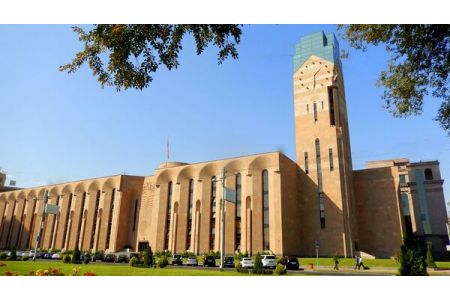 Yerevan City Hall is considering introducing a valet parking system in the city
 Political scientist: If Russian-Armenian relations are destroyed, Turkey will take Russia`s place
 Political scientist: The Armenian public is simply obliged to significantly change the entire content of public discourse and struggle
 Cross tattoos are being removed from the skin of Christian prisoners in Azerbaijan by fire, according to a human rights activist.
 Zakharova: Armenia`s likely introduction of visas with Russia will be a step against Yerevan itself
 Putin: Armenia`s recognition of Karabakh as part of Azerbaijan in Prague has given Russia`s position on this issue an ambivalent character
 Putin: Armenia`s adoption of the law on EU accession means an announcement of its withdrawal from the Eurasian Economic Union
 Medvedev: Yerevan will never become an EU member, but it will permanently damage relations with the Eurasian Economic Union, including with Moscow.
 Aram Vardevanyan: Public demands solutions, not apology scandals in Parliament
 Arrested Armenian oligarch on economy and new jobs
  "In Baku, we gave a worthy rebuff to the false claims regarding the past and present of our people" – Former Artsakh Parliament Speaker from Baku captivity
  NA Vice Speaker candidate believes his wife`s salary as director of HayPost is the lowest in the company`s history