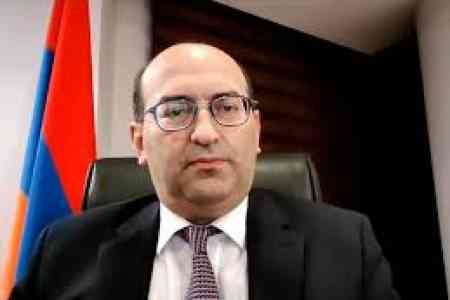
ArmInfo. It is necessary to combat the denial of the genocide through all possible means, as stated by the Armenian Ambassador to Greece, Tigran Mkrtchyan, during his speech at the event commemorating the 110th anniversary of the Armenian Genocide, held at the Acropolis Theater in Athens.
As reported by the Armenian Embassy in Greece, the Armenian diplomat recalled that since April 24, Armenia, many cities in Greece and other parts of the world are marking the 110th anniversary of the remembrance of the victims of the Armenian Genocide, planned and carried out by the leadership of the Young Turks in the Ottoman Empire. According to him, political leaders make statements dedicated to the memory of the victims of the Armenian Genocide. In this regard, he particularly highlighted the statements of Greek President Konstantinos Tasoulas, Prime Minister Kyriakos Mitsotakis, Parliament Speaker Nikitas Kaklamanis, as well as politicians and representatives from almost all parliament factions.
"Every time I reflect on the memory of the Armenian Genocide, I consider it important to touch upon several circumstances, if we prioritize them in our daily efforts, we will be able to achieve progress in preventing new genocides. First, it is necessary to combat genocide denial in every possible way. Denial takes various forms and methods, all aiming to deny genocide of Armenians and other peoples. The fight against denial is evident in various resolutions adopted by international bodies and national legislation, in particular, in resolutions criminalizing denial. In this sense, Greece stands out as one of the few countries that has not only recognized, condemned and honored the memory of the victims of the Armenian Genocide at the state level, but also criminalized the denial of the Armenian Genocide, the Holocaust and other genocides," the Armenian diplomat noted. Secondly, according to him, one key to successfully preventing genocide is to incorporate education about genocide not only in universities, but also in secondary schools.
"Thirdly, observing days of remembrance for the Armenian Genocide and other genocides is important. On these days, we pay tribute to the memory of innocent victims. In 2015, they were canonized by the Armenian Apostolic Church." Mkrtchyan noted that in the case of the Armenian Genocide, all of the aforementioned circumstances - the rejection of genocide denial, teaching it and the general commemoration of Genocide Day - were implemented in Greece, and this was not at all accidental. "Greece was one of the first countries to accept a significant number of Armenian refugees during the Hamidian massacres of 1895-1896. In 1915-1923, Greeks and Armenians fought together in self-defense battles in Trabzon, Samsun and other places. During the genocide, many Armenians found refuge in Greek homes, and Armenian children in the institutions of the Greek Orthodox Church," the Armenian diplomat noted.



















 RA Government guarantees high salaries for CC justices, Syunik families deprived of family benefits - politician
  Armenian experts, leading Turkish think tanks discuss prospects for expanding cooperation
  Political Scientist: As long as the opposition remains silent, Pashinyan can use Plan B and secure a constitutional majority
 US-Iranian memorandum more beneficial for Iran from political and economic perspective - expert
  Zakharova: Armenia`s pro-EU pivot poses economic security risks to EAEU member states
 It`s time for South Caucasus countries to think of South Caucasus as single, unified region - RA premier
  Pashinyan: Armenia and Azerbaijan should leave each other alone
 Moscow sees situation with Armenia as attempt to attack Russia-involving integration associations - Russian presidential aid
 Zakharova: Armenia views relations with Russia as tool for financially securing reorientation toward EU
 The Armenian Minister of Justice and the EU Ambassador discussed visa liberalization issues for Yerevan.
 Azerbaijan`s aggressive plans against Armenia became possible in wake of Pashinyan`s decisions on Artsakh - expert
  Zakharova: Russia sent a note of protest to Armenia over the act of vandalism at the "Mother Armenia" memorial in Gyumri
 Samvel Karapetyan proposes creating a post-election opposition coalition
 Artsakh`s Cultural Heritage Ombudsman called on Moscow to respond to destruction of WWII monuments by Azerbaijan in occupied NKR
 Prosecutor General`s Office petitions Central Electoral Commission for criminal prosecution of Robert Kocharyan
 Dutch Prime Minister expresses his support for Armenia`s democratic reform and economic diversification agenda
 Heritage: It`s time for Armenia`s opposition to present people with legitimate alternative to power
 RA Security Council Sec, Assistant to President of Azerbaijan hold negotiations in Dilijan