
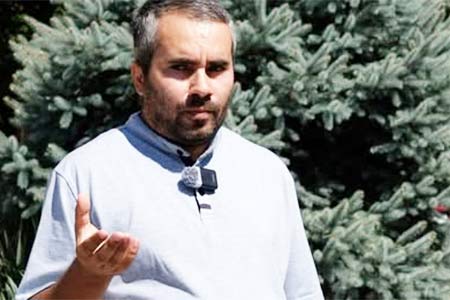
ArmInfo. The Armenian government is pursuing a clear goal: to prepare Armenian society for life under the protectorate of Turkiye, and in the long term - for its complete assimilation. This was stated by the coordinator of the "Hayakve" initiative Avetik Chalabyan, responding to the statement of the Prime Minister of Armenia Nikol Pashinyan on the need to revise the issue related to the Armenian Genocide in the Ottoman Empire.
In this vein, he recalled that back in May 2023, the civil initiative presented two important bills: one provided for criminal liability for recognizing Artsakh as part of another state, and the second - punishment for refusing to internationally recognize the Armenian Genocide.
"We realized that these two issues are closely interrelated, and that the current regime will try to advance the Turkish agenda in both aspects, since it is subordinate to Turkey's interests in the region. In the first case, it concerned the transfer of Artsakh and the expulsion of Armenians. Now, a year and a half later, the authorities no longer hide the fact that they initially did this allegedly to get rid of Russian influence, but in fact, to fulfill their political obligations to Turkey," Chalabyan explained.
As the public and political figure explained, the current regime in Armenia has moved on to the next stage of implementing its pro-Turkish agenda. According to him, the authorities are not only refusing international recognition of the genocide, but are also questioning its real existence, shifting the blame to the victims and raising absurd questions about how the Armenian Genocide ended up on the agenda at all, since it was beneficial to someone.
To achieve this goal, according to Chalabyan, the Armenian government needs to deepen the victim complex in the consciousness of society, deprive it of historical memory and the ability to resist.
"This has a simple goal: to prepare the Armenian society for life under the protectorate of Turkey and, ultimately, for its complete assimilation. In the past, the Armenian population of Turkey has already gone through something similar. And today, Ankara is preparing the same for the Armenian population of Armenia, which is the last major collective political unit of the Armenians and is capable of putting up organized resistance to the ambitious plans to create a Great Turan. Today, we are faced with a historical dilemma that calls into question our right to remain Armenians," Chalabyan emphasized. He explained that all this is being done in stages to remove another particle of Armenian identity from the consciousness of society and gradually turn people into rootless, dishonest and culture-less nomads. In this vein, he recalled other anti-Armenian actions of the current government: the exclusion of the subject "History of the Armenian Apostolic Church" from Armenian schools, the replacement of the history of the Armenian people with the history of Armenia, the attempt to remove the biblical Ararat from the coat of arms of the Republic and erase Artsakh from the memory of society. Chalabyan emphasized that all this is not an accident, but a deeply thought-out, well-calculated and cruel plan to expel Armenians from Armenia.
In this regard, he called on the Armenian public to resist the authorities in the implementation of their monstrous plan. "We must resist this monstrous plan and emerge from this ordeal even stronger than we are today. You will be brought to not only historical judgment, but also human judgment, and that day is steadily approaching," the coordinator of the Ayakwe initiative summed up.
During his visit on January 5, 2025, Armenian Prime Minister Nikol Pashinyan, in a video released by the government, questioned the fact of the Armenian Genocide in the Ottoman Empire at a meeting with representatives of the Armenian community in Switzerland. In it, he, in particular, stated: "We must understand what happened and why it happened. And how we perceived it, through whom we perceived it: how did it happen that in 1939 there was no agenda for the Armenian Genocide, but in 1950 it appeared? How this happened, we should understand or should not understand," the Armenian Prime Minister noted. Independent experts are inclined to believe that he is apparently either unaware that the term Genocide was introduced into circulation by genocide scholar Raphael Lemkin only in 1944, or he is deliberately trying to create a narrative that "this issue was artificially raised by the Soviet Union to put pressure on Turkey."
The Armenian Genocide in the Ottoman Empire was the first genocide in the 20th century. Armenians remember the victims of the tragedy every year on April 24. Turkey traditionally denies accusations of mass extermination of more than 1.5 million Armenians. The fact of the Armenian Genocide has been recognized by many states and a number of authoritative international organizations. The first country to recognize the Genocide in 1965 was Uruguay. Then this fact was recognized by Cyprus, Russia, Greece, Canada, Lebanon, Belgium, France, Paraguay, Argentina, Sweden, Bolivia, Great Britain, Holland, Slovakia, Germany, Lithuania, Venezuela, Poland, Chile, Switzerland, Brazil, Luxembourg, Austria, Vatican, Czech Republic, Denmark, Portugal, as well as the provisional government of Libya, the USA, Syria, the European Parliament, the World Council of Churches.











 Armenian Analyst: One of the Key Tasks of the United Opposition is to Form Effective Mechanisms to Contain the Armenian Authorities
 Armenian expert: Could modern Azerbaijan even exist without Russian and Soviet modernization?
 South Caucasus is entering a new phase of turbulence - ex-official
  Zatulin: Pashinyan was eager to get back to Russia because he actually lost the elections
 Human rights activist Ruben Melikyan dismissed from YSU
 Pashinyan removed from INNOPROM guest list
 Zakharova: Armenia`s pro-EU pivot poses economic security risks to EAEU member states
 It`s time for South Caucasus countries to think of South Caucasus as single, unified region - RA premier
  Pashinyan: Armenia and Azerbaijan should leave each other alone
 Moscow sees situation with Armenia as attempt to attack Russia-involving integration associations - Russian presidential aid
 Zakharova: Armenia views relations with Russia as tool for financially securing reorientation toward EU
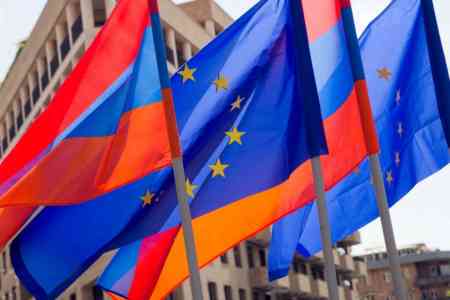 The Armenian Minister of Justice and the EU Ambassador discussed visa liberalization issues for Yerevan.
 Azerbaijan`s aggressive plans against Armenia became possible in wake of Pashinyan`s decisions on Artsakh - expert
  Zakharova: Russia sent a note of protest to Armenia over the act of vandalism at the "Mother Armenia" memorial in Gyumri
 Samvel Karapetyan proposes creating a post-election opposition coalition
 Artsakh`s Cultural Heritage Ombudsman called on Moscow to respond to destruction of WWII monuments by Azerbaijan in occupied NKR