ArmInfo. A commission will be formed under the Public Council of Armenia to collect facts about human rights violations during election campaigns. Amendments to the law "On the Public Council" were approved on November 28 in the second and final reading at a meeting of the RA National Assembly Committee on State and Legal Affairs.
Presenting the project, Deputy Minister of Justice of the Republic of Armenia Tigran Dadunts noted that since September 21, 1991, massive human rights violations have regularly occurred during elections in Armenia, accompanied by the persistent presence of systemic and political corruption in the country, which has been noted in a number of international reports. The political changes that took place in the republic in 2018 were the result of the sense of injustice accumulated in society as a result of these phenomena. The strategy of judicial and legal reforms approved on July 21, 2022, establishes the need to apply transitional justice tools to study cases of violation of citizens' rights that have taken place in Armenia since independence and collect facts on them. For these purposes, it is necessary to form a structure that should have such functions that will allow studying and mapping cases of massive and regular human rights violations during electoral processes that have taken place in Armenia since 1991, as well as their causes, submitting proposals for the restoration and protection of violated rights and preventing their recurrence.
As a result of the constitutional amendments of 2015, the Public Council was established in 2018, which operates as an advisory body to the RA Government. The main objectives of the Public Council are to represent the interests of various segments of society, promote the participation of civil society in public administration processes, promote the formation of mutual trust, dialogue and partnership between the government, public administration bodies and civil society institutions, as well as the formation of mutual trust, dialogue and partnership between Armenia and the Diaspora on common national issues.
It is proposed to form a commission under the Public Council to collect facts about violations of fundamental rights and freedoms of citizens. At present, according to the RA Law "On the Public Council", the functions of the PC include organizing public hearings or discussions on issues of public interest, as well as issues related to the most important areas of public life, conducting public examination of current laws and other regulatory legal acts, state programs, strategies, concepts and submitting conclusions, including recommendations for making changes and additions to them. Now one more function will be added to these functions - studying the facts of human rights violations from September 21, 1991 to 2023. The task of the commission will include identifying facts of human rights violations during elections, recognizing and restoring the rights of victims, implementing positive socio-political changes.
Thus, the commission under the OS will become an institution that complements criminal justice. At the same time, it will not be a judicial body, will not establish criminal liability or apply sanctions. If there is evidence useful for the investigation, this may help the work of the courts. The OS commission will have to focus on identifying fundamental human rights violations during the elections. Unlike parliamentary investigative commissions, the jurisdiction of the OS truth commission will be extended over a fairly broad period of time, which will allow it to identify historically entrenched systemic violations.
Their mandate will include identifying the scope of violations, including falsification of election results, murders and kidnappings, enforced disappearances, torture and other gross human rights violations, interrogating all those who can provide information on the facts under investigation, cooperating with government agencies and making the necessary visits, submitting requests, and carrying out witness protection measures. Based on the results of its work, the commission will present interim and final reports.
The final version of the report is subject to publication two years after the formation of the commission, with the right to extend this period for another year. Persons who have never previously held positions of state or civil servants and who demonstrate a reserved position on political issues may become members of the commission. Candidates will be represented by public organizations.










 Analyst: The primary issue with Armenia`s new Parliament Speaker`s speech lies is its one-sided interpretation of the causes of the political crisis
 Expert: Gagik Tsarukyan embodies post-Soviet model of big business-state relations; this model is used in many other post-Soviet countries
 Expert: Azerbaijan promoting aggressive plans against Armenia at state level
 Iranologist: Baku`s propaganda of might masks the country`s inability to provide water to its own population
 NA Vice Speaker candidate believes his wife`s salary as director of HayPost is the lowest in the company`s history
 RF Permanent Representative: There is no CSTO-Armenia conflict
 Moscow: NATO seeking to "Pull" Armenia away from CSTO Allies
  Political analyst: Russia intends to determine which "Camp" Armenia will choose through a referendum
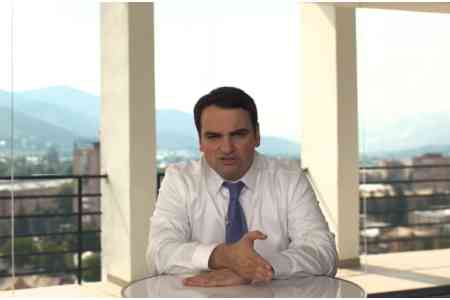 Narek Karapetyan will give up his parliamentary salary in favor of charitable contributions.
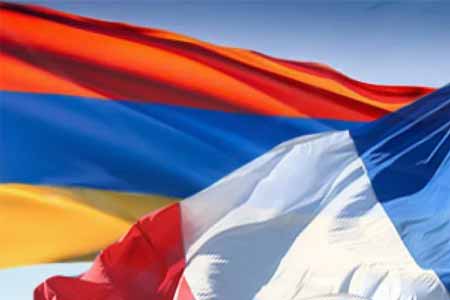 Armenia and France discuss further development of strategic partnership and EU cooperation
 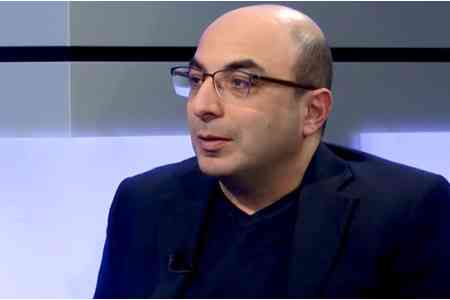 To overcome risks Armenia must reduce domestic escalation - expert
 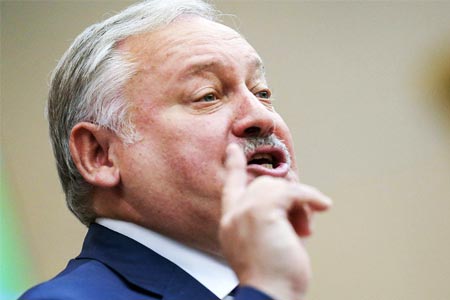 Zatulin: Pashinyan was eager to get back to Russia because he actually lost the elections
 Human rights activist Ruben Melikyan dismissed from YSU
 Zakharova: Armenia`s pro-EU pivot poses economic security risks to EAEU member states
 It`s time for South Caucasus countries to think of South Caucasus as single, unified region - RA premier
  Pashinyan: Armenia and Azerbaijan should leave each other alone
 Moscow sees situation with Armenia as attempt to attack Russia-involving integration associations - Russian presidential aid