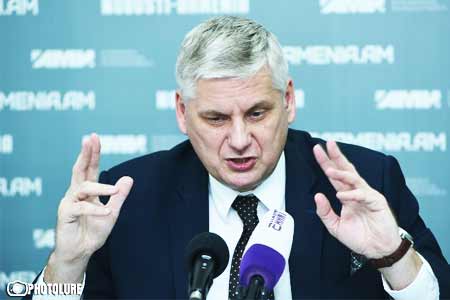
ArmInfo. The 2024 parliamentary elections will be the first campaign held within the internationally recognized borders of Azerbaijan. This was stated by Sergei Markedonov, Russian political scientist.
The political expert wondered whether the issues of climate change on Earth could be connected to the Armenian-Azerbaijani conflict and the Nagorno-Karabakh problem. He stated that posing such a question appeared as a bold postmodern approach. However, according to him, paradoxical convergence of different agendas sometimes occurs in international politics. He mentioned that on the first day of September, citizens of Azerbaijan would be electing deputies to the Milli Majlis (parliament) of the republic.
At the same time, Markedonov noted that throughout the post-Soviet history of Azerbaijan, parliamentary elections have not played a significant role, with the exception of the 2005 campaign. He said that during that time, many external experts were influenced emotionally and psychologically by the 2003 presidential campaign, which was the first elections involving Ilham Aliyev and was marked by mass protests, as well as the "Rose Revolution" in Georgia and "Orange Revolution" in Ukraine. "They were looking for signs of similar upheavals in Baku in the street actions of the Azerbaijani opposition blocs "Azadlig" and "Yes-New Policy". However, these expectations turned out to be inversely proportional to the real consequences of these actions.
Since those years, much has changed in Azerbaijan. Heydar Aliyev's successor turned out to be more than the son of a great father. He was able to not only rely on the vertical power structure created by his predecessor, but also to rebuild it based on his own ideas about the beauty. Naturally, these ideas did not always align with those of the opposition and external players," Markedonov believes. According to him, however, the political and ideological weaknesses of the former, and the interests in Azerbaijan among the latter, compensated for these problems.
"Having successfully resolved the issue of restoring the country's territorial integrity, Ilham Aliyev has further strengthened his own positions both domestically and internationally. And yet, in 2024, parliamentary elections were conducted as part of an extraordinary campaign, following the pattern of the 2020 and the 2024 presidential elections. Looking back now, we understand that the delay of the 2020 parliamentary elections was primarily due to the second Karabakh war. Spantaneous decisions in such matters are usually well thought out. In 2024, the postponement of the elections is attributed to Baku hosting the UN Climate Conference (Climate Summit/COP-29) from November 11-22. Azerbaijan is now taking over from the UAE," Markedonov added.
In this regard, he wondered what Nagorno-Karabakh has to do with it? "There is an indirect connection here for two main reasons. The upcoming 2024 parliamentary elections will be the first campaign held within the internationally recognized borders of Azerbaijan. Following the presidential election in February, now it is time for the parliamentary elections. During the presidential elections in Nagorno- Karabakh, 26 polling stations were open for 20 thousand voters. In September, there will be 55 stations for 40 thousand people. It is clear that this will be a significant event for the authorities. As Pierre Bourdieu taught us, symbols have a profound impact on the political landscape, sometimes even more so than economic factors," the political scientist added.
At the same time, he is certain, that without the KS-29, the Azerbaijani authorities would have found another reason. Markedonov believes that the key is Ilham Aliyev and his team's desire to modernize the national and state agenda. "Climate change is just one aspect of this strategy. Following this path has both advantages and obvious risks. Transitioning from a state of conflict to a development trajectory is an appealing option (hence the COP-29, Central Asia summits, economic diversification and focus on innovation). However, the Karabakh issue, in the political context of our country, has been the primary (and reliable) "glue" of Azerbaijani society and politics. How much stronger will the new national structures be compared to the old ones? The answer to this question remains to be seen," Markedonov concluded.













 Political Scientist: As long as the opposition remains silent, Pashinyan can use Plan B and secure a constitutional majority
 US-Iranian memorandum more beneficial for Iran from political and economic perspective - expert
  Political analyst: While Pashinyan pledges peace with Azerbaijan, Baku continues promoting the "Western Azerbaijan" project
 Political analyst: In light of new realities, Yerevan may propose advancing peace process with Baku without constitutional referendum
 It`s time for South Caucasus countries to think of South Caucasus as single, unified region - RA premier
  Pashinyan: Armenia and Azerbaijan should leave each other alone
 Moscow sees situation with Armenia as attempt to attack Russia-involving integration associations - Russian presidential aid
 Zakharova: Armenia views relations with Russia as tool for financially securing reorientation toward EU
 The Armenian Minister of Justice and the EU Ambassador discussed visa liberalization issues for Yerevan.
 Azerbaijan`s aggressive plans against Armenia became possible in wake of Pashinyan`s decisions on Artsakh - expert
  Zakharova: Russia sent a note of protest to Armenia over the act of vandalism at the "Mother Armenia" memorial in Gyumri
 Samvel Karapetyan proposes creating a post-election opposition coalition
 Artsakh`s Cultural Heritage Ombudsman called on Moscow to respond to destruction of WWII monuments by Azerbaijan in occupied NKR
 Prosecutor General`s Office petitions Central Electoral Commission for criminal prosecution of Robert Kocharyan
 Dutch Prime Minister expresses his support for Armenia`s democratic reform and economic diversification agenda
 Heritage: It`s time for Armenia`s opposition to present people with legitimate alternative to power
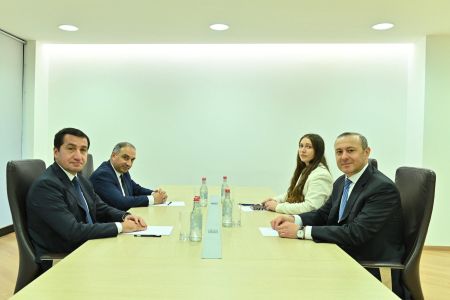 RA Security Council Sec, Assistant to President of Azerbaijan hold negotiations in Dilijan
 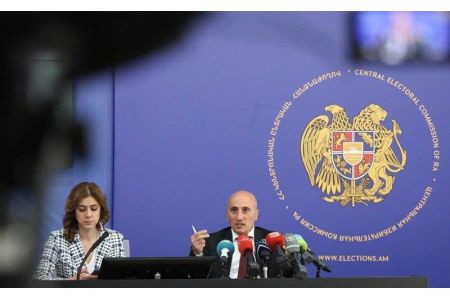 CEC Neutralizes PAP: Three Political Forces to Enter Armenian Parliament Following Election Vote