

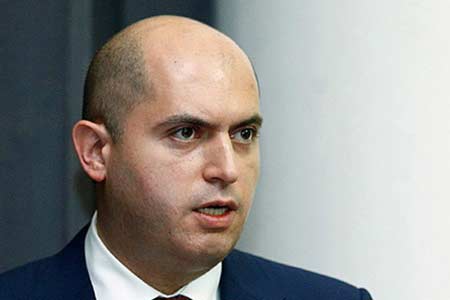
ArmInfo. The European Parliament completed discussing the situation in Nagorno-Karabakh, with about 20 short speeches, Armen Ashotyan, Vice-Chairman of the Republican Party of Armenia (RPA), wrote in a Facebook message.
All the speakers were unanimous in condemning Azerbaijan, demanding immediate unblocking of the Lachin corridor.
"They spoke of democracy, Azerbaijani gas and air communication, with accents on the West-Russia conflict as well.
"The European Commissioner for Transport [Adina Ioana Valean] made a speech on behalf of the European Commission, and her speech was, so to say, about nothing. Here is a unified version compiled out of 5 drafts. The vote is scheduled for January 19, and you will understand the content of debate from the draft," Ashotyan wrote.
The European Parliament,
- having regard to its previous resolutions on Armenia and Azerbaijan,
- having regard to Rules 144(5) and 132(4) of its Rules of Procedure,
A. whereas the only road connecting Nagorno-Karabakh with Armenia and the outside world, the Lachin corridor, has been blocked by self-proclaimed environmentalists from Azerbaijan since 12 December 2022; whereas this has disrupted access to essential goods and services, including food, fuel and medication, for the 120 000 Armenians living in Nagorno-Karabakh, effectively placing them under a blockade;
B. whereas the blockade has led to a severe humanitarian crisis, significantly affecting the most vulnerable populations; whereas the transfer of critically ill patients is nearly impossible, with one death resulting from this situation; whereas hundreds of families remain separated;
C. whereas this humanitarian crisis was further aggravated by Azerbaijan's disruption of the natural gas supply to Nagorno-Karabakh, which left houses, hospitals and schools without heating;
D. whereas by sustaining the blockade of the Lachin corridor, Azerbaijan is breaching its international obligations under the trilateral ceasefire statement of 9 November 2020, under which Azerbaijan must guarantee the security of persons, vehicles and cargo moving along the corridor in both directions;
E. whereas the impediments to the use of the Lachin corridor set back the peace process between Armenia and Azerbaijan and undermine international confidence; 1. Deplores the tragic humanitarian consequences of the blockade of the Lachin corridor and the Nagorno-Karabakh conflict;
2. Urges Azerbaijan to respect and implement the trilateral statement of 9 November 2020 and immediately reopen the Lachin corridor to enable free movement and ensure access to essential goods and services, thus guaranteeing security in the region and safeguarding residents' livelihoods;
3. Underlines the need for a comprehensive peace agreement, which must guarantee the rights and security of Nagorno-Karabakh's Armenian population; calls on Azerbaijan to protect the rights of Armenians living in Nagorno-Karabakh and refrain from its inflammatory rhetoric that calls for discrimination against Armenians and urgesArmenians to leave Nagorno-Karabakh;
4. Urges Azerbaijan to refrain from undermining the functioning of transport, energy and communication connections between Armenia and Nagorno-Karabakh in future;
5. Strongly condemns Azerbaijan's scapegoating of human rights defenders and CSOs and calls on EU and Member State representations to support their work;
6. Condemns the inaction of Russian 'peacekeepers'; considers that their replacement with OSCE international peacekeepers, under a UN mandate, should be negotiated urgently;
7. Calls for international organisations to be granted unimpeded access to NagornoKarabakh to assess the situation and provide the necessary humanitarian assistance;
8. Calls for a UN or OSCE fact-finding mission to the Lachin corridor to assess the humanitarian situation on the ground;
9. Calls for the urgent resumption, without preconditions, of negotiations based on the principles of the Helsinki Final Act;
10. Calls for the EU to be actively involved and ensure that the inhabitants of NagornoKarabakh are no longer held hostage by Baku's activism, Russia's destructive role and the Minsk Group's inactivity;
11. Instructs its President to forward this resolution to Armenia, Azerbaijan and international institutions.
Last December, the official website of the European Parliament published a draft resolution on the annual report on the implementation of the European Union's Common Foreign and Security Policy (CFSP).
The document reads, in particular:
91. Welcomes the Union's enhanced engagement with the countries of the Southern Caucasus, notably the swift adoption of an EU monitoring capacity mission along Armenia's international border with Azerbaijan in order to monitor the situation in the region, build confidence and contribute to restoring peace and security; highlights the importance of decreasing Russian influence in the region through increased EU presence; calls on the Council to expand the number of deployed experts and increase the mission capacity, and calls for stronger presence in the region;
92. Strongly condemns the latest military aggression by Azerbaijan on 12 September 2022 on the sovereign territory of Armenia, which constituted a breach of the ceasefire and is having serious consequences on the peace process; is also concerned by the alleged war crimes and inhuman treatment perpetrated by the armed forces of Azerbaijan against Armenian prisoners of war and civilians; reiterates that the territorial integrity of Armenia must be fully respected and underlines the EU's readiness to be more actively involved in settling the region's protracted conflicts; calls on the Azerbaijani authorities, therefore, to immediately withdraw from all parts of the territory of Armenia and to release the prisoners of war under their control; recalls that only diplomatic means will bring a just and lasting response to the conflict that will benefit the populations of Armenia and Azerbaijan;
93. Is convinced that a sustainable peace between Armenia and Azerbaijan cannot be achieved through military means but needs a comprehensive political settlement in accordance with international law, including the principles enshrined in the UN Charter, the 1975 Organization for Security and Co-operation in Europe (OSCE) Helsinki Final Act, as well the OSCE Minsk Group's 2009 Basic Principles of territorial integrity, self-determination and non-use of force;
94. Supports the initiative taken by the President of the European Council Charles Michel to convene and mediate bilateral meetings of the leaders of Armenia and Azerbaijan in Brussels and encourages the work on the ground by the EU's special representative for the South Caucasus and the crisis in Georgia; believes that the EU can play the role of an honest broker to prevent further escalation and achieve sustainable peace; urges Armenia and Azerbaijan to fully engage in the drafting of a comprehensive peace treaty; reiterates that such a treaty has to address all the root causes of the conflict, including the rights and security of the Armenian population living in Nagorno-Karabakh, the return of displaced persons and refugees to their homes under the control of the Office of the UN High Commissioner for Refugees, inter- religious dialogue, the protection and conservation of cultural, religious and historical heritage and territorial integrity;
95. Calls for the full implementation of the Comprehensive and Enhanced Partnership Agreement with Armenia and underlines the need to continue negotiations on the Comprehensive and Enhanced Partnership Agreement between the EU and Azerbaijan;
96. Insists that any deepening of EU relations with Azerbaijan must remain conditional on the country making substantial progress on the respect for human rights, the rule of law, democracy and fundamental freedoms;







 Political Scientist: As long as the opposition remains silent, Pashinyan can use Plan B and secure a constitutional majority
 US-Iranian memorandum more beneficial for Iran from political and economic perspective - expert
  Political analyst: While Pashinyan pledges peace with Azerbaijan, Baku continues promoting the "Western Azerbaijan" project
 Political analyst: In light of new realities, Yerevan may propose advancing peace process with Baku without constitutional referendum
 Present-day geopolitical competition shifts from territorial control to infrastructure flows
 Zakharova: Russia sent a note of protest to Armenia over the act of vandalism at the "Mother Armenia" memorial in Gyumri
 Artsakh`s Cultural Heritage Ombudsman called on Moscow to respond to destruction of WWII monuments by Azerbaijan in occupied NKR
 Prosecutor General`s Office petitions Central Electoral Commission for criminal prosecution of Robert Kocharyan
 Dutch Prime Minister expresses his support for Armenia`s democratic reform and economic diversification agenda
 Heritage: It`s time for Armenia`s opposition to present people with legitimate alternative to power
 RA Security Council Sec, Assistant to President of Azerbaijan hold negotiations in Dilijan
  CEC Neutralizes PAP: Three Political Forces to Enter Armenian Parliament Following Election Vote
 Elections in Armenia were accompanied by unprecedented pressure on opposition, RF MFA spokesperson claims
  Expert: Even OSCE observers recorded numerous violations during elections in Armenia
  Moscow to await official results of Armenian elections - Peskov
 Antonio Costa: EU to deepen its partnership with Armenia, expanding cooperation in energy, trade, and digitalization
 Israeli MFA congratulates Pashinyan
 Turkish MFA comments on results of Armenian elections
  Zakharova: International observers cannot ignore `flagrant violations` in Armenian elections