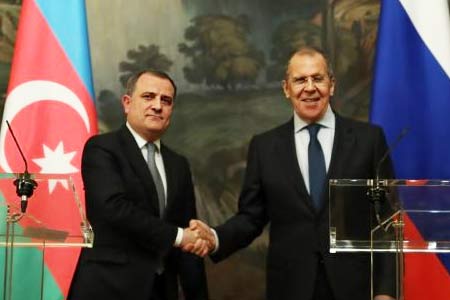
ArmInfo. Russian Foreign Minister Sergei Lavrov at a press conference following the talks with his counterpart from Azerbaijan Jeyhun Bayramov expressed regret that Armenia at the last moment refused to participate in the trilateral meeting planned in Moscow.
According to him, there was an agreement to hold both a separate meeting of the Foreign Ministers of Armenia and Azerbaijan in Moscow, and a trilateral meeting with the mediation of Russia.
"Unfortunately, Armenia refused to participate in the meeting at the last moment. We take it under advisement, but, nevertheless, decided to meet and see where we are both in terms of current issues of today and in terms of moving towards long-term settlement of this whole situation, in all its aspects," Lavrov said.
He stated that the meeting discussed the situation, which now arouses the greatest interest - the aggravation of the situation in the Lachin corridor. "We confirmed that Russian peacekeepers are working literally hourly to resolve the situation, in contacts with the relevant parties. And we are in favor of restoring full- fledged transport links as soon as possible and resolving disagreements on the development of ore deposits in the region," the Russian minister said, adding that this is habitual topic, inherited from the Soviet Union.
According to him, it is necessary to remove its severity as soon as possible. "We proceed from the fact that everyone must strictly adhere to the obligations contained in the tripartite statement of the leaders of Armenia, Russia and Azerbaijan dated November 9, 2020 regarding movement along the Lachin corridor. As I understand it, our Azerbaijani partners have the same position," said the Russian minister.
He once again noted that today the topic of the peace treaty between Armenia and Azerbaijan should have been discussed in a tripartite format, but Yerevan did not participate in the meeting. "Nevertheless, we touched on the topic of a peace treaty today. We believe that everything must be done to bring the positions of the parties together. At a certain stage, it seemed that the initial Azerbaijani proposals, which were positively received by Armenia, would create a basis for the development of an already relevant legal document ", he said, emphasizing that both Yerevan and Baku recognize the need for Russia to assist this process, and is recorded in the Sochi document of this year.
Lavrov assured that Russia, like no one else, is interested in seeing a lasting, fair peace be established in this region, between states friendly to Moscow, and any relapses of past manifestations of conflicts were reliably excluded.
The Russian Foreign Minister informed that during the meeting, the implementation of all trilateral agreements between the leaders of Armenia, Russia and Azerbaijan, which form the basis of work, including the normalization of Armenian-Azerbaijani relations, was analyzed.
"And we also noted certain progress on the issue of unblocking all economic and transport ties in the South Caucasus. We hope that soon the deputy prime ministers of our three countries will be able to start developing specific agreements. Fundamental sollutions at the level of the presidents of Russia and Azerbaijan were discussed, and were supported by the Prime Minister of Armenia. There is no reason now to further delay the practical implementation of these agreements," the Russian Foreign Minister said.
According to him, an exchange of views took place on stabilizing the situation on the Armenian- Azerbaijani border, and mutual agreement was expressed that the best solution to all issues would be the practical launch of the work of the delimitation commission, which has already been formed. In this vein, he stressed the importance of ensuring the full and sustainable operation of this mechanism, while refraining from any recurrence of the use of force and resolving all contentious issues exclusively by political and diplomatic means.
"Another topic is related to the issues of the South Caucasus," Lavrov said, recalling the Azerbaijani President's initiative to form a "3+3" regional platform (Russia, Iran, Turkey, Armenia, Azerbaijan and Georgia).
"And today we are preparing a meeting at the ministerial level. There is an understanding of the expediency of organizing such a meeting. We are agreeing on the time and place where it can take place," he said, expressing the hope that this process would not take much time.
In conclusion, he noted that the topic of a peace treaty requires close attention, and the more efforts are made in this direction, the sooner issues will be resolved. In this vein, he expressed Moscow's readiness to receive friends from Armenia and Azerbaijan to continue negotiations on this issue.






 Expert: Current process is not about peace, but implementing Azerbaijan`s wishlist
 Expert: Real peace unattainable until Armenia-Azerbaijan agreement is signed and ratified
 TRIPP`s proximity to Iranian border could slow its implementation - expert
  Who and why is sacrificing RA National Security Service`s reputation? - expert
  Tehran creating security environment in which sustainable shipping in Strait of Hormuz difficult to imagine without its direct participation - expert
  Arrested Armenian oligarch on economy and new jobs
  NA Vice Speaker candidate believes his wife`s salary as director of HayPost is the lowest in the company`s history
 RF Permanent Representative: There is no CSTO-Armenia conflict
 Moscow: NATO seeking to "Pull" Armenia away from CSTO Allies
  Political analyst: Russia intends to determine which "Camp" Armenia will choose through a referendum
 Narek Karapetyan will give up his parliamentary salary in favor of charitable contributions.
 Armenian analyst: Developing relations with Europe and the U.S. must not jeopardize relations with regional powers
 Armenia and France discuss further development of strategic partnership and EU cooperation
  To overcome risks Armenia must reduce domestic escalation - expert
  Zatulin: Pashinyan was eager to get back to Russia because he actually lost the elections
 Human rights activist Ruben Melikyan dismissed from YSU
 Pashinyan removed from INNOPROM guest list
 Zakharova: Armenia`s pro-EU pivot poses economic security risks to EAEU member states
 It`s time for South Caucasus countries to think of South Caucasus as single, unified region - RA premier
  Pashinyan: Armenia and Azerbaijan should leave each other alone