
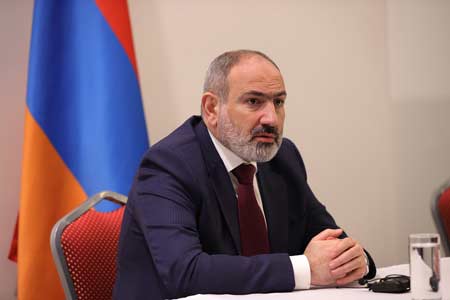
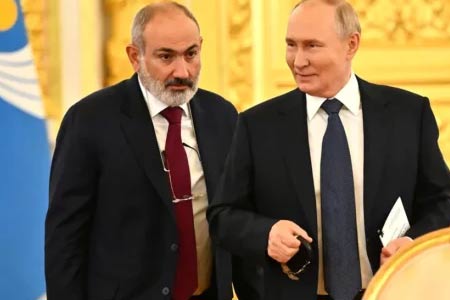
ArmInfo. The rhetoric of official Baku and other Azerbaijani sources after this attack show that Azerbaijan has intentions to occupy more territories of Armenia, which must be prevented. Prime Minister Nikol Pashinyan stated this on October 14 in Astana, the capital of Kazakhstan, at a meeting of the Council of Heads of State of the Commonwealth of Independent States.
According to the press service of the Prime Minister of the Republic of Armenia, Pashinyan recalled that the Armenian side is working on normalizing relations with Azerbaijan. He noted the importance of the role of the CIS in this context. "The work of the Delimitation and Border Security Commissions is important in the process of normalization, an agreement on the formation of which was reached during a trilateral meeting of the President of Russia, the President of Azerbaijan and the Prime Minister of Armenia in Sochi on November 26, 2021," the Armenian Prime Minister said.
As Pashinyan pointed out, following a meeting in Prague on October 6 this year with the President of Azerbaijan, through the mediation of the President of France and the President of the European Council, an agreement was reached that in the process of delimitation the parties will rely on the fundamental documents of the CIS, according to which the former administrative borders of the Soviet republics became state borders between already independent countries, including between Armenia and Azerbaijan. "I want to draw your attention to the fact that the abovementioned is an important factor also from the point of view of our today's agenda, since we are also discussing the issue of the CIS Appeal on granting observer status to the CSTO," he said.
According to him, before making a decision, it is important to decide on the following issues. <Does the CSTO recognize the state borders of the CIS countries, established in 1991 by the founding documents of the CIS? This is an important issue, since we are talking about the area of responsibility of the CSTO and, let me say, about the functionality of the organization itself. If we rely on interpretations according to which there are no borders between the CIS countries, since these borders are not delimited, this means that the area of responsibility of the CSTO is not defined, that is, it does not exist. And this blurs the functionality of the CSTO>, Pashinyan emphasized.
In addition, according to the head of the Armenian Cabinet, it is very important to clearly answer the following question: do the CIS member states respect the borders recognized in 1991 as the fundamental documents of the CIS? An unequivocal, affirmative answer to this question is very important for stability and security in the CIS space, the prime minister noted. Without a clear explanation of these issues, he said, the decision to apply to the CSTO to grant the CIS observer status is premature. Nikol Pashinyan stressed that these issues have become especially acute for the RA due to the recent military aggression of Azerbaijan against Armenia. <On September 13, Azerbaijan launched an unprovoked military aggression against Armenia. Using heavy artillery, multiple launch rocket systems and combat UAVs, the armed forces of Azerbaijan shelled 36 settlements in the depths of the sovereign territory of Armenia, including the cities of Goris, Jermuk, Vardenis, Kapan, and the settlement of Geghamasar. I want to make it clear that this was not a border or frontier incident or clash, but a direct, undeniable attack on the sovereignty and territorial integrity of Armenia. This aggression of Azerbaijan was discussed in the UN Security Council, the majority of whose members condemned the illegal military actions of Azerbaijan. Aggression was also condemned by the world community>, the prime minister said.
He noted that the Azerbaijani attack was deliberately directed against the civilian population and vital civilian infrastructures. <The total number of temporarily displaced persons from the Gegharkunik, Vayots Dzor and Syunik regions of Armenia amounted to more than 7,600 people, mostly women and the elderly, as well as 1,437 children and 99 disabled people. About 192 residential buildings, 3 hotels, 2 schools, 1 medical facility were partially or completely destroyed. 7 power supply facilities, 5 water supply facilities, 3 gas pipelines, 1 bridge were damaged. 2 ambulances and 4 private cars were fired upon. The Kechut reservoir was also shelled. As a result of the aggression, the number of victims and missing persons has now exceeded 210 people, of which 3 civilians were killed and 2 civilians were missing. 293 servicemen and 8 civilians were wounded. The number of missing servicemen is 28 people. The Azerbaijani side itself distributed shocking videos of torture, mutilation of the captured persons and bodies of already dead servicemen, about numerous cases of extrajudicial executions, murders and ill-treatment of Armenian prisoners of war, as well as degrading treatment of the bodies. The bodies of Armenian female soldiers were mutilated with particular cruelty, and then "proudly" filmed by Azerbaijani soldiers. These videos of clear war crimes and crimes against humanity are being shared and praised by a number of Azerbaijani social media users.
Undoubtedly, the commission of such indescribable atrocities is a direct consequence of the long-term policy of planting Armenophobia and enmity in Azerbaijani society by the political leadership," the prime minister said. He stressed that the risk of new aggression from Azerbaijan remains very high, especially given that Azerbaijan continues to consistently violate the ceasefire, trying to attribute its provocative actions to the Armenian side. Another factor of further escalation may be an inadequate response to the current situation by regional security organizations, which has raised very acute questions in the Armenian society>, the Prime Minister of Armenia said.
















 To overcome risks Armenia must reduce domestic escalation - expert
  Armenia and France discuss further development of strategic partnership and EU cooperation
  Zatulin: Pashinyan was eager to get back to Russia because he actually lost the elections
 Human rights activist Ruben Melikyan dismissed from YSU
 Pashinyan removed from INNOPROM guest list
 Zakharova: Armenia`s pro-EU pivot poses economic security risks to EAEU member states
 It`s time for South Caucasus countries to think of South Caucasus as single, unified region - RA premier
  Pashinyan: Armenia and Azerbaijan should leave each other alone
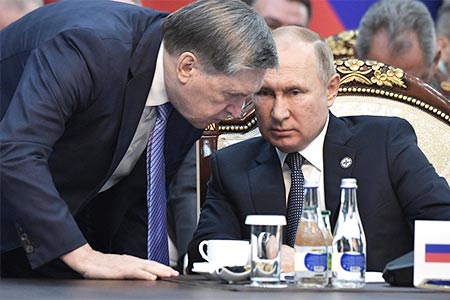 Moscow sees situation with Armenia as attempt to attack Russia-involving integration associations - Russian presidential aid
 Zakharova: Armenia views relations with Russia as tool for financially securing reorientation toward EU
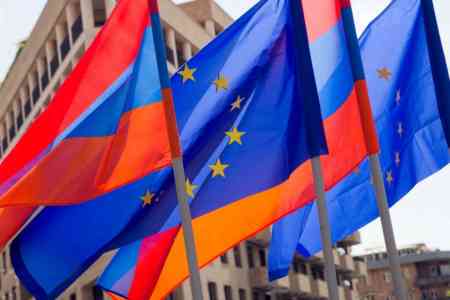 The Armenian Minister of Justice and the EU Ambassador discussed visa liberalization issues for Yerevan.
 Azerbaijan`s aggressive plans against Armenia became possible in wake of Pashinyan`s decisions on Artsakh - expert
  Zakharova: Russia sent a note of protest to Armenia over the act of vandalism at the "Mother Armenia" memorial in Gyumri