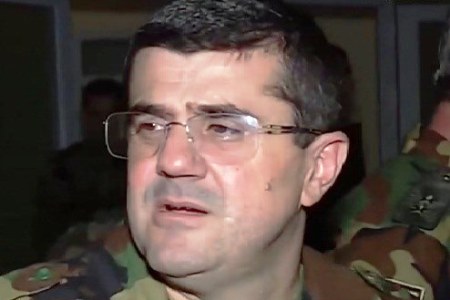
ArmInfo. President of the Artsakh Republic Araik Harutyunyan wrote a letter to President of the Russian Federation Vladimir Putin asking him to make efforts to end hostilities in Nagorno-Karabakh and resume political processes in the zone of the Azerbaijani-Karabakh conflict.
In his message to the Russian leader, Arayik Harutyunyan emphasized that at all stages of the settlement of the Azerbaijan-Karabakh conflict, Russia strictly observes the provisions of international law and the peaceful settlement of the conflict based on the principle of non-use of force and the threat of force. He noted that in the process of settling the Azerbaijani-Karabakh conflict, Russia acts both as a co-chairing country of the OSCE Minsk Group and as a country that has its own special role in maintaining peace and stability in the region.
"The Republic of Artsakh highly appreciates the mediation efforts of Russia, its active role and decisive contribution at all stages of the conflict settlement and the achievement of the 1994 Trilateral Ceasefire Agreement. Russia also played a decisive role in restoring peace and stability during the next escalation of the Azerbaijan-Karabakh conflict in 2016. On April 5, 2016, it was with the mediation of Russia in Moscow that an agreement was reached on the cessation of hostilities and the restoration of the 1994 ceasefire. We highly appreciate the active efforts of Russia and your personal contribution aimed at stopping large-scale military actions and Azerbaijan's aggression against Artsakh, "the President of Artsakh writes.
At the same time, he touched upon the speech of Vladimir Putin at the meeting of the Valdai discussion club, noting that the speech and objective assessment of the Russian president of the situation in Artsakh caused a great resonance.
"In your speech, you stressed the following:" This conflict began not just as an interstate conflict and a struggle for territories, it began with ethnic confrontation. Unfortunately, it is a fact when in Sumgait and then in Nagorno-Karabakh, cruel crimes were committed against the Armenian people. We must take all this into account in a complex>. Unfortunately, to this day Azerbaijan continues to pursue this policy of genocide, "Arayik Harutyunyan noted.
Stressing that the relations between Artsakhomi and Russia have a long history, he added that Russia is perceived in the historical memory of the people of Artsakh as a fraternal country, which in the most difficult situations has always extended a helping hand to this part of the Armenian people. Russian-Artsakh relations reached a qualitatively new level during the heyday of the meliks (principalities) of Artsakh, about which there is a lot of documentary evidence. For more than a century (from the beginning of the 19th to the end of the second decade of the 20th century), Karabakh was part of the Russian Empire. This historical period was marked for Karabakh by a long period of peace, creation, repatriation of compatriots expelled from their native lands and economic recovery. Cultural life has reached particular development. Thus, since the second half of the 19th century, the administrative and political center of Artsakh, the city of Shushi, has been one of the most important cultural and economic centers of the entire Transcaucasia.
In the same historical period, a whole galaxy of Karabakh Armenians played an important role in the military-political and social life of Russia. Valerian Madatov, Ivan Lazarev, Lazar Serebryakov, Mikhail Loris-Melikov, Vasily Bebutov and others take a special place among them.
Close bilateral ties were maintained during the Soviet period as well. About 90 thousand Armenians from the Nagorno-Karabakh Autonomous Region and historical Artsakh fought on different fronts of the Great Patriotic War, half of whom fell defending their homeland. In terms of the number of heroes of the Soviet Union and holders of the Order of Glory per capita, Artsakh occupied one of the first places in the USSR. All five Marshals of the USSR of Armenian origin - Ivan Bagramyan, Ivan Isakov, Amazasp Babajanyan, Sergey Khudyakov (Armenak Khanferyants), Sergey Aganov - were from Artsakh. More than thirty generals and thousands of officers showed commanding talent and heroism in defending the Motherland. Brothers Anastas and Artem Mikoyan, Ivan Tevosyan, Andranik Iosifyan, Nikolay Yenikolopov, Mikael Tariverdiyev and many other figures also had Artsakh roots, "the Artsakh president said.
He also stressed that close relations between Artsakh and Russia continue to this day. A significant part of the representatives of the three million Armenian diaspora in Russia are from Artsakh, among whom there are many forcibly deported as a result of the policy of genocide and ethnic cleansing carried out by the Azerbaijani authorities in the late 1980s and early 1990s.




 South Caucasus is entering a new phase of turbulence - ex-official
  Expert: Azerbaijan`s political leadership states `occupation of Armenia is their new national goal`
  Expert: Armenian society falls into security trap of totalitarianism
 Expert: Pashinyan`s visit to Russia creates prerequisites for restoring dialogue, but thaw in relations is more symbolic
 Human rights activist Ruben Melikyan dismissed from YSU
 Pashinyan removed from INNOPROM guest list
 Zakharova: Armenia`s pro-EU pivot poses economic security risks to EAEU member states
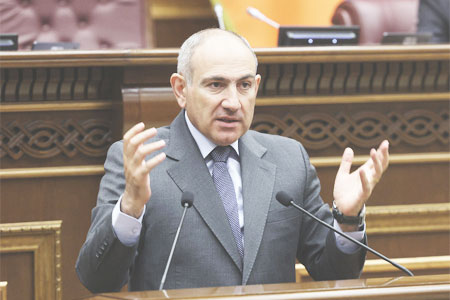 It`s time for South Caucasus countries to think of South Caucasus as single, unified region - RA premier
  Pashinyan: Armenia and Azerbaijan should leave each other alone
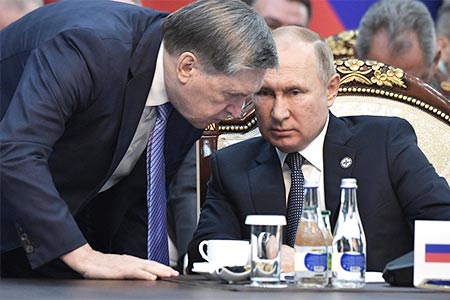 Moscow sees situation with Armenia as attempt to attack Russia-involving integration associations - Russian presidential aid
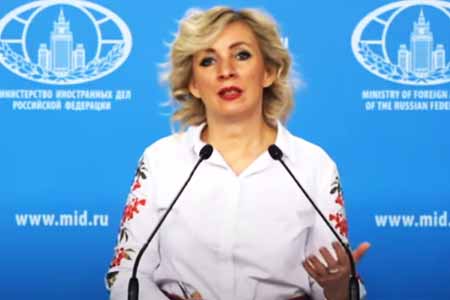 Zakharova: Armenia views relations with Russia as tool for financially securing reorientation toward EU
 The Armenian Minister of Justice and the EU Ambassador discussed visa liberalization issues for Yerevan.
 Azerbaijan`s aggressive plans against Armenia became possible in wake of Pashinyan`s decisions on Artsakh - expert
  Zakharova: Russia sent a note of protest to Armenia over the act of vandalism at the "Mother Armenia" memorial in Gyumri
 Samvel Karapetyan proposes creating a post-election opposition coalition
 Artsakh`s Cultural Heritage Ombudsman called on Moscow to respond to destruction of WWII monuments by Azerbaijan in occupied NKR
 Prosecutor General`s Office petitions Central Electoral Commission for criminal prosecution of Robert Kocharyan
 Dutch Prime Minister expresses his support for Armenia`s democratic reform and economic diversification agenda
 Heritage: It`s time for Armenia`s opposition to present people with legitimate alternative to power