
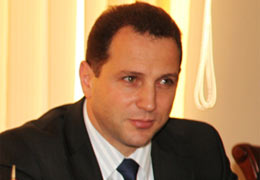
The arms market is open for Armenia, however, there are some political restrictions. The EU and the United States have restricted deliveries of any types of military hardware to Armenia and Azerbaijan that can increase the countries' military capacities (under the Treaty on Conventional Armed Forces in Europe - editor's note), Deputy Defense Minister of Armenia David Tonoyan says in an interview with the RFE/RL Armenian Service (Azatutyun), when commenting on Armenian President Serzh Sargsyan's statement that the Armenian army is fighting with the weapons made in the 1980s, while the Azerbaijani armed forces use modern arms.
So, there is an arrangement not to supply military goods to the conflict zone, Tonoyan says. "Naturally, the weapons are being purchased from the countries having no such restrictions. The problem is the quality, diversity and price. As you see, our weapons made in the 1980s neutralized the threat, i.e. these weapons forced the adversary to quit its intentions. As regards Israel, it offered the same weapons [as it sold to Azerbaijan] to Armenia," he says.
Tonoyan says that Armenia rejected that proposal because there was no need for it and because the Armenian army solved that problem by other methods. In this light, he says, practice shows that those weapons are not so effective. He also points out that a civil vehicle can be hit by a simple grenade launcher and that it is inexpedient to use a very expensive combat drone to hit the target.
"Over the past two years we revised the defense strategy and prepared two serious strategic documents, particularly, an Armed Forces Development Plan and an Arms and Military Hardware Development Plan. The development plan envisages acquisition of up-to-date weapons. This does not mean that the weapons will be purchased in 5 years. The plan envisages annual purchase of weapons," Tonoyan says.

















 Who and why is sacrificing RA National Security Service`s reputation? - expert
  Tehran creating security environment in which sustainable shipping in Strait of Hormuz difficult to imagine without its direct participation - expert
  Arrested Armenian oligarch on economy and new jobs
  NA Vice Speaker candidate believes his wife`s salary as director of HayPost is the lowest in the company`s history
 RF Permanent Representative: There is no CSTO-Armenia conflict
 Moscow: NATO seeking to "Pull" Armenia away from CSTO Allies
  Political analyst: Russia intends to determine which "Camp" Armenia will choose through a referendum
 Narek Karapetyan will give up his parliamentary salary in favor of charitable contributions.
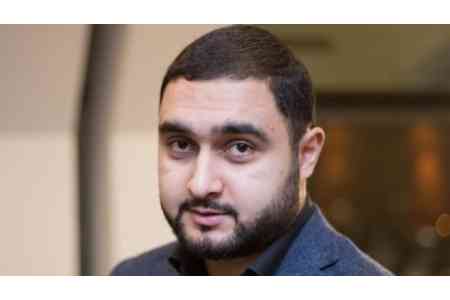 Armenian analyst: Developing relations with Europe and the U.S. must not jeopardize relations with regional powers
 Armenia and France discuss further development of strategic partnership and EU cooperation
 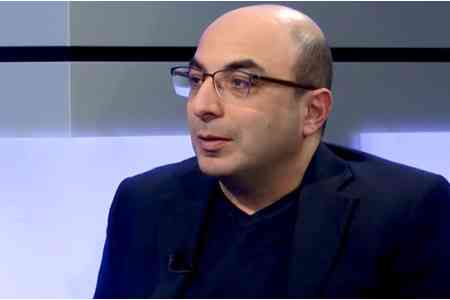 To overcome risks Armenia must reduce domestic escalation - expert
 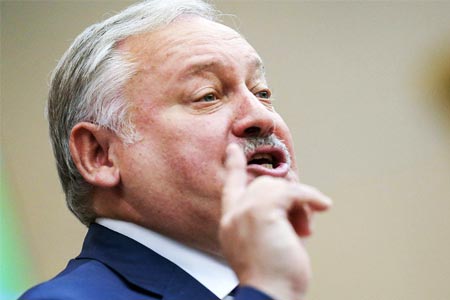 Zatulin: Pashinyan was eager to get back to Russia because he actually lost the elections
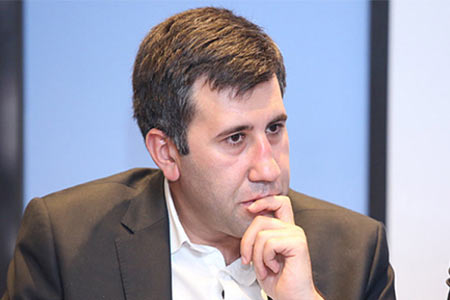 Human rights activist Ruben Melikyan dismissed from YSU
 Pashinyan removed from INNOPROM guest list
 Zakharova: Armenia`s pro-EU pivot poses economic security risks to EAEU member states
 It`s time for South Caucasus countries to think of South Caucasus as single, unified region - RA premier
  Pashinyan: Armenia and Azerbaijan should leave each other alone