


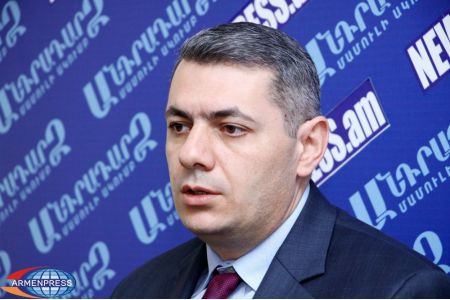
Arminfo. Today, Eurasia is once again becoming the main arena of rivalry among the great powers. Arsen Gasparyan, Doctor of Political Sciences, professor at the American University of Armenia and member of the editorial board of BRICS Business Magazine, stated this at the Russian-Armenian University (RAU) during an international roundtable on the topic "Russian-Chinese Relations in a Changing World: Together for Peace and Stability."
According to him, it is precisely in the context of Eurasian security that the Russian-Chinese partnership can be viewed as one of the most important factors altering the global balance of power. "The rapprochement between Russia and China is primarily обусловлено by the coincidence of interests in the international relations system. It is manifested in the development of military cooperation, the conduct of joint exercises, the expansion of energy ties and a steady increase in trade. I would like to remind you that in 2001, trade between the countries amounted to just $10 billion. Over 25 years, it reached $200 billion, which is a tremendous achievement specifically in trade and economic relations. All of this testifies to the importance of the Russian-Chinese partnership in the contemporary international system," the expert noted.
Speaking about the reasons why Eurasia is once again occupying a central place in the system of international relations, he emphasized that the continent brings together several major centers of military, industrial and economic power, as well as demographic potential. "Eurasia encompasses the European balance of power, Russia’s continental strategic position, China’s growing capabilities, the maritime communications of the Pacific region and the largest industrial economies of East Asia. States capable of controlling a significant part of this interconnected continental space acquire resources and strategic advantages capable of fundamentally changing the global distribution of power," Gasparyan explained.
He noted that this factor is of major importance to the United States. "Since 1823, when President Monroe’s doctrine was proclaimed, the United States, possessing regional hegemony in the Western Hemisphere and subsequently, already in the 20th century, preventing any other power from achieving comparable dominance, has adhered to a certain strategic course. Following the collapse of the Soviet Union, its aim became not merely to ensure the security of its own territory and the Western Hemisphere, but also to preserve an international system that would not allow another great power to become strong enough to challenge American supremacy," the professor recalled.
Under these conditions, he said, Russia and China play a strategic role in shaping the architecture of Eurasian security, acting as two major centers of political and strategic coordination on the continent. At the same time, he noted that the European factor cannot be ignored when considering issues of Eurasian security. "The book "Europe as the Western Peninsula of Greater Eurasia: Geoeconomic Regions in a Multipolar World" examines two possible ways for Europe to respond to multipolarity. And here I would like to point out that although many people speak of a movement toward a multipolar world, in fact, we are already living in conditions of multipolarity. Today, there are three great powers in the international relations system—the United States, China and Russia. The first path assumes that Europe should adapt to the new distribution of power, diversify its economic ties and abandon the bloc-based policies of the Cold War era. The second path consists of resisting these changes and attempting to restore the collective hegemony of the West," the expert said.
In this context, he said, it is important to take into account that the administration of Donald Trump, in its new National Security Strategy, outlined increased U.S. attention to Asia while simultaneously placing greater demands on Europe but offering it less in return. However, he said, Europe refuses to adapt to the realities of a multipolar world. "It is precisely in this context that the Russian-Chinese partnership contributes to the formation of an alternative to Western military and political mechanisms for ensuring Eurasian security. At the same time, this is not about creating a unified collective defense system, but about coordinating the national strategies and interests of the two powers seeking to preserve and strengthen their positions in Eurasia. Moreover, this partnership is not merely bilateral economic cooperation, but the strategic interaction of two permanent members of the UN Security Council that play an important role in shaping the contemporary international order," Gasparyan concluded.
























 Expert: Armenia should soberly assess the risks surrounding TRIPP
 Expert: In Armenia, 43% of families with three or more young children are poor—almost twice the national average
 A security sphere expert commented on a video about Papikyan`s achievements during his five years as Defense Minister
 In several Russian cities, screenings of the film “Monte” have been canceled under pressure from the Azerbaijani lobby.
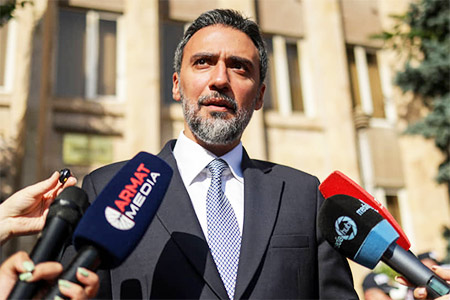
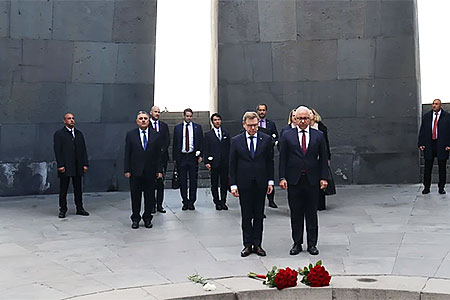
 Turkish diplomat calls removal of references to the Armenian Genocide from Armenia’s draft new constitution historic
 Ultra-Orthodox Jews continue to desecrate Armenian holy sites in Jerusalem’s Armenian Quarter
 The Yerevan Museum of Russian Art Turns 42
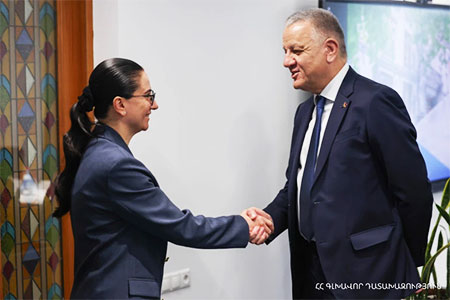
 Armenia and Germany held consultations on defense issues
 Armenia wants to host COP-34 in 2029
 Speaker: Armenia has never approached the CSTO regarding the Karabakh issue
 Lavrov: Armenia will not be expelled from the CSTO
 Orientalist: In 2026, Baku made special efforts to achieve greater diplomatic effect on the issue of victory over Artsakh
 Drmeyan: The ECHR rejected Azerbaijan`s appeal in the case of Artsakh Defense Army Major Hayk Toroyan
 "Strong Armenia": The brawl in parliament was staged to distract public attention from Pashinyan`s failed foreign policy