

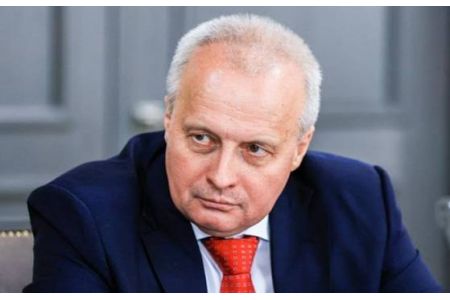
Arminfo. Russia and China, together with like-minded partners, are consistently contributing to the formation of a more just multipolar world order and the development of a space of security and cooperation, of which the South Caucasus is also a part. Russian Ambassador to Armenia Sergey Kopyrkin stated this at the Russian-Armenian University (RAU) during an international round table on “Russian-Chinese Relations in a Changing World: Together for Peace and Stability.”
He recalled that 30 years ago, Russia and China, in a Joint Declaration, proclaimed for the first time a new model of interstate relations—partnership aimed at strategic cooperation in the 21st century. According to the diplomat, this formula was further enshrined in the Treaty of Good-Neighborliness, Friendship and Cooperation between the Russian Federation and the People’s Republic of China, which was signed 25 years ago in Moscow by the President of Russia and the Chairman of the PRC. “Today, the Russian-Chinese strategic partnership is one of the cornerstones of the international relations system and a crucial factor in maintaining security. Russia and China, together with like-minded partners, are consistently contributing to the formation of a more just multipolar world order and the development of a space of security and cooperation, of which the South Caucasus is also a part,” the Russian ambassador emphasized.
As Kopyrkin recalled, Moscow and Beijing are actively cooperating within the framework of the Eurasian Economic Union (EAEU), contributing to the transformation of the Eurasian continent into a single space of economic development and prosperity. In the same vein, he said, the countries advocate strengthening peace and stability in the South Caucasus. “Presidents Vladimir Putin of Russia and Xi Jinping of the People’s Republic of China play a special role in developing Russian-Chinese cooperation. A trusting political dialogue has developed between the leaders, within the framework of which they regularly coordinate their positions on the bilateral and international agenda. Their political will makes it possible to find constructive solutions to complex issues and develop joint responses to the most pressing global challenges,” the diplomat emphasized.
According to him, the summit of Russian-Chinese talks held on November 18, 2026, in Shenzhen on the sidelines of the Asia-Pacific Economic Cooperation (APEC) summit served as another confirmation of this and demonstrated the high level of partnership between Russia and China. He recalled that the Russian side expressed its full support for China’s chairmanship of APEC. “The economies of our countries complement each other organically; the figures speak for themselves— for the fourth consecutive year, trade between Russia and China has exceeded $200 billion. At the same time, settlements between our countries have been almost completely switched to national currencies. Transport connectivity is also being consistently strengthened. The joint development of the potential of the Northern Sea Route is progressing steadily. Initiatives in the field of peaceful nuclear energy are being successfully implemented, cooperation in the space industry is developing, and collaboration in agriculture and other areas is deepening,” Kopyrkin emphasized.
According to him, bilateral relations between the countries are also enriched through creative exchange, contributing to the mutual interpenetration of cultures. “Our countries advocate traditional diversity, recognizing cultural identity and respect for historical development as one of the foundations of a multipolar world,” the diplomat added.
Over the past quarter-century, according to the Russian ambassador, the foreign policy coordination of the two states at international forums—one of the key components of the Russian-Chinese strategic partnership—has also strengthened significantly. As Kopyrkin noted, Moscow’s and Beijing’s approaches to most global and regional issues are close and, more often than not, coincide. According to him, this concerns, in particular, maintaining global strategic stability, arms control, and countering terrorism and other modern challenges. “Of particular importance in this context is the Joint Declaration on the Formation of a Multipolar World and a New Type of International Relations, adopted following talks between Vladimir Putin and Xi Jinping in Beijing. The document enshrines the system-forming principles for establishing a more just multipolar world order,” the Russian ambassador recalled.
In conclusion, Kopyrkin noted that the unbreakable friendship and growing cooperation between the countries are also reflected in the interaction between the diplomatic missions of Russia and China in Armenia.






































 Expert: Armenia should soberly assess the risks surrounding TRIPP
 Expert: In Armenia, 43% of families with three or more young children are poor—almost twice the national average
 A security sphere expert commented on a video about Papikyan`s achievements during his five years as Defense Minister
 The future of the South Caucasus was discussed in the capital of a country whose problem remains unresolved — Davtyan
 An Armenian orientalist presented possible US actions against Iran
 In several Russian cities, screenings of the film “Monte” have been canceled under pressure from the Azerbaijani lobby.
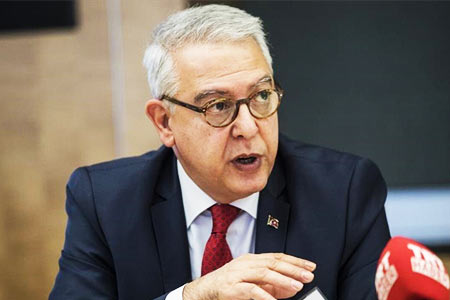 Turkish diplomat calls removal of references to the Armenian Genocide from Armenia’s draft new constitution historic
 Ultra-Orthodox Jews continue to desecrate Armenian holy sites in Jerusalem’s Armenian Quarter
 The Yerevan Museum of Russian Art Turns 42
 Armenia and Germany held consultations on defense issues
 Armenia wants to host COP-34 in 2029
 Speaker: Armenia has never approached the CSTO regarding the Karabakh issue
 Lavrov: Armenia will not be expelled from the CSTO
 Drmeyan: The ECHR rejected Azerbaijan`s appeal in the case of Artsakh Defense Army Major Hayk Toroyan
 "Strong Armenia": The brawl in parliament was staged to distract public attention from Pashinyan`s failed foreign policy